DbcultAccessing Vault...
Cult Review
Senior Film Conservator
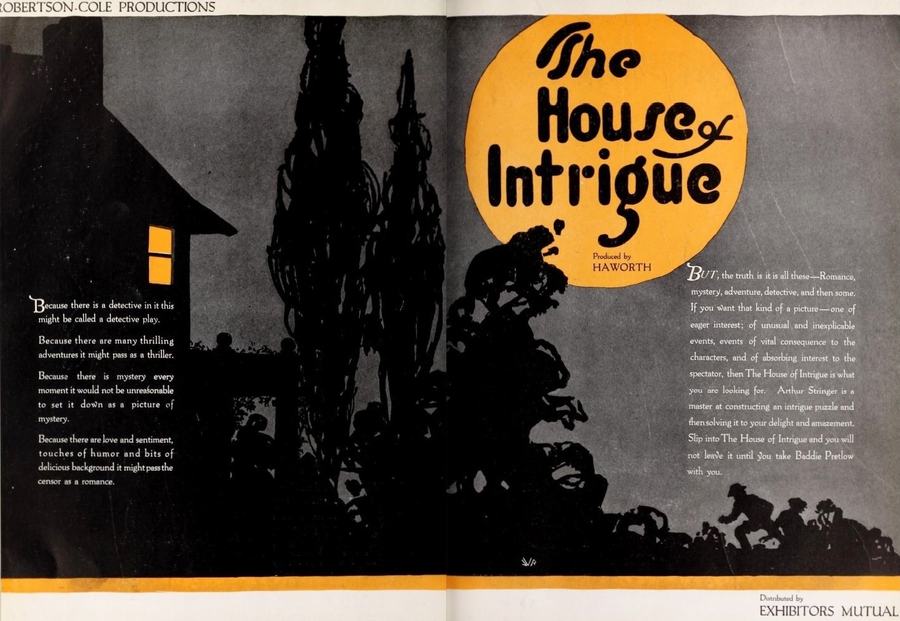
The silent era, often romanticized yet frequently underestimated in its narrative sophistication, birthed countless cinematic gems that, even a century later, retain their potent allure. Among these, *The House of Intrigue* (1917) stands as a testament to the period's capacity for intricate plotting, compelling character arcs, and a nuanced exploration of morality. Directed with a keen eye for suspense and human foible, and penned by the collaborative genius of Arthur Stringer and Richard Schayer, this film transcends its vintage to offer a surprisingly modern meditation on circumstance, choice, and the often-blurred lines between innocence and complicity.
At its heart, *The House of Intrigue* is a masterclass in narrative convolution, a meticulously constructed edifice of deception and revelation. We are first introduced to Barbara Pretlow, portrayed with a poignant vulnerability by Peggy May, an aspiring actress whose artistic dreams clash harshly with the stark realities of Manhattan's unforgiving rental market. Evicted and desperate, Barbara finds herself unwittingly drawn into the orbit of Pinky McClone, a pickpocket whose seemingly innocuous request for a distraction sets in motion a chain of events far grander than a mere street theft. This initial misstep is crucial, establishing Barbara not as a criminal, but as a victim of circumstance, her moral compass still firmly oriented towards rectitude despite her unfortunate predicament.
Parallel to Barbara’s struggle, the film introduces Clarissa Rhinelander Bartlett, played by Helene Sullivan, an heiress whose wealth is matched only by her remarkable naiveté. Clarissa possesses a curious predilection for men of questionable character, a flaw that leads her into an infatuation with a lifeguard—a man, unbeknownst to her, who is deeply enmeshed in Pinky McClone’s criminal enterprise. This juxtaposition of the struggling ingénue and the sheltered heiress immediately highlights themes of class disparity and the divergent paths fate can carve for individuals based on their birthright. Clarissa's guardian, Wendy Washburn (Virginia True Boardman), a figure of discerning wisdom and quiet authority, senses trouble and initiates an investigation into the lifeguard's background. This investigation, however, takes an unexpected turn when the target of her scrutiny falls genuinely in love with Barbara, adding another layer of romantic entanglement to the burgeoning web of intrigue.
The narrative escalates dramatically during a jewel heist, a pivotal moment where Wendy Washburn, demonstrating her strategic prowess, confronts Barbara with the unvarnished truth about her associates' criminality. This revelation serves as a moral crucible for Barbara. Her subsequent escape, while a testament to her inherent goodness, plunges her back into the familiar despair of unemployment. It's a cruel twist, a reward for integrity that feels like punishment. The film brilliantly uses this period of extreme vulnerability to test Barbara's limits. When an enigmatic old man offers her a staggering one thousand dollars to impersonate Clarissa, Barbara, hungry and utterly devoid of hope, accepts. This decision is not born of greed, but of a profound, primal need for survival, a choice that resonates with the desperate measures taken by characters in contemporary dramas like Graft, where societal pressures often push individuals to moral edges.
The true test of Barbara’s character arrives when she is asked to sign Clarissa’s name to a will. This act, crossing the line from impersonation to outright fraud, proves to be her breaking point. In a stroke of narrative genius, her refusal and subsequent thwarting of the crooks—who, in a remarkable coincidence, are simultaneously robbing Clarissa's house—culminate in a climactic confrontation. This sequence is a vibrant example of silent film's capacity for kinetic storytelling, relying on visual cues and rapid pacing to convey suspense and action. The resolution to this convoluted plot comes with Wendy Washburn's revelation that the thousand-dollar offer was, in fact, an elaborate test of Barbara's honesty. Barbara, having proven her unwavering integrity under immense duress, is finally accepted by Wendy, signifying not just a personal triumph, but a moral vindication. And in a final, charmingly whimsical touch, Clarissa, ever the romantic idealist, finds her next object of affection in the very policeman who apprehends the criminals, completing a cycle of mistaken identities and newfound affections.
In the silent era, the burden of conveying emotion, intent, and character rested squarely on the shoulders of the actors' physicality, facial expressions, and nuanced gestures. The cast of *The House of Intrigue* rises to this challenge with remarkable skill. Peggy May, as Barbara Pretlow, delivers a performance that is both delicate and resilient. Her wide, expressive eyes communicate Barbara's initial innocence, her growing despair, and ultimately, her steadfast moral resolve. May avoids the trap of melodrama, instead opting for a portrayal that feels genuinely human, allowing the audience to empathize with Barbara's plight without ever doubting her fundamental goodness. Her journey from victim to accidental hero is rendered believable through her subtle yet powerful acting.
Helene Sullivan's Clarissa Rhinelander Bartlett provides a delightful contrast. Clarissa could easily have been a one-dimensional caricature of the flighty heiress, but Sullivan imbues her with a certain charming capriciousness that makes her endearing despite her lack of worldly wisdom. Her rapid succession of infatuations, while a plot device, also speaks to a yearning for connection, however misguided. Virginia True Boardman's Wendy Washburn is the film's quiet anchor. Her performance is a masterclass in understated authority. Boardman conveys Wendy's intelligence, her protective instincts, and her strategic mind through measured glances and deliberate movements. She is the moral compass and the architect of Barbara's ultimate redemption, a formidable presence without ever needing to resort to histrionics.
Even the supporting players, such as Bert Hadley as Pinky McClone and Donald MacDonald as the lifeguard, manage to etch memorable impressions. Hadley's McClone is not a purely villainous figure but rather a product of his environment, a man operating within a system of petty crime. MacDonald's lifeguard, caught between his criminal associates and his genuine affection for Barbara, adds a layer of moral ambiguity that enriches the narrative. The ensemble works in concert, each performance contributing to the film's overall texture and believability, a testament to the directorial guidance that understood the power of visual storytelling in an age without spoken dialogue. One might even draw parallels to the spirited performances in films like The Madcap, where character dynamism drives much of the narrative, albeit in a different tonal register.
Beyond its compelling plot and solid performances, *The House of Intrigue* distinguishes itself through its astute stylistic choices and the thematic richness it explores. The film's cinematography, while adhering to the conventions of the era, effectively builds suspense and highlights character emotions. Close-ups are used judiciously to emphasize Barbara's despair or Wendy's calculating gaze, drawing the audience into their internal worlds. The sets, though perhaps modest by today's standards, effectively differentiate between Barbara's humble lodgings and Clarissa's opulent estate, visually reinforcing the class divide that underpins much of the narrative conflict.
The screenwriters, Arthur Stringer and Richard Schayer, craft a narrative that, despite its numerous twists and coincidences, maintains a surprising degree of logical coherence within its own established universe. The pacing is brisk, a necessary attribute for silent films where intertitles must carry the weight of dialogue and exposition without dragging the visual momentum. The film cleverly uses these intertitles not just for dialogue, but also for poignant observations and to propel the plot forward, much like a well-structured novel. The narrative flow is reminiscent of intricate melodramas such as Tangled Lives, where destinies are interwoven and secrets slowly unravel to create a tapestry of human experience.
The film's central themes resonate with enduring relevance. It's a profound examination of morality in the face of desperation, questioning how far an individual might bend their principles when pushed to the brink of survival. Barbara’s journey is a powerful affirmation of integrity, suggesting that true character is revealed not in comfort, but in crisis. It also subtly critiques societal structures that can leave individuals like Barbara vulnerable, while simultaneously showcasing the inherent goodness that can emerge even from the most dire circumstances. The contrast between Barbara's earned morality and Clarissa's inherited privilege, and her subsequent frivolous romantic choices, offers a quiet commentary on the nature of wisdom and experience.
*The House of Intrigue* is more than just a historical artifact; it is a vibrant piece of cinematic storytelling that continues to engage and provoke thought. Its intricate plot, which could easily feel contrived, is instead propelled by genuine character motivations and a relentless forward momentum. The film's ability to balance moments of high suspense with touches of character-driven drama is a testament to its enduring craftsmanship. For those accustomed to the rapid-fire dialogue and explicit narratives of contemporary cinema, returning to a silent film like this offers a unique opportunity to appreciate the artistry of visual communication, where a glance, a posture, or a subtle gesture can convey volumes.
The film also serves as a fascinating historical document, providing a glimpse into the social mores and anxieties of its time. The portrayal of women, particularly the contrasting figures of Barbara, Clarissa, and Wendy, offers insights into evolving gender roles and expectations. Barbara's struggle for independence and survival, even if framed within a melodramatic plot, speaks to the burgeoning spirit of self-reliance seen in many female characters of the era, echoing the resilience found in films like A Modern Thelma or Polly Redhead. Wendy's role as a shrewd, protective guardian, who ultimately empowers Barbara, further highlights a shift towards more complex and capable female archetypes.
In an era dominated by rapid technological change and shifting artistic paradigms, *The House of Intrigue* stands as a reminder of the foundational elements of compelling storytelling. It demonstrates that human drama, moral dilemmas, and the thrill of a well-crafted mystery transcend the presence or absence of sound. It invites viewers to actively participate in the narrative, interpreting emotions and intentions through visual cues, a skill that enriches the viewing experience in a way that passive consumption of modern blockbusters often does not. This active engagement is a hallmark of the silent film experience, making each viewing a unique and personal journey of discovery.
Ultimately, *The House of Intrigue* is a film that deserves to be rediscovered and celebrated. It is not merely a relic from a bygone era but a vibrant, engaging piece of cinema that offers both entertainment and intellectual stimulation. Its themes of integrity under duress, the complexities of human relationships, and the serendipitous nature of fate are timeless. For enthusiasts of classic Hollywood, students of film history, or simply anyone seeking a compelling narrative, this film provides a rich and rewarding experience. It reminds us that the foundations of cinematic storytelling were laid with ingenuity and a profound understanding of the human condition, long before the advent of synchronized sound.
The enduring appeal of films like *The House of Intrigue* lies in their ability to strip away superficialities and focus on the core elements of drama: conflict, character, and resolution. Without the crutch of dialogue, every gesture, every expression, every shift in lighting carries immense weight, demanding a different kind of appreciation from the audience. It’s a testament to the power of pure visual narrative, a form that, when executed with such skill and precision, can be as emotionally resonant and intellectually stimulating as any contemporary masterpiece. This film isn't just a window into the past; it's a mirror reflecting timeless human struggles and triumphs, proving that true artistry never truly fades.
IMDb 6.4
1932
Community
Log in to comment.