DbcultAccessing Vault...
3.2/10
Senior Film Conservator
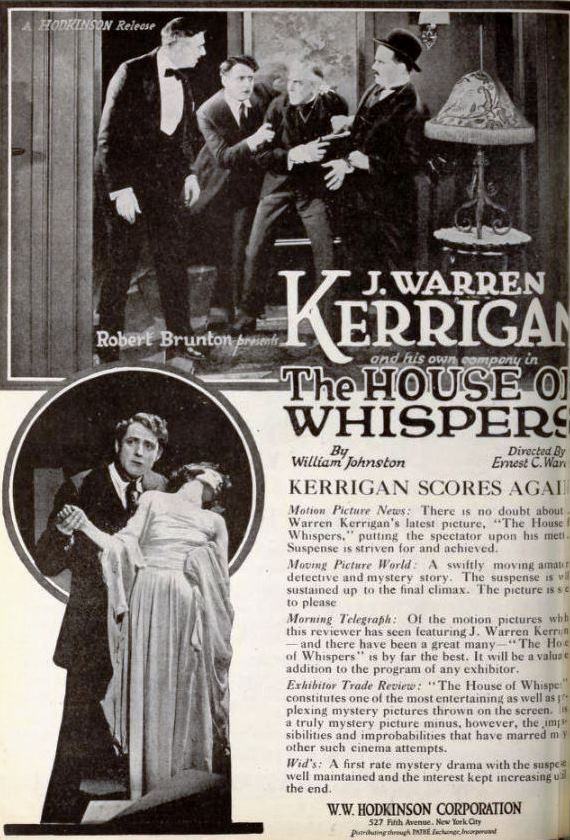
A definitive 3.2/10 rating for a film that redefined the boundaries of cult cinema. The House of Whispers remains a cornerstone of transgressive art.
In the burgeoning landscape of early American cinema, 1920 stands as a pivotal threshold where the pastoral simplicity of films like The Wishing Ring: An Idyll of Old England began to yield to the claustrophobic anxieties of the urban sprawl. The House of Whispers, a silent enigma directed by Ernest C. Warde and penned by the prolific Jack Cunningham, serves as a quintessential specimen of this transition. It is not merely a mystery; it is an exploration of the domestic space as a site of psychological warfare. Where The Path of Happiness sought to find solace in the external world, Warde’s film retreats into the shadows of the internal, suggesting that the very walls we inhabit may be sentient conduits of malice.
J. Warren Kerrigan, an actor whose presence often commanded a certain aristocratic resolve, portrays Spaulding Nelson with a nuanced blend of skepticism and chivalry. Unlike the more whimsical characters found in Cupid's Day Off, Nelson is a man of the modern age, a proto-noir detective who understands that ghosts are rarely more than the echoes of living sins. His entry into the titular apartment building follows the psychological collapse of his uncle, a narrative beat that mirrors the generational trauma often explored in Strathmore. Kerrigan’s performance is anchored by his ability to convey internal deduction through the limited lexicon of silent-era pantomime; his eyes do not merely see—they dissect the environment.
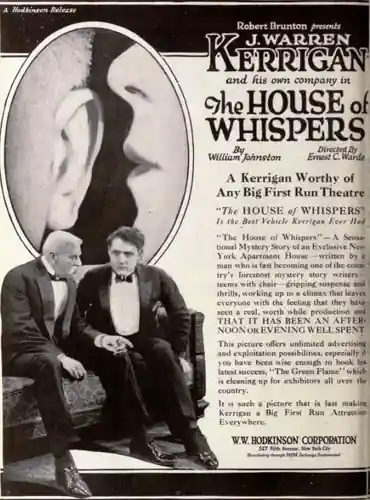
The central conceit of the film—the whispers—presents a fascinating challenge for a silent medium. How does a director visualize a sound that drives men to the brink of insanity? Warde utilizes expressive intertitles and the frantic reactions of the cast to create an auditory landscape that exists purely in the viewer's imagination. This technique is far more sophisticated than the literal interpretations found in Mute Witnesses. Here, the silence of the film enhances the terror of the unheard. When Clara, played with a fragile intensity by Claire Du Brey, cringes at the sound of her 'dead' husband Roldo’s voice, the vacuum of the silent screen amplifies her isolation. We are trapped in her subjective experience, a stylistic choice that elevates the film from a mere procedural to a psychological thriller.
The true antagonist of the piece is not merely a man, but the architectural philosophy of Henry Kent. By constructing a building riddled with secret passageways and acoustic anomalies, Kent has transformed a sanctuary into a panopticon. This theme of the 'dishonest house' predates the gothic flourishes of later Hollywood noir and shares a spiritual kinship with the subterranean machinations of Mysteries of Paris. The house is a character unto itself—a skeletal framework of betrayal where every panel door is a potential for violation. It is a stark contrast to the romanticized locales of La gitana blanca, emphasizing a shift toward an American gothic sensibility that finds horror in the mundane.
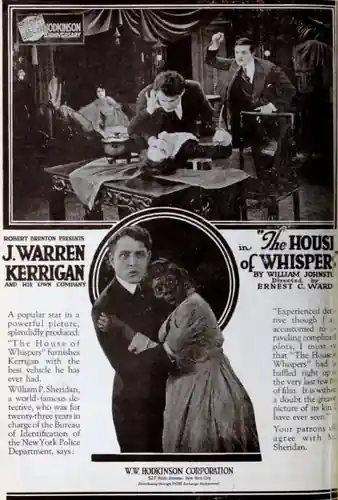
The narrative takes a sharp turn into the macabre with the murder of Daisy Luton. Fritzi Brunette’s brief but impactful appearance as the doomed actress provides the necessary stakes for Nelson’s investigation. The trope of the wrongly accused protagonist, a staple of early cinema also seen in After the War, is utilized here to heighten the tension. Nelson is no longer just a curious bystander; he is a fugitive within the very labyrinth he seeks to expose. The sequence where he eludes the detectives by vanishing into the walls is a masterpiece of early editing and spatial logic. It creates a sense of vertigo, as the boundaries between the 'public' rooms of the apartment and the 'private' veins of the building dissolve.
Margery Wilson’s Barbara Bradford is more than a mere damsel in distress. While she adheres to certain conventions of the era, her partnership with Nelson suggests a burgeoning equality in the face of shared peril. This is a far cry from the more decorative roles in The Deciding Kiss. Barbara’s agency is tied to her sister’s survival, and her acceptance of Nelson’s proposal at the film’s end feels like a union forged in fire rather than a mere contractual obligation of the genre. The presence of Nettie Kelly (Myrtle Rishell), Roldo’s first wife, adds a layer of tragic realism. Her confession is the linchpin of the resolution, suggesting that the 'whispers' were also the voices of women discarded by the patriarchal greed of men like Kent and Roldo.
The visual language of The House of Whispers is surprisingly modern. The use of low-key lighting to emphasize the depth of the secret corridors creates a chiaroscuro effect that anticipates German Expressionism. Unlike the brightly lit sets of Peggy Does Her Darndest, this film embraces the dark. The shadows are not just aesthetic choices; they are the physical manifestation of the secrets Kent has built into the foundation. The camera lingers on the mechanical aspects of the house—the sliding panels, the hidden levers—turning the domestic space into a giant, malevolent machine. This mechanical terror is a precursor to the industrial anxieties found in Fire and Sword.
The final confrontation in the secret heart of the building is a kinetic explosion of action. Warde manages to coordinate multiple character arcs—the exposure of Roldo, the redemption of Nelson, and the legal downfall of Kent—within a confined space. The resolution avoids the saccharine pitfalls of Girls or the historical rigidity of For Napoleon and France. Instead, it offers a cathartic release from the tension of the unknown. When the 'dead' husband is revealed to be a living fraud, the supernatural elements are stripped away, leaving behind the cold reality of human avarice. This pivot from the uncanny to the criminal is a hallmark of the American mystery tradition, one that would be perfected in the decades to follow.
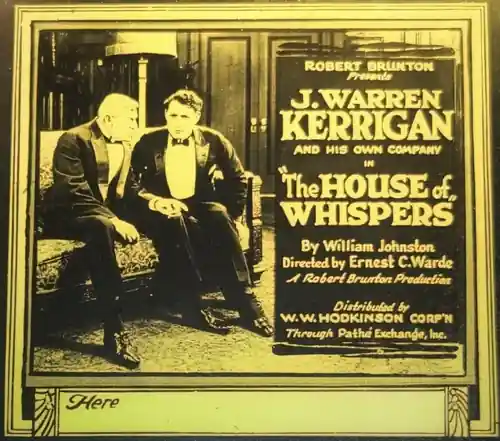
To view The House of Whispers today is to witness the birth of the 'Old Dark House' subgenre. While it lacks the overt horror of later Universal classics, its focus on the psychology of space and the vulnerability of the domestic sphere is profound. It shares a certain stylistic DNA with the Russian dramas of the era, such as Korol Parizha or Lyubov statskogo sovetnika, in its willingness to explore the darker facets of the human condition within the upper echelons of society. The film’s legacy is found in every thriller that suggests our homes are not as secure as we believe, and that the whispers we hear in the night might just be the sound of the truth trying to break through the drywall.
Ultimately, the film succeeds because of its narrative economy. There are no wasted frames. Every shot of a corridor, every glance between the conspirators, and every shadow cast on Barbara’s face serves to tighten the noose. The writers, Cunningham and Johnston, understood that in a mystery, information is the primary currency. By withholding the true nature of the house until the final act, they ensure that the audience’s curiosity is as piqued as Nelson’s. This is a masterclass in suspense that many modern filmmakers, lost in the excess of CGI, would do well to study. The House of Whispers remains a haunting reminder that the most terrifying things are often those that are hidden in plain sight, behind the very walls we trust to protect us.
A cinematic relic that transcends its era, The House of Whispers is a testament to the power of atmosphere over artifice. It invites the viewer to listen closely to the silence, for in that silence, the most profound secrets are told.
IMDb —
1921
Community
Log in to comment.