DbcultAccessing Vault...
5.5/10
Senior Film Conservator
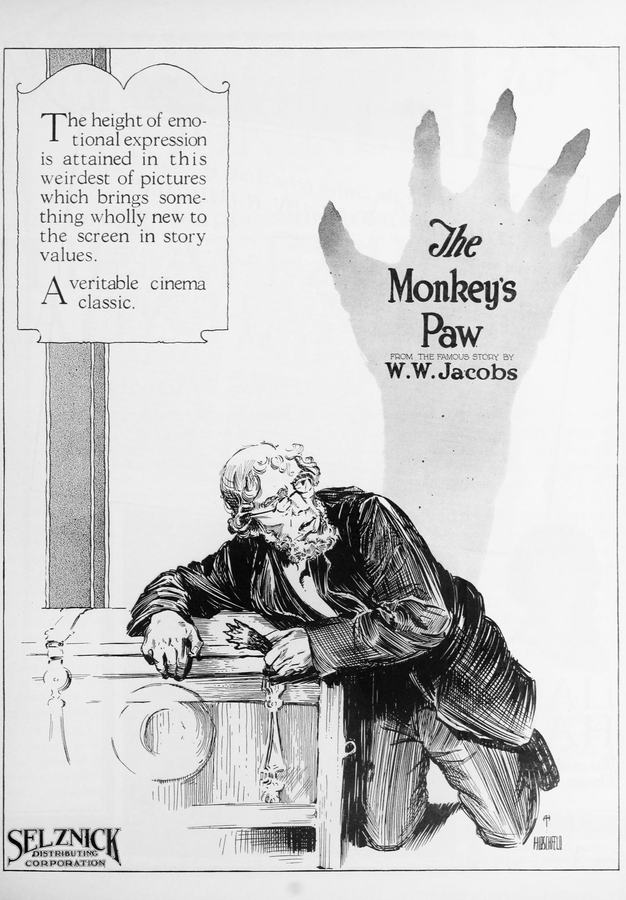
A definitive 5.5/10 rating for a film that redefined the boundaries of cult cinema. The Monkey's Paw remains a cornerstone of transgressive art.
In the annals of silent horror, few works possess the lingering, spectral weight of the 1923 adaptation of The Monkey's Paw. While contemporary audiences are often desensitized by the hyper-kinetic violence of modern slasher films, this Manning Haynes production operates on a frequency of pure, unadulterated psychological tension. It is a film that understands the primal fear of the unknown, utilizing the limitations of its era to craft a visual language of shadows and suggestion. Unlike the more adventurous narratives found in The Seventh Noon, which leans into the pulpier aspects of mystery, The Monkey's Paw remains rooted in a grim, domestic reality that makes its eventual supernatural intrusion all the more jarring.
The casting of Charles Ashton and Marie Ault as the elder Whites provides the film with its emotional anchor. Ault, in particular, delivers a performance of such raw, visceral sorrow that it transcends the typical pantomime style often associated with the silent period. Her transformation from a contented matriarch to a woman possessed by a necrophiliac hope is nothing short of terrifying. As we observe her descent, one might recall the dramatic gravity seen in The Rosary, yet here the religious solace is replaced by a pagan curse. The pacing is deliberate, almost agonizingly slow during the middle act, mirroring the agonizing passage of time for a family waiting for a miracle that they know, deep in their marrow, will be a monstrosity.
The visual composition by the camera department avoids the flamboyant experimentation found in some European imports of the time, opting instead for a static, voyeuristic quality. This stillness forces the viewer to scan the frame for movement, particularly in the final scenes where the darkness of the White household seems to press inward. It is this economy of movement that separates it from the more traditional melodrama of St. Elmo. In The Monkey's Paw, the horror isn't just in what is shown, but in the vast, empty spaces where a resurrected son might be lurking.
The introduction of the paw by Sergeant-Major Morris (Moore Marriott) brings a subtext of British colonial anxiety into the narrative. The paw is an 'othered' object, a relic of an India that the British Empire sought to control but could never truly understand. This theme of foreign curses and domestic ruin was a staple of the era, yet here it feels more intimate. Unlike the broader societal critiques found in The Lane That Had No Turning, the consequences here are strictly personal. The Whites are not politicians or heroes; they are simple people whose modest desire for financial security—specifically the two hundred pounds to pay off their mortgage—leads to an existential bankruptcy. The irony that the money is paid out as insurance for their son’s mangled body is a critique of industrial capitalism that still resonates with a modern audience.
The final sequence remains one of the most effective in horror history. The rhythmic knocking at the door—silent, yet deafening in the viewer's imagination—is a masterstroke of tension. We see the frantic struggle of the father to find the paw for his final wish, while the mother fumbles with the bolt of the door, desperate to embrace the thing that was once her child. The film cleverly avoids showing us the 'thing' behind the door, a decision that elevates it above more literal interpretations like The Dagger Woman. By keeping the horror off-screen, Haynes leverages the audience's own imagination, which is far more capable of conjuring a mutilated, water-logged corpse than any 1920s prosthetic could achieve.
The screenplay, a collaborative effort involving Lydia Hayward and Louis N. Parker, manages to expand Jacobs’ short story without diluting its potency. They weave in a sense of impending doom that permeates even the early, lighter scenes. There is a certain cynicism here that contrasts sharply with the more escapist fare of The Beauty Shop or the lightheartedness of Bride and Gloomy. Instead, the writers lean into the fatalism. Every line of dialogue—presented via intertitles—feels weighted with double meanings. When the son jokingly remarks about the paw before leaving for work, the audience feels a pang of dramatic irony that is almost physically painful.
The Monkey's Paw is more than just a ghost story; it is an exploration of the human inability to accept loss. It posits that the natural order, however cruel, is preferable to a supernatural intervention that defies the finality of the grave. While films like Dangerous Lies deal with the deceptions of the living, Haynes' work deals with the ultimate deception of the dead. It remains a foundational text for the 'be careful what you wish for' trope, influencing everything from The Twilight Zone to modern folk horror. For those interested in the evolution of the genre, this 1923 version is essential viewing, offering a stark, unblinking look at the shadows we invite into our homes when we refuse to say goodbye. It captures a specific British gloom, a post-war malaise where the desire to bring back the lost was a national fantasy, and the film serves as a stern, terrifying warning against such impulses.
In the end, the film leaves us in the dark, much like the White family. The final wish is made, the knocking stops, and the door opens to reveal... nothing. The street is empty. The silence that follows is not one of relief, but of total, crushing desolation. It is a reminder that some doors, once closed by fate, should never be beaten upon. As a piece of cinematic art, it rivals the atmospheric depth of The Jack Rider or the starkness of Fattigdrengen, yet it carves out its own unique niche in the hall of horrors. It is a somber, beautifully executed memento mori that demands to be seen and respected for its restraint and its uncompromising vision of the macabre.
IMDb —
1926
Community
Log in to comment.