DbcultAccessing Vault...
Cult Review
Senior Film Conservator
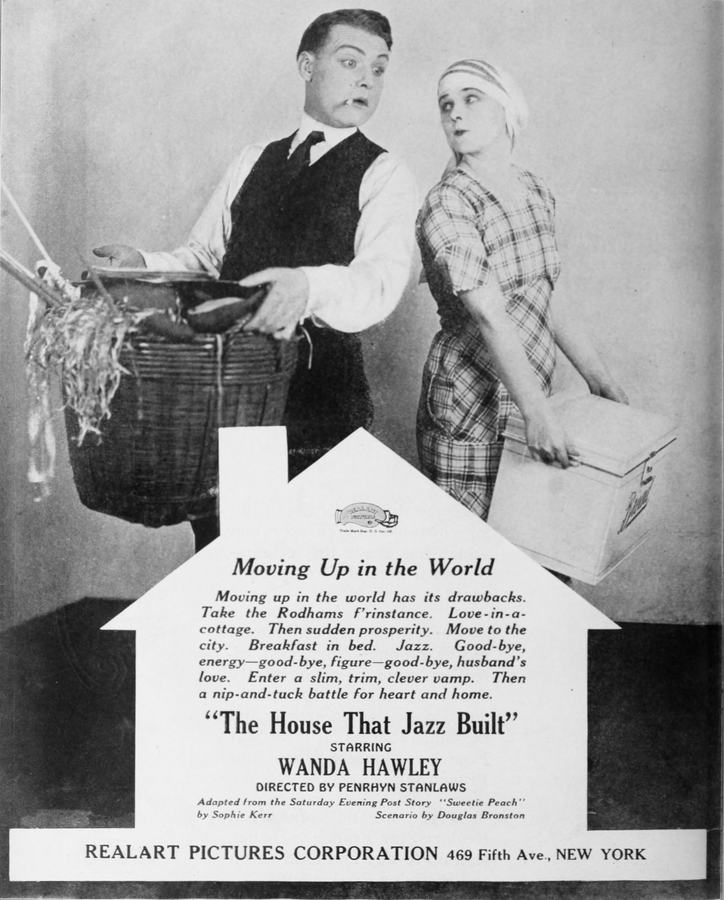
Stepping back into the cinematic tapestry of the early 1920s, one encounters 'The House That Jazz Built' (the-house-that-jazz-built), a film that, despite its era's silent conventions, speaks volumes about the tumultuous interplay between environment, identity, and marital fidelity. Penned by the insightful Sophie Kerr and Douglas Bronston, this narrative, featuring the compelling performances of Wanda Hawley as Cora Rodham and Forrest Stanley as her husband Frank, alongside Helen Lynch as the alluring Lila Drake, offers a surprisingly nuanced critique of societal pressures and personal transformation. It's a journey from suburban idyll to urban disillusionment, culminating in a powerful reclamation of self and spouse, a theme as resonant today as it was a century ago.
Initially, we meet Cora Rodham, a woman perfectly attuned to the rhythms of her modest suburban bungalow. Her existence is a testament to domestic harmony, marked by an almost artistic efficiency and an infectious happiness that radiates from her meticulous care of their shared space. She is the archetypal contented housewife, finding profound satisfaction in the quietude and predictability of her life with Frank. This portrayal, while perhaps appearing quaint to modern eyes, underscores a prevalent ideal of womanhood during the period, where a woman's fulfillment was often intrinsically linked to her prowess within the domestic sphere. Wanda Hawley, even in the silent medium, conveys this initial serenity with a subtle grace, her expressions speaking of a soul at peace. The early scenes paint a picture of a marriage seemingly impervious to external strife, built on mutual contentment and the simple joys of a well-ordered home.
The narrative's fulcrum swings dramatically with Frank Rodham's professional ascent, necessitating a move to the vibrant, yet potentially corrosive, heart of New York City. This relocation isn't merely a change of address; it's a seismic shift in Cora's entire being. The city, with its ceaseless hum and myriad distractions, begins to subtly erode the disciplined structure of her suburban life. The very title, 'The House That Jazz Built,' hints at this insidious influence, suggesting a world built on fleeting pleasures, superficiality, and a certain moral laxity that jazz music, in its nascent popular form, often symbolized to conservative sensibilities. Cora, once the epitome of trim efficiency, slowly succumbs to the city's indolent embrace, becoming 'fat, indolent, and carefree.' This physical transformation is a powerful visual metaphor for her internal decline. She sheds her former self, not for growth, but for a languor that strips her of her previous vitality and purpose. It’s a cautionary tale about how environment can reshape identity, often for the worse, when one lacks a strong anchor. Compare this narrative of a woman losing herself in the city to the struggles faced by protagonists in films like Pauline or Polly of the Circus, though their challenges are external adventures rather than internal decay. The contrast highlights the unique psychological journey Cora undertakes.
As Cora drifts further from her former self, Frank's affection, once steadfast, begins to fray. His weariness with his transformed wife is palpable, a silent judgment that underscores the era's often rigid expectations of female appearance and demeanor within marriage. Frank, portrayed with a certain detached pragmatism by Forrest Stanley, finds solace and renewed interest in the vivacious Lila Drake. Lila, likely embodying the modern, liberated woman of the Jazz Age, represents everything Cora has ceased to be: slender, engaging, and seemingly unburdened. Helen Lynch's portrayal of Lila would have needed to capture this alluring superficiality, making her a credible threat to the Rodhams' already fragile union. Frank's decision to pursue divorce, rather than attempt to reconnect with Cora, speaks volumes about the ease with which marital bonds could be severed when convenience and personal desire superseded commitment. This narrative thread resonates with the themes of marital discord and betrayal explored in films like The Love Swindle, where deceit and shifting allegiances complicate romantic relationships, though 'The House That Jazz Built' grounds its conflict more in a visible transformation.
The specter of divorce, however, acts not as a final blow but as a powerful catalyst for Cora's reawakening. This is where the film transcends a simple melodrama and delves into a compelling narrative of female agency. Cora's decision to regain her 'trim figure' is not merely an act of vanity; it is a profound declaration of self-possession and a strategic move to reclaim her life and her husband. Her physical transformation becomes a visible manifestation of her renewed mental fortitude and determination. Wanda Hawley's performance here would have been crucial, requiring a visible shift from indolence to resolve, conveying the internal struggle and triumphs through gesture and expression. This journey of self-improvement, driven by a desire to fight for what she believes is rightfully hers, imbues Cora with a strength that was perhaps dormant even in her initially happy state. It speaks to a deeper understanding of identity, suggesting that true happiness and worth are not static but require continuous cultivation.
With her physical vitality restored, Cora's mental acuity sharpens, allowing her to perceive the true nature of Lila Drake. The film cleverly positions Cora not as a victim, but as an active participant in her own redemption, employing intelligence and wit to expose Lila's 'heartlessness.' This pivotal moment is more than a simple revelation; it's a stark contrast between genuine affection, however tarnished by neglect, and superficial allure. Lila's character, likely designed to be a foil, represents the empty promises of the 'jazz' lifestyle—glamorous but ultimately devoid of substance. Cora's successful unmasking forces Frank to confront the harsh reality of his choices and to see the profound difference between transient infatuation and the enduring foundation of his marriage to Cora. The dramatic climax, where Cora wins back her husband, is less about a woman 'getting her man' and more about a woman reclaiming her rightful place through resilience and the undeniable truth of her character. It echoes themes found in films like Her Triumph, where female protagonists overcome adversity to assert their worth and secure their happiness, often against formidable odds.
While the absence of sound might make contemporary audiences pause, the power of silent cinema lies in its visual storytelling and the nuanced performances of its actors. Wanda Hawley, as Cora, carries the emotional weight of the film. Her journey from contentedness to languor, and finally to determined resurgence, would have demanded a remarkable range of expression and physical acting. Forrest Stanley, as Frank, must convey a similar arc – from initial devotion to disillusionment, then to temptation, and ultimately, to a renewed appreciation for his wife. Helen Lynch, as Lila Drake, would have needed to imbue her character with a captivating yet ultimately shallow charm, making her a believable antagonist. The supporting cast, including Robert Bolder, Clarence Geldert, and Gladys George, undoubtedly contributed to the film's texture, filling out the societal landscape against which the Rodhams' drama unfolds. The collaboration of writers Sophie Kerr and Douglas Bronston is evident in the clear progression of Cora's character and the distinct moral compass guiding the narrative, providing a well-structured framework for the actors to inhabit. The pacing, a crucial element in silent films, would have dictated the emotional impact of Cora's transformation and the dramatic tension of her confrontation with Lila.
'The House That Jazz Built' is more than a period piece; its core themes possess a remarkable durability. The film serves as a potent commentary on the societal pressures placed upon women, particularly concerning their physical appearance and their role within marriage. Cora's initial contentment in domesticity, followed by her urban-induced inertia, and then her fierce self-reclamation, mirrors countless narratives of individuals struggling to maintain identity amidst changing circumstances. The 'jazz' in the title, while a symbol of a specific cultural moment, can be interpreted more broadly as any seductive force that promises freedom but delivers stagnation. It speaks to the dangers of complacency, the importance of self-awareness, and the enduring power of genuine connection over superficial attraction. This narrative, crafted by Kerr and Bronston, subtly critiques the fickle nature of desire when untethered from deeper emotional bonds. The film's message, that true love and partnership are forged through mutual effort and respect, and that self-worth is paramount, remains profoundly relevant in an age saturated with transient pleasures and societal expectations. The question of whether Frank's return is purely out of love or a recognition of Cora's renewed 'value' adds a layer of complexity, inviting audiences to ponder the true nature of their reconciliation. It's a testament to the film's enduring quality that these questions persist, provoking thought and discussion even today.
In the grand scheme of early 20th-century cinema, 'The House That Jazz Built' stands as a compelling example of a narrative grappling with evolving social mores. It mirrors, in some ways, the domestic dramas of the time, often exploring the tensions between traditional values and emerging modernities. While not as overtly adventurous as Wolf Lowry or as focused on grand social change as The Turmoil, its intimate portrayal of a marital crisis offers a microcosm of broader societal shifts. The film's exploration of a woman's journey from passive contentment to active self-determination could be seen as an early iteration of feminist themes, albeit one couched within the conventions of its time. It’s a quiet but powerful assertion of agency, demonstrating that even within the confines of a seemingly conventional plot, profound statements about individual resilience could be made. The depiction of New York City as both a place of opportunity and a potential moral quagmire also aligns with other films of the era that explored the complex relationship between individuals and their urban environments. It’s a valuable piece for understanding the anxieties and aspirations of a society on the cusp of significant change, reflecting on how easily individuals can be swayed by their surroundings, and the strength required to reclaim one's authentic self. The film's title itself serves as a cultural signifier, anchoring it firmly in the Jazz Age, an era of unprecedented social and cultural upheaval, which it subtly critiques through Cora's journey.
Ultimately, 'The House That Jazz Built' endures as a fascinating artifact and a surprisingly relevant narrative. It reminds us that the struggle for identity, the complexities of marital bonds, and the pervasive influence of our environment are timeless human experiences. Through Cora Rodham's journey, we witness not just a plot unfolding, but a profound commentary on the human spirit's capacity for renewal, even when faced with the seductive, yet ultimately hollow, promises of a world built on fleeting pleasures. It's a testament to the enduring power of silent cinema to communicate intricate emotional landscapes and profound social observations, proving that a story well-told, regardless of its medium, can resonate across generations. The film invites us to reflect on our own 'houses'—the environments we build for ourselves, the relationships we cultivate, and the vigilance required to protect them from the 'jazz' that might threaten their very foundation. Its quiet brilliance lies in its ability to transform a seemingly simple domestic drama into a nuanced exploration of self-discovery and the enduring strength of a woman scorned, but ultimately, triumphant.
IMDb 5.8
1928
Community
Log in to comment.