DbcultAccessing Vault...
Cult Review
Senior Film Conservator
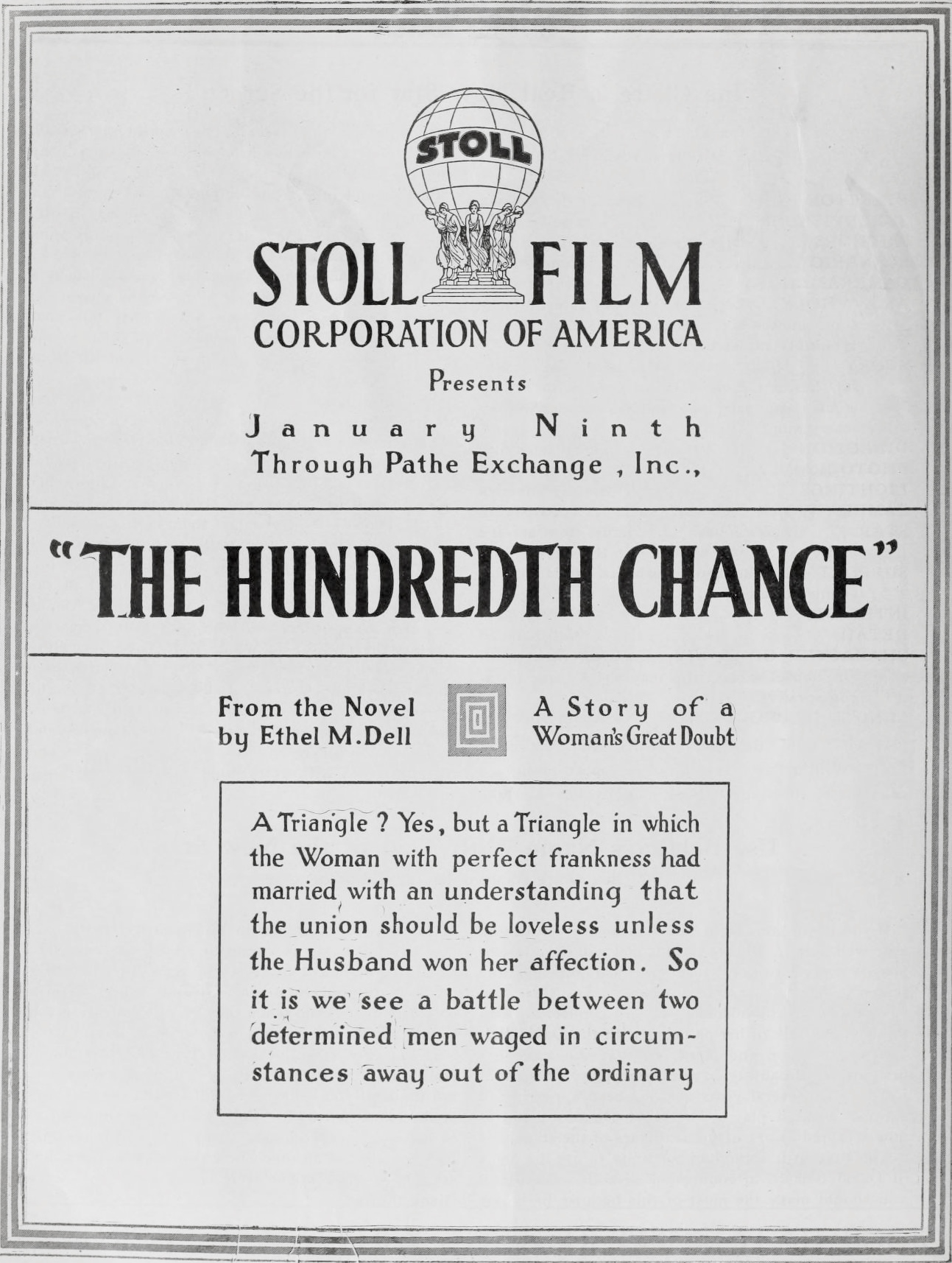
Picture a universe where devotion is measured in stallion breaths and the creak of a wheelchair counts as percussion. The Hundredth Chance—shot in the bruised autumn of 1919 and birthed into cinemas the following spring—feels like a fever dream stitched from peat smoke, saddle leather, and the brittle Anglican light that Sinclair Hill traps inside every frame. Ethel M. Dell’s pulp-pious plot becomes, in Hill’s hands, a silent opera of withheld flesh and equine transubstantiation.
Carmita Lascelles, all clavicles and candle-ivory skin, plays Lady Vyvyan—though the title is a ghost she refuses to claim. She glides through hayloft shadows like a Pre-Raphaelite mourner who has mislaid her lute, eyes flicking always toward the crooked form of her brother Christopher, whose legs are as useful as snapped cello strings. Enter Teddy Arundell’s Heron Mallister: weather-beaten, monosyllabic, the sort of man who can calm a thoroughbred merely by counting heartbeats. Their wedding is a business contract sealed with chaste lips; the unconsummated silence that follows is louder than any church bell.
What keeps the film from sliding into Victorian hokum is the savage sensory honesty Hill wrings from the scenario. We smell the iodine swabbed on saddle sores, feel the hoof-beat tremor that travels up a human spine when a mare clears a steeplechase brush. The camera, starved of dialogue, grows carnivorous: it lingers on Lascelles’s glove peeling away from Arundell’s wrist with the slow reluctance of a scab. Each denied caress is a coin dropped into a cosmic vending machine that may never deliver.
Dennis Neilson-Terry’s physician, a cigarette always burning at the filter, provides the third corner of this scalene love affair. He offers hydrotherapy, ultraviolet lamps, cod-liver sermons—miracles on the installment plan. His laboratory scenes, awash in sea-blue nitrate tinting, glow like an undersea cathedral, every beaker a stained-glass promise. Meanwhile Eille Norwood’s sardonic groom foreshadows doom with the curl of a lip, foreshadowing the equine catafalque that will eventually rupture the stalemate.
When that rupture arrives—a splintered fence, a mare’s cannon bone jutting like snapped chalk—the cut is so abrupt that audiences gasped even in 1920. Hill intercuts the collapse with a tight close-up of Mary Glynne’s housekeeper squeezing a rosary until the beads leave lunar craters in her palm. The mercy bullet that follows is not merely an act of veterinary euthanasia; it is the sound of one woman’s hymeneal lock snapping open. Christopher, hearing the shot, rises from his wicker invalid chair as though the projectile has lodged in his own spine, not the mare’s brainpan. The crutches fall like useless ex-lovers.
Only then does Lascelles allow her nightgown strap to slide—an inch, no more—yet the gesture irradiates the screen with more erotic voltage than any modern nude scene. Arundell lifts her not like a groom carrying a bride over a threshold but like a penitent shouldering a crucifix that has suddenly become warm, pliable, willing. The fade-out is not to black but to saffron, as if the celluloid itself has achieved climax.
Hill and cinematographer Jack MacKenzie shoot the stables in low Dutch angles so that the rafters loom like the ribs of some great whale. Moonlight drips through gaps in the thatch, pooling on the straw in mercury puddles. Compare this chiaroscuro to The Labyrinth where German expressionism gave us tilted alleys; here the distortion is internal, a moral scoliosis rather than an architectural one.
The film’s central visual motif is the horseshoe nailed upside-down—supposedly bad luck, yet Mallister insists it lets the luck run out onto the earth rather than trapping it uselessly inside. That tiny superstition becomes a visual shorthand for the entire narrative: love must be spilled, wasted, risked on the ground before it can be reclaimed.
Lascelles, primarily a stage actress, understands that the camera drinks from her collarbones first, her eyes second. She modulates breathing rather than facial muscles; the rise and fall of her clavicular hollow speaks the unspeakable. Arundell, meanwhile, weaponizes stillness. Watch the way he removes a glove: one finger at a time, as though undressing the concept of patience itself. Their chemistry is not a slow burn but a controlled freeze—two glaciers colliding until the friction finally births a spark.
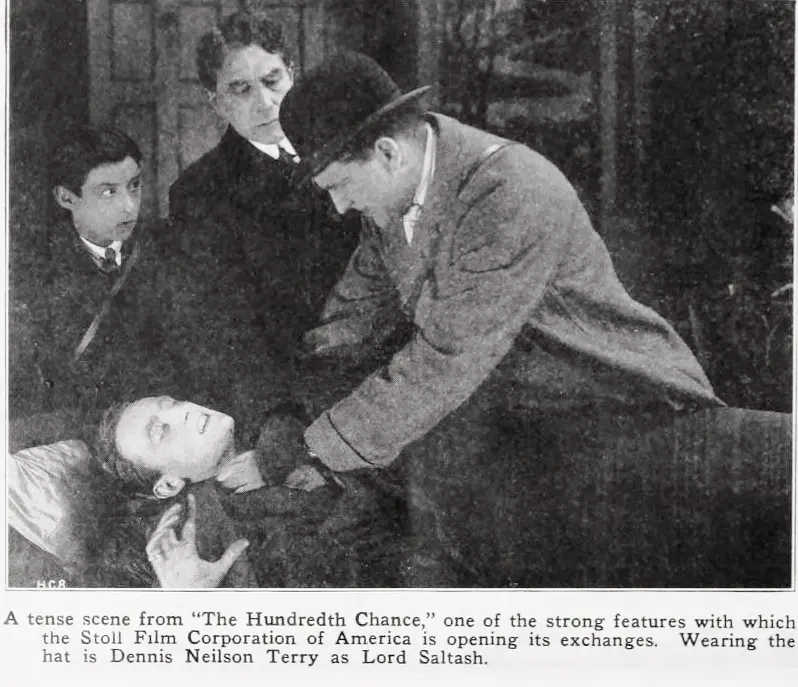
Supporting players orbit like motley planets. Patrick Key’s drunkard jockey provides comic relief that never topples into bathos; his hiccup syncopates perfectly with the flicker of the projector. Mary Glynne’s housekeeper, a whisper away from a Mrs. Danvers, carries her own unspoken torch for the lady, her gaze a velvet leash.
Dell’s original novel drenched itself in Edwardian piety; Hill mercilessly wrings out the sermonizing until only the muscle of myth remains. Yet biblical undertones persist: the brother’s healing on the third season evokes resurrection; the mare’s death is an equine agony in the garden. Even the withheld marriage debt nods to 1 Corinthians 7:5, albeit twisted into a perverse wager with the Almighty.
Cinephiles will detect the structural DNA of The Eternal Mother—another tale where a woman’s sexuality is mortgaged against a child’s survival—yet Hill refuses the maternal sanctification that film peddles. Here the bargain is rawer, more transactional: one body for another, no halo appended.
The sole surviving 35 mm print, housed at the BFI National Archive, was chemically bloomed like a bruise until the 2018 4K restoration peeled back decades of fungal fog. Now the straw looks sharp enough to cut your finger, the night scenes a bath of molten copper. On the festival circuit—Pordenone, Il Cinema Ritrovato—audiences discovered the film’s bizarre contemporary resonance: a culture still bargaining over who owns female bodies, still promising miracle cures for the uncurable.
Critics who dismiss silent melodrama as soapy relic should be strapped to a chair and forced to watch the final ten minutes without blinking. The orgasmic release is not prurient; it is existential. You feel the universe click back into gear, the cosmic gears grinding after a long, rusted hiatus.
Where A Marked Man uses scarred flesh as moral ledger, The Hundredth Chance keeps its scars internal, liminal. Compared to The Divorcee with its jazz-age sexual brinkmanship, this rural fable feels medieval, flagellant. Yet all three orbit the same black hole: desire deferred is desire weaponized.
Meanwhile German contemporaries like Der Andere split identity via Jekyll/Hyde clichés; Hill splits identity via marriage contract—two strangers sharing one surname, one bed, zero skin.
The original 1920 release shipped with a cue sheet calling for Schumann’s “Träumerei” during the brother’s first tottering steps—a sentimental choice that modern accompanists rightly ditch. Instead, a muted trumpet improvises around the diegetic sound we cannot hear: the mare’s final whinny becomes a sustained note bent blue, the crutch-clatter a snare brush. Silence itself becomes an instrument, plucked like a lyre.
By the time the end title card appears—“And the hundredth chance was love”—you realize the film has smuggled a Trojan horse into your chest. The line reads banal on paper, yet after ninety minutes of withheld warmth it detonates like an incendiary device. You stagger out craving the smell of straw, the salt of human sweat, the terrifying possibility that maybe—just maybe—your own cruelties could be un-written by a single act of carnal generosity.
That is the sleight-of-hand only great silent cinema can achieve: without a syllable spoken, it strips you naked and offers the hundredth chance you didn’t know you needed.
IMDb 6.4
1933
Community
Log in to comment.