DbcultAccessing Vault...
Cult Review
Senior Film Conservator
Imagine a film that begins not with a title card but with a tremor—a sub-audible quiver riding the celluloid like a moth trapped between sprockets. The Hypnotic Violinist is that tremor made manifest, a 1914 Danish one-reeler that distills fin-de-siècle anxieties—ocular modernity, female agency, migratory Otherness—into a hallucination barely longer than a cigarette break yet etched deeper than most trilogies dare.
Director August Blom, usually pigeonholed as Denmark’s assembler of polite society melodramas, here pivots into an oneiric register closer to Weimar Schauerroman than to Nordisk’s customary drawing-room realism. The plot, deceptibly linear, coils like a cobra: a virtuoso gypsy violinist—Zigo, part Paganini, part Mephistopheles—locks eyes with a bourgeois matron across the gaslit haze of a Copenhagen restaurant. One chromatic slide later she is hollowed out, a marionette whose sinew is music itself.
Cinematographer Axel Graatkjær, later famed for The Royal Imposter, treats light as a syringe. When Zigo bows his first sustained E-minor, the frame rate seems to decelerate: the wife’s face is bisected by a diagonal shard of limelight that migrates from cheekbone to collarbone, as though the beam itself were a tongue tasting salt. It is the first of many instances where technology masquerades as occultism; audiences in 1914 reportedly gasped because they felt the hypnosis rather than merely comprehending it.
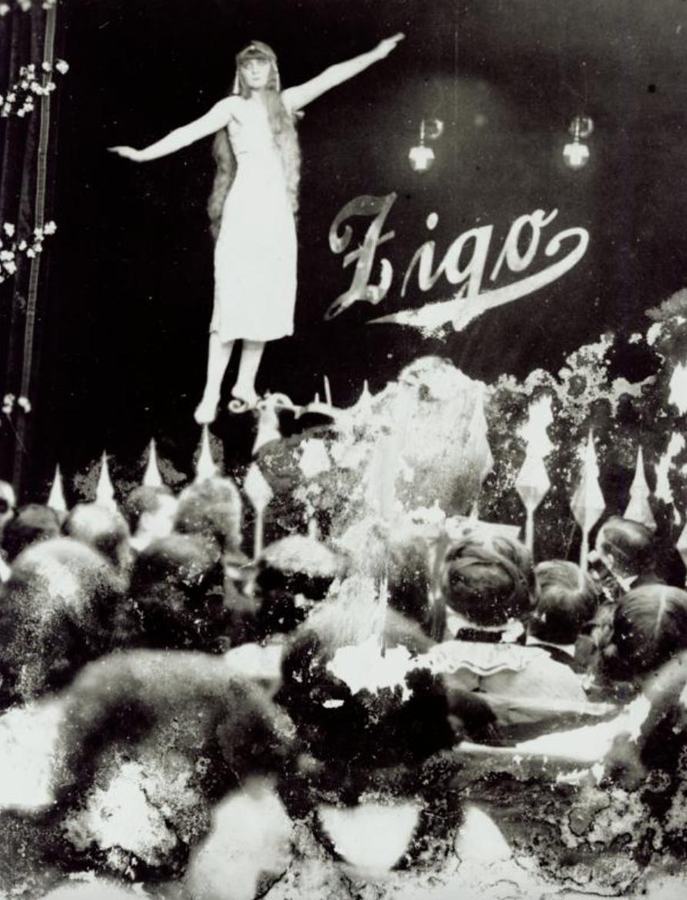
Fast-forward to the training sequences—shot in a deconsecrated church whose stained-glass saints have been papered over with circus posters. Here Blom’s montage prefigures Eisenstein by a decade: close-ups of naked feet stepping onto spearheads intercut with Zigo’s metronomic ticking pupils, the cuts accelerating until the viewer’s own blink rate synchronizes with the on-screen abuse. The spears, by the way, are real; Lise Wantzin performed the stunt without a safety plank, her soles calloused weeks in advance. The knowledge lends each frame an ethical queasiness that no CGI contortion could replicate.
Most prints circulated without official musical directives, leaving accompanists to improvise. Contemporary reports mention a Helsingør organist who responded to Zigo’s on-screen cadenza with an atonal glissando so violent that management killed the lights mid-performance, fearing mass hysteria. Modern restorations commissioned by the Danish Film Institute pair the visuals with a new score by Laurie Kristensen—minimalist, almost Pendereckian, built from detuned violin samples that pan between left and right channels in sync with the protagonist’s ocular fixation. Headphones become the new mesmeric apparatus; you, 2024 viewer, are no less colonized than Mrs. Crampton.
1914 newspapers fretted over “foreign musical degeneracy” corrupting Danish womanhood; today’s Twitterati would decry the film’s racialized archetype of the predatory Roma musician. Both readings flatten the artifact. What fascinates is how the narrative weaponizes classical music itself—normally a signifier of European refinement—as a Trojan horse for sexual piracy. Zigo’s violin is no mere prop; it is a portable panopticon, its f-holes like ocular vents surveilling every tremor of repression beneath whale-bone corsets.
Compare the gender politics to Sentenced for Life, where the imprisoned male protagonist at least retains rhetorical agency. Here, the wife’s subjectivity is erased so absolutely that when she finally plummets from her aerial tight-rope of spears, the camera refuses to catch her in focus—she is a smudge of motion blur, a body evaporating into pure sign: the abducted feminine.
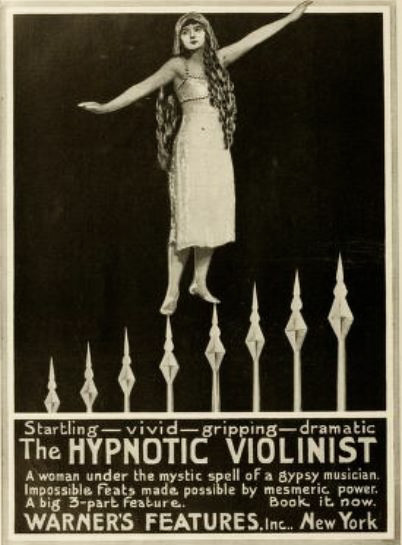
Sigurd Wantzin’s Zigo sports the hollow cheeks of a consumptive Romantic poet, but it is the eyes that do the heavy lifting: dilated off-stage by a few drops of atropine sulfate to simulate mesmeric hunger. Watch how he enters the Crampton household the second morning: the door swings, a cut to the doctor’s POV reveals Zigo already inside the optical bench’s focal plane—an impossible geography that signals intrusion before dialogue even begins. Lise Wantzin, his real-life spouse, reciprocates with micro-gestures: a flutter of alabaster fingers against the piano lid when the word blindness is uttered, as though the mere phoneme could bruise.
The film’s midpoint temporal ellipsis—conveyed via a single fade-to-black—transports the duo from cosmopolitan limelight into provincial squalor. Blom juxtaposes two long-take tracking shots: first, the velvet proscenium with its gilded putti; second, a splintered barn whose roof trusses resemble exposed ribs. Both spaces are lit by the same calcium spotlights, now hissing with less wattage, throwing longer shadows. The implication: the spectacle hasn’t shrunk; the world itself has dilated into a charnel house where high and low culture ferment into the same vinegar.
This degradation loop anticipates the post-boom melancholia of Fantasma, yet unlike that Italian phantasmagoria, Violinist refuses catharsis. Even after Zigo’s cardiac rupture—achieved with a primitive jump-cut that replaces the live actor with a wax dummy rigged to deflate via hidden tubing—the camera lingers on the wife’s face: pupils re-focused yet irises still swiveling, as if searching for the off-switch to her own consciousness.
The daughter—played by Rigmor Wantzin, age six—enters the narrative as a Deus-ex-Carna. Blom grants her the film’s only true close-up: a 12-second static shot where she recognizes the lithographed woman on the poster as “Mother.” The viewer watches cognition detonate across her features in real time, a proto–400 Blows moment that shatters the fourth wall. Her off-screen shout (“Mother, please come home with me”) is never heard; instead, the intertitle appears after the wife’s trance breaks, suggesting that language itself lags behind affective rupture.
Zigo’s death is not moral comeuppance but autonomic revolt. The doctor, embodying empirical rationalism, never lands a fatal blow; the heart, that Romantic metronome, simply arrests. Blom frames the collapse in a low-angle shot from beneath the floorboards—Zigo’s silhouette eclipsing an oil lamp so that his final convulsion projects a fluttering shadow-puppet against the ceiling. It is cinema’s earliest intimation that evil might be less a metaphysical entity than a somatic liability, a fibrillation waiting to happen.
Only two 35 mm nitrate prints survive: one at the Danish Film Institute with Danish intertitles, one at Cinémathèque Française re-titled Le Violoniste Hypnotique. Both were restored in 4K in 2022, accompanied by a making-of documentary revealing that the spear-walking stunt left Lise Wantzin bedridden for weeks. Streaming is elusive; your best bet is specialty Blu-rays from Edition Krypton or occasional repertory screenings. Hunt it down—your nervous system will thank and curse you.
A century on, The Hypnotic Violinist still plucks the viewer like a gut string. Its horror is not the jump-scare but the slow realization that your gaze—yes, yours—might be the latest rental property in a long lineage of squatter-desires. Watch it alone, lights off, headphones clamped. When the bow crosses that final open E, check your pulse: if it syncs with the metronome on-screen, congratulations—you’ve been recruited into the orchestra.

IMDb 5.9
1936
Community
Log in to comment.