DbcultAccessing Vault...
Cult Review
Senior Film Conservator
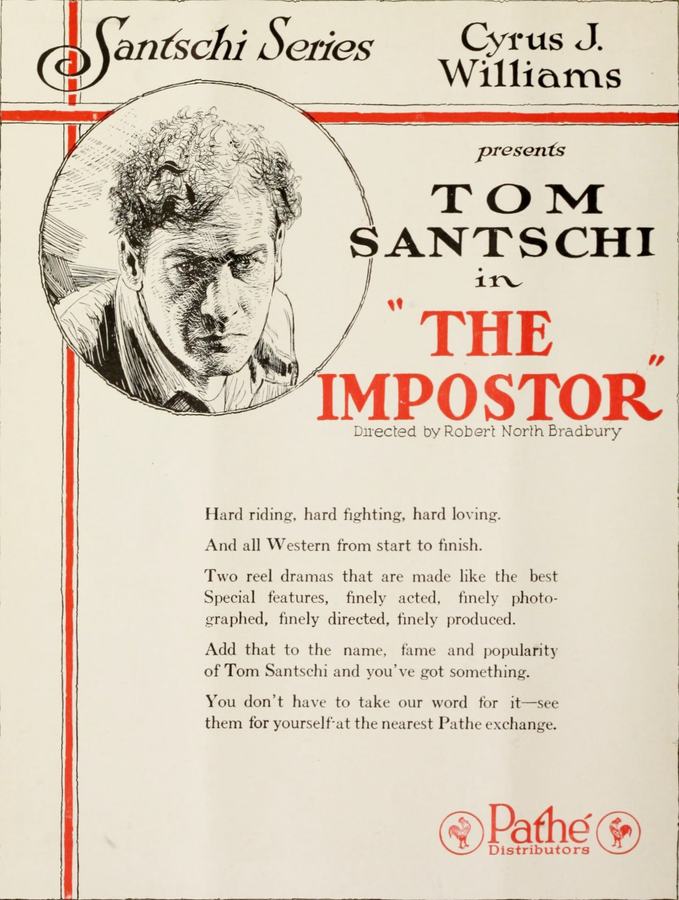
Tom Santschi’s creased face—half boxcar, half cathedral—carries the entire parable of 1921’s The Impostor as though the film stock itself were tattooed on his jawline.
The picture opens on a hobo jungled under trestle shadows; moonlight drips like mercury across stolen stationery. That single purloined letter becomes both skeleton key and Pandora’s lid, unlocking a lakeside domain of white pine and Protestant rectitude. Bradbury, who would later refine outdoor morality plays in The Man from Lost River, here lets the forest do half the acting: steam whistles stand in for Greek chorus, and the rasp of cross-saws undercuts every supposed redemption.
Because this is pre-code silent cinema, sin is neither off-screen garnish nor Production Code footnote; it is atmosphere. The camera lingers on a stolen ham glistening in close-up, on the heroine’s ungloved wrist sliding across Tom’s battered coat—moments that feel scandalous even without sync sound. When the payroll robbery finally detonates, the intertitle card burns white-hot: “The wages of deceit—counted in cedar smoke and cordite.” You half expect the celluloid to cough up splinters.
Yet what lingers is the slow osmosis of decency. Tom’s conversion isn’t thunderbolt but mildew—creeping, inconvenient, ultimately immovable. His two sidekicks, sketched with Mabuse-like glee, keep yanking the narrative back into heist territory, so that every tender impulse feels contraband. The result is a tonal braid you rarely find in contemporaries like The Love Cheat or White and Unmarried, both of which prefer their morals ironed flat and their endings matrimonially pre-chewed.
The lumberman’s daughter—played by an uncredited actress whose eyes seem perpetually startled by their own clarity—functions less as love interest than as conscience made flesh. Watch how she first appears: framed by a doorway, haloed by kerosene flare, as though the house itself were trying to decide whether to expel the parasite at the dinner table. Their eventual union feels less like Hollywood inevitability and more like a shotgun wedding between two conflicting genres, noir and Sunday-school tract, dragged kicking into the same logging camp.
Visually, Bradbury exploits the hard contrast between cathedral-dark interiors and the blinding snowfields outside. Interiors swallow faces in chiaroscuro, while exteriors bleach everything to near-orthochromatic blindness, so that morality itself seems weather-dependent. Compare this to the sun-baked fatalism of Sangre y arena or the claustrophobic haciendas in The Slave; here, nature is both accomplice and confessor.
Santschi, a veteran of sweat-smeared westerns, never once begs for sympathy. His shoulders carry the slump of a man who has woken up inside someone else’s dream and decided—against every instinct—to prolong it. Notice how he fingers the stolen letter early on: thumb rubbing wax seal like a gambler testing an unfamiliar coin. Later, after the payroll has been reclaimed, the same thumb absently strokes a child’s spinning top found in the snow; the gesture rhymes without rhetoric.
The film’s most bravura sequence—a nighttime sled chase across a half-frozen river—was shot with cameras lashed to felled trunks, the ice cracking in real time beneath stuntmen. Contemporary trade sheets gossiped about hypothermia, about a cinematographer losing two toes. Whether apocryphal or not, the peril translates: every frame judders with authentic jeopardy, a precursor to the flume-ride finale of The Arizona Cat Claw but colder, crueller, more spiritually lonesome.
Redemption arcs in 1921 usually arrive pre-packaged, ribboned with scripture and last-reel baptism. Bradbury withholds that comfort. Tom’s restitution—lugging the ruptured payroll sack back across the drifts—reads less like absolution than like a man paying rent on a room he’ll never truly inhabit. Even the closing wedding is staged in a logging clearing, sawdust on the ground, axes stacked like mute witnesses. The bride’s veil snags on a branch; no one bothers to untangle it. The camera dollies back until the congregation becomes a charcoal smear against white nothingness, the hymn dissolving into wind.
If you scour the fossil record of silent cinema you’ll find curios galore—Charles IV with its expressionist backdrops, Auf den Trümmern des Paradieses with its colonial guilt—but few negotiate the serrated ridge between pulp and penitence as nimbly as The Impostor. Its DNA splinters later into the proto-noir of The Stepping Stone and even, in odd allelic echoes, into Capra’s American Madness: the same dread that virtue might be a con you play on yourself.
Public-domain 16 mm prints circulate like samizdat among archivists; most are haunted by cue-scratches, emulsion blooms, missing intertitles guessed by projectionists with a Ouija flair. Yet even in tatters the film exhales something fierce and unbroken. You can find a watchable rip on the Internet Archive, but do yourself a favor: track down a 35 mm restoration screened with live accompaniment—preferably a single piano whose pedals simulate the hush of snow. In that darkness you’ll feel the full torque of 1921 trying to decide whether civilization is anything more than a well-spun lie told by men who never had to sleep in boxcars.
So is The Impostor a rediscovered masterpiece? Masterpiece is cathedral language; this is campfire legend. It flickers, it misbehaves, it leaves cinders in your pockets. But if you crave silent-era fare that refuses to choose between damnation and deliverance—something leaner than The First Born yet more merciless than A Mormon Maid—then Santschi’s haunted grin is waiting, letter in hand, ready to con you into believing that maybe, just maybe, a man can outrun his own shadow.
Verdict: Seek it, squint through the nitrate wounds, and let the sawdust get under your skin.
IMDb —
1914
Community
Log in to comment.