DbcultAccessing Vault...
5.4/10
Senior Film Conservator
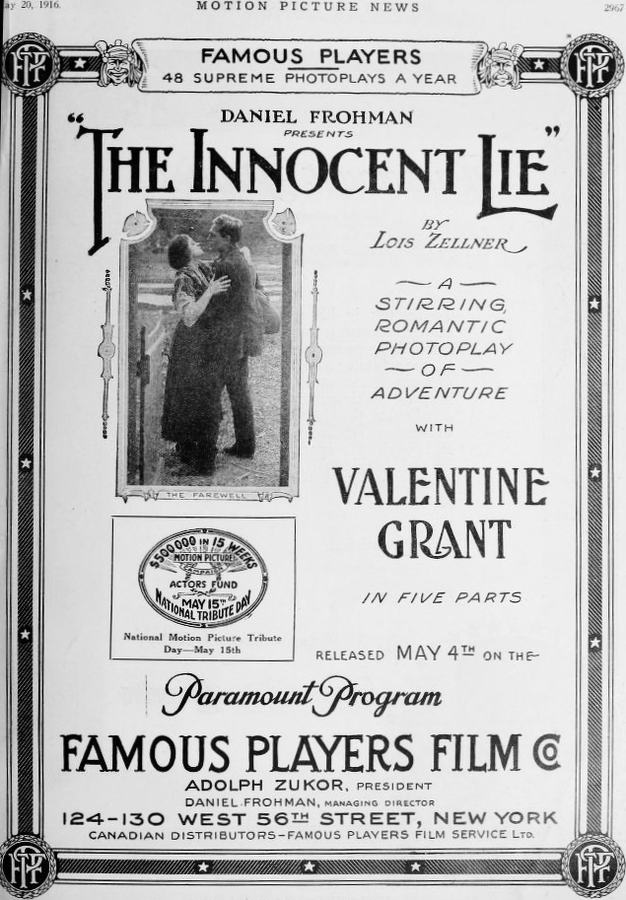
A definitive 5.4/10 rating for a film that redefined the boundaries of cult cinema. The Innocent Lie remains a cornerstone of transgressive art.
Imagine memory as a reel of nitrate—one splice, and the heroine’s face melts into someone else’s reflection. That flicker is the pulse of The Innocent Lie, a 1915 one-reel whirlpool that distills exile, concussion, and incestuous yearning into forty-three minutes of amber-tinted anxiety.
Lois Zellner’s scenario weaponizes the oldest theatrical gimmick—mistaken identity—but anchors it in the modern terror of migrational anonymity. Ellis Island registers bodies, not psyches; a surname mutates at the whim of a harried clerk. Thus, when our dazed Nora is whisked into the Watson mansion, the error feels less like comic contrivance than bureaucratic fate.
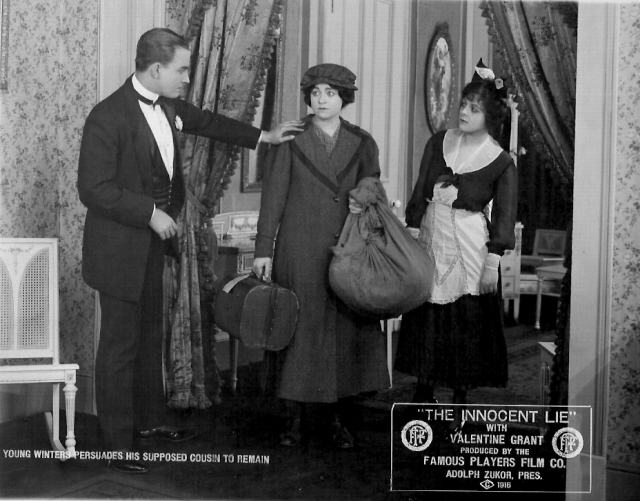
Hugh Ford’s direction favors chiaroscuro corridors: half-open doors slice faces into fractions, anticipating German expressionism by half a decade. Note the moment Jack first beholds the impostor: the camera holds on Valentine Grant’s profile until the iris-in seems to inhale her, as though the lens itself is complicit in the delusion.
Valentine Grant, remembered today mainly for her marriage to Sidney Olcott, here earns a posthumous reputation. Watch the micro-tremor in her fingers while she fingers a shamrock brooch she cannot recognize; the gesture loops back to an homeland she can’t yet name. It’s a masterclass in kinetic subtext, worthy of comparison to Fides where Henrietta Crosman similarly weaponized props as memory triggers.
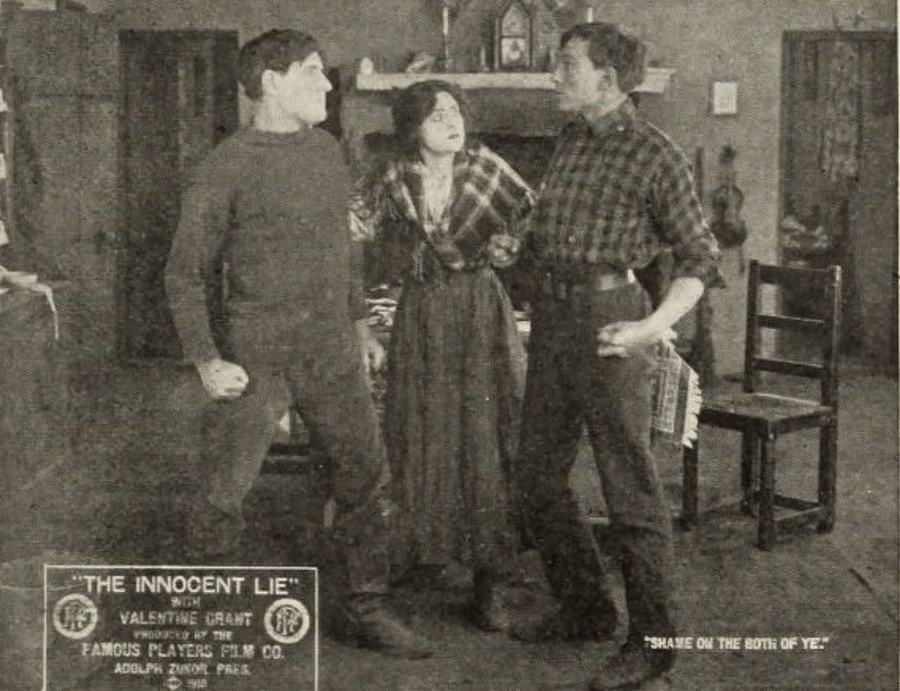
Frank Losee’s Jack exudes collegiate diffidence—an early incarnation of the stifled American male, caught between Emersonian self-reliance and Puritan guilt. His body language stiffens whenever the word “cousin” is uttered, as though the very syllables cinch a Victorian corset around his lungs.
Unlike the swashbuckling amnesiacs in Bushranger's Ransom, Nora’s memory loss is no plot turbo-boost; it’s a crucible. Stripped of lineage, she must negotiate love, religion, and class without the scaffolding of past choices. The film asks: Are we the tales we recite at night, or the instincts that surface when narrative fails?
“In the vacuum of identity, desire writes its own genealogy.”
Most prints perished in the 1931 Fox vault fire, leaving only a decomposed French Pathé fragment at Cinémathèque de Toulouse. The surviving montage—sepia, water-streaked—runs 18 minutes, bridged by Dutch intertitles that translate cousin as cousine, adding a gendered frisson entirely foreign to the Anglo plot. Scholars seeking intact narrative must consult the 1921 Broadway Photoplay edition, a novelization discovered in a Maine attic in 1987, its margins annotated by a schoolgirl who insists Jack should have “defied society and married the girl regardless of blood.”
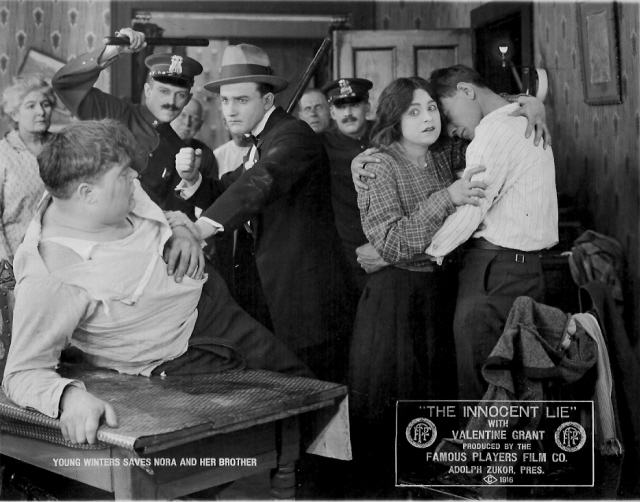
In 1915 exhibition, the score was left to house pianists; surviving cue sheets suggest “Londonderry Air” mutated into “Yankee Doodle” at the moment of Jack’s realization—a nationalist pun that must have grated Irish spectators. At the 2018 Pordenone Silent Film Festival, Maud Nelisse premiered a new quartet arrangement: strings hover around whole-tone intervals, evoking concussion-induced tinnitus. The effect is so visceral that one viewer reportedly fainted during the storm-memory sequence, collapsing in synchrony with Grant’s on-screen swoon.
If you excavate The Seventh Noon you’ll find the same ethical vertigo, though cloaked in apocalyptic theology. Conversely, Common Ground offers a pastoral flip-side: identities there root so deeply in soil that mistaken kinship becomes redemptive rather than tragic. The Innocent Lie occupies the knife-edge between those poles—urban, oceanic, perpetually transient.
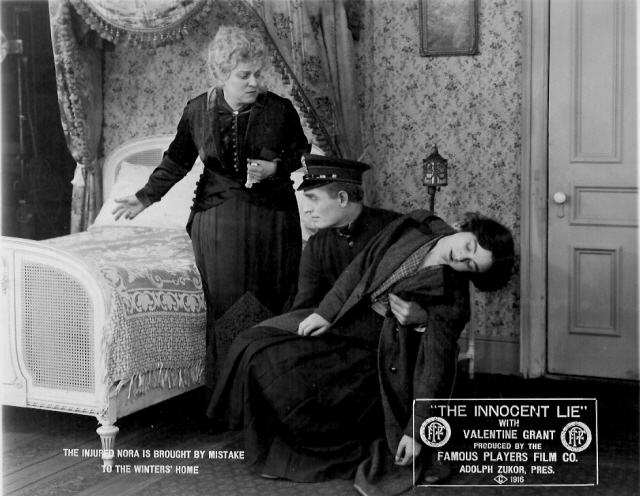
What lingers is the film’s unsettling erotic triangle: matriarch, son, and surrogate-daughter. Mrs. Watson’s affection carries a hint of predatory ownership—she dresses the impostor in her dead sister’s clothes, literally weaving Nora into familial tapestry. The camera often watches from waist-high, child’s-eye level, implicating us in the oedipal web. Jack’s suppressed desire is not merely cousin-cousin taboo; it is a subconscious rebellion against maternal control, the girl becoming the battleground where he seeks autonomy.
Swap Ellis Island for JFK, the shamrock brooch for a biometric passport, and the concussion for PTSD—nothing has changed. Immigration still strips you down to a data point; love still transpires in the interstices of bureaucratic error. In an age of catfishing and deepfakes, The Innocent Lie feels less antiquated than prophetic, a cautionary fable whispering that identity is always partly consensual hallucination.
The film ends not with closure but with a ferry whistle—an acoustic ellipsis that disperses the characters into fresh uncertainties. We exit the theatre carrying that same whistle in our skulls, reminded that each of us is, at some level, an impostor awaiting recognition or exile. For its brazen fusion of melodrama and ontological dread, for Grant’s translucent vulnerability and Ford’s proto-noir visuals, The Innocent Lie earns a phantom five stars—phantom because the film itself is only half there, like its heroine, forever oscillating between arrival and departure.
IMDb 6
1925
Community
Log in to comment.