DbcultAccessing Vault...
Cult Review
Senior Film Conservator
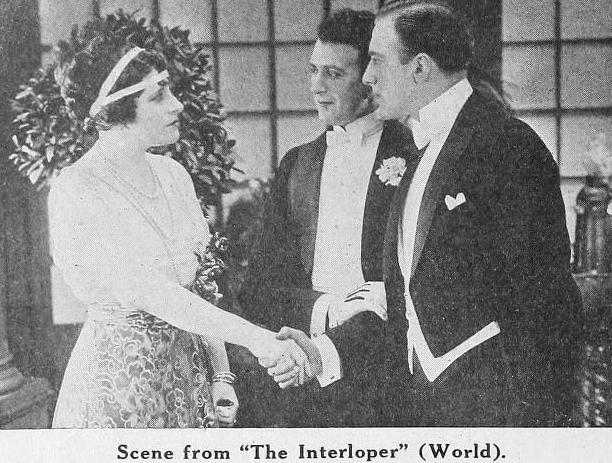
In the flickering twilight of 1918, when the world still stitched its wounds from one global conflagration while bracing for the Spanish influenza’s spectral scythe, The Interloper arrived as a gossamer whisper of domestic apocalypse. Triangle Film Corporation—already wobbling toward insolvency—nonetheless bankrolled this languid Virginia gothic, handing the reins to screenwriter Clara Beranger and scenarist Wallace Clifton so they could exhume the bones of marriage, memory, and manifest destiny.
Kitty Gordon, the British-born diva whose sapphire eyes read like gas-jets on orthochromatic stock, essays Jane Cameron with the hauteur of a woman who knows soil clings to silk. Her first appearance—framed against plantation columns that loom like exhumed Greek temples—establishes the film’s visual grammar: every vertical line wants to impale her, every horizontal vista wants to spirit her away. Frank Mayo’s Paul Whitney arrives astride a literal iron horse, his tailored three-piece suit as crisp as the railroad shares folded inside his breast pocket. The courtship plays out in a procession of iris shots: magnolia petals tremble, a parasol twirls, a right-of-way contract flutters like a wounded bird.
Beranger’s intertitles, mercifully preserved in the 2018 MoMA restoration, eschew the usual Victorian frippery. When Jane capitulates to Paul’s proposal, the card reads: “I give you my land, my name, my nights—may they prove enough.” The line is erotic, agrarian, and fatalistic all at once, hinting that the plantation’s topsoil itself is dowry and hostage.
Upon transplantation to the Whitney citadel—a mausoleum of Eastlake mahogany and Tiffany gloom—Jane confronts the first wife’s cult. Director J. Stuart Blackton, co-founder of Vitagraph and by 1918 a Triangle mercenary, stages these scenes like séances. Evelyn’s portrait, veiled in perpetual crepuscular light, hangs above the grand staircase so that her gaze descends with the chandelier’s prisms. Servants genuflect; even the Steinway retains sheet music the dead woman once played. Jane’s kimono-clad figure glides through corridors whose very wallpaper seems to inhale her scent and exhale reproach.
Cinematographer William S. Adams employs diffused lenses and mirrors to fracture Jane’s reflection, so that we witness her self-fragmentation in real time. One tableau—Jane seated at Evelyn’s escritoire, opening a lacquered music box whose ballerina twirls to “La Golondrina”—carries the uncanny chill of The Soul’s Cycle, yet here the reincarnation is metaphoric: the second wife must pirouette inside the first wife’s choreographed absence.
George MacQuarrie, whose saturnine handsomeness the intertitles describe as “a smile that apologized in advance,” imbues Edmond with Byronic exhaustion. He is the archetypal homme fatal—not the pursuer of married women but their reluctant confessor. His disclosure of the affair with Evelyn arrives not as torrid revelation but as sighing capitulation: “We were two ghosts haunting the same wound.”
The staging of Jane’s rejection is a masterclass in negative space. Blackton blocks the actors at opposite ends of a conservatory where tropical ferns cast serpentine shadows onto Edmond’s white flannels. Jane’s slap—rendered in a single, unforgiving insert—feels less like retribution than exorcism. The film declines to punish Edmond further; he simply evaporates, leaving the narrative to ponder whether adulterers or their confessors carry the heavier burden.
Jane’s refusal to tell Paul is the picture’s ethical engine, aligning The Interloper with contemporaneous suffrage-era melodramas like The Woman in the Case, wherein female protagonists wield silence as both shield and weapon. Yet Beranger complicates the trope: Jane’s silence is not sacrificial but sovereign. In a private moment she burns Evelyn’s love letters atop a kerosene lamp, the flames painting her face the color of molten brass. The act is framed in medium-close-up so that each curling page resembles a moth immolating itself on the bulb of history.
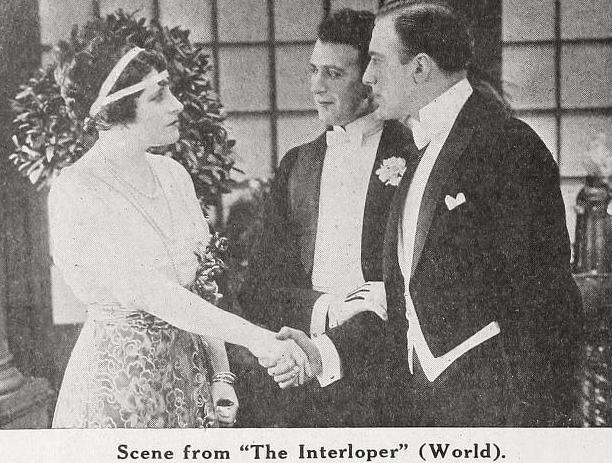
The film’s macrocosmic tension—progress versus patrimony—echoes the dialectic of Michael Strogoff, albeit on a domestic scale. Paul’s railroad is both seducer and colonizer; it promises to stitch the republic together while slicing the Cameron plantation like a surgeon’s incision. The final shot—a locomotive whistle echoing across verdant fields while Jane stands on the platform, her gloved hand interlaced with Paul’s—suggests reconciliation. Yet the preceding close-up of her eyes, glistening with unshed rain, intimates that the cost of unity is amnesia.
Kitty Gordon, derided by Variety in 1918 as “a statuesque beauty whose range begins and ends with the tilt of a feathered hat,” here achieves something closer to hypnotic minimalism. She modulates tension through the angle of her clavicles, the tremor of a lace cuff. Frank Mayo, saddled with the thankless role of the obtuse husband, nonetheless conveys—via the micro-gesture of fingers drumming against a fishing reel—the panic of a man sensing an emotional earthquake he cannot name.
Supporting players shimmer like peripheral ghosts. Isabel Berwin as the spinster aunt delivers a sly cameo: observing Jane’s first attempt at household management, she murmurs via title card, “A new broom may sweep clean, but it also frightens the cobwebs into corners.” The line, both domestic and prophetic, earns a chuckle that dies in the throat.
MoMA’s 4K restoration, struck from a 35mm nitrate print discovered in a Perpignan attic, revives the film’s original tinting: Virginia sunsets glow amber, Northern parlors bask in cerulean, and the climactic conflagration of letters pulses in crimson. The photochemical grain, left unscrubbed, breathes like living tissue. One particular two-shot—Jane and Paul framed by a locomotive’s driving rods—achieves the kinetic lyricism of The Road to the Dawn, yet here the machinery of progress becomes a throbbing metronome for marital rapprochement.
Cinephiles will detect pre-echoes of Rebecca (1940) in the spectral first wife motif, though du Maurier’s Mrs. Danvers is prefigured here by a portrait rather than a flesh-and-blood gorgon. Likewise, Jane’s ethical silence anticipates the heroine of The Moment Before, who also withholds adulterous truth to spare a spouse. Yet where that film treats silence as tragic flaw, The Interloper frames it as matriarchal praxis—a refusal to let male transgressions set the narrative agenda.
Viewed today, amid discourse on emotional labor and the unpaid psychic bookkeeping wives perform, the film feels eerily current. Jane’s ultimate victory is not erotic but editorial: she rewrites the family mythos without ever brandishing exposition. The railroad still cleaves the plantation, but the wound has been sutured by strategic amnesia—a bargain the United States itself strikes with its own ghosts of slavery and civil war.
As of this writing, the MoMA restoration streams on the Criterion Channel under the banner “Silent Women: Rediscovered Classics.” A Blu-ray from Kino Lorber includes an audio essay by historian Shelley Stamp and a new score by chamber duo Knoxville Morning—all pizzicato strings and ghostly harmonica that never insult the film’s restraint.
The Interloper does not climax with a kiss or a death but with a shared gaze inside a moving railway car. The landscape blurs, the whistle keens, and two flawed humans consent to inhabit the same hurtling continuum. That the film denies us cathartic confession, opting instead for the quiet dignity of negotiated memory, makes it not merely an artifact but an accomplice—an unindicted co-conspirator in our own willingness to let sleeping wives lie.
Ninety-odd years after its première, this slender ribbon of celluloid still vibrates like the railroad it depicts: a testament that love, like steel, is forged in fire, quenched in compromise, and laid down atop the graves it needs to traverse.
IMDb 6.5
1933
Community
Log in to comment.