DbcultAccessing Vault...
Cult Review
Senior Film Conservator
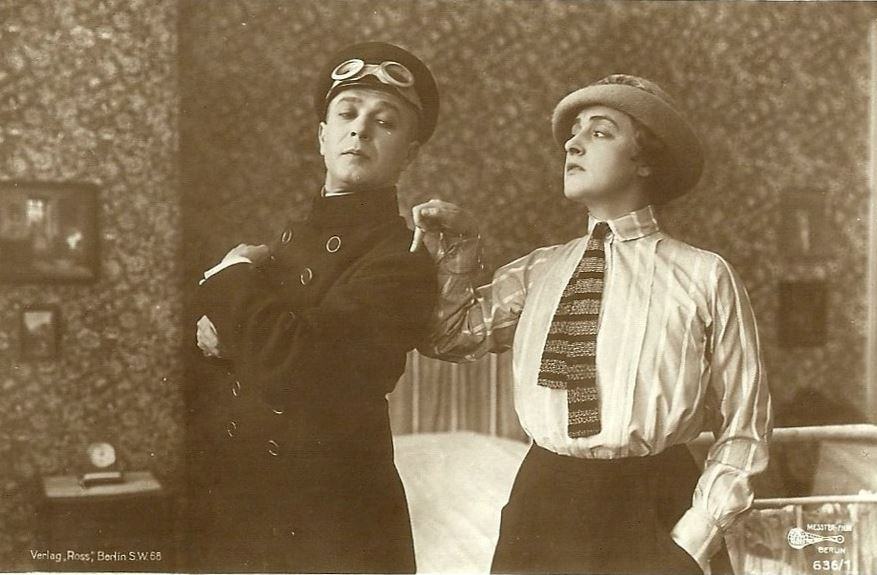
The year 1919 stands as a pivotal monolith in the history of global cinema, particularly within the bruised but burgeoning creative atmosphere of the Weimar Republic. Die Fahrt ins Blaue (The Journey into the Blue) emerges from this historical crucible not merely as a piece of entertainment, but as a sophisticated socio-cultural document. It is a film that balances on the precarious precipice between the Victorian-inflected sensibilities of the past and the avant-garde radicalism that would soon define the German screen. To watch it today is to witness the DNA of modern romantic comedy being synthesized in real-time, under the guidance of some of the most formidable minds in film history.
The screenplay of Die Fahrt ins Blaue is an extraordinary specimen of narrative economy and wit, a feat unsurprising given the involvement of Robert Wiene and Hanns Kräly. Wiene, who would shortly thereafter revolutionize the medium with The Cabinet of Dr. Caligari, demonstrates here a mastery of a different sort: the light, observational touch. While his later work leaned into the distorted psychology of the frame, here he focuses on the distorted psychology of social etiquette. Kräly, meanwhile, brings the razor-sharp comedic sensibilities that would eventually make him Ernst Lubitsch’s most vital collaborator. Together, they construct a story that feels as airy as a summer breeze yet possesses the structural integrity of a well-built timepiece.
Unlike the more somber psychological explorations found in Pro domo, das Geheimnis einer Nacht, this film opts for a kineticism that mirrors the movement of its central motif—the automobile. The 'journey' is both a plot device and a thematic declaration. In 1919, the idea of simply driving away into the unknown—the 'blue'—carried a weight of liberation that is difficult to overstate. It was a rejection of the trenches, the bread lines, and the rigid Prussian discipline that had led to catastrophe.
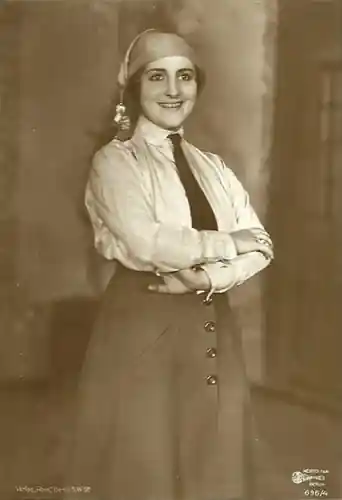
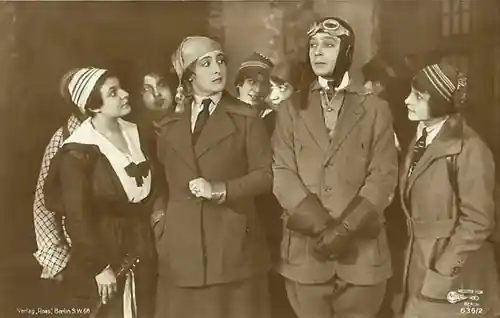
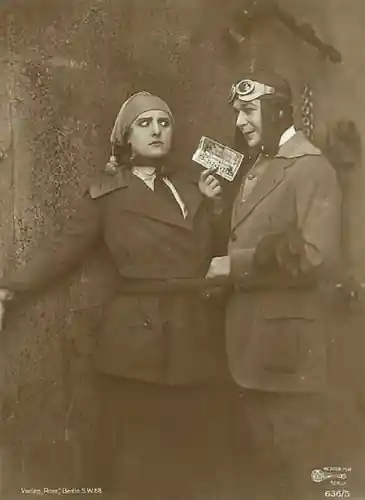
To discuss Die Fahrt ins Blaue without focusing on Henny Porten would be akin to reviewing the sun without mentioning its light. Porten was the first true superstar of the German screen, a figure of such immense popularity that she commanded her own production company. In this film, she displays the 'Porten-Stil' in its most refined form. She possesses a naturalism that was rare in the silent era, eschewing the exaggerated gesticulations of the stage for a subtle, internalize performance style. Her ability to convey complex emotional shifts through a mere tilt of the head or a softening of the eyes provides the film with its soul.
When compared to the more overtly theatrical performances in The Painted Soul or the heavy-handed melodrama of Zhivoy trup, Porten’s work feels startlingly modern. She represents the 'New Woman' of the Weimar era—independent, capable, and possessed of a sharp, if gentle, irony. The chemistry she shares with Georg Alexander and Robert Scholz elevates the film from a simple romp to a nuanced study of human connection.
Director Rudolf Biebrach, a frequent collaborator of Porten, utilizes the camera with a fluidity that was quite advanced for its time. The location shooting provides a sense of verisimilitude that studio-bound productions of the era, such as The Eternal City, often lacked. There is a tactile quality to the dust of the roads and the dappled sunlight through the trees that enhances the film’s escapist atmosphere. The cinematography captures the contrast between the ornate, heavy interiors of the urban elite and the expansive, liberating vistas of the countryside.
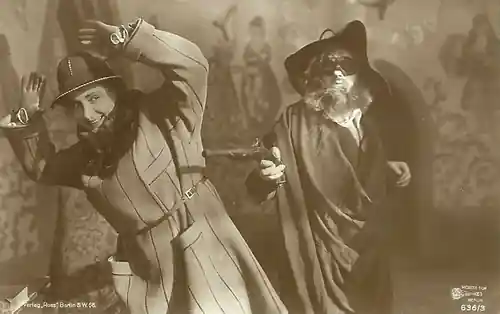
This visual dichotomy serves the film's critique of class. While it lacks the biting cynicism of Social Hypocrites, it nonetheless pokes fun at the absurdity of maintaining high-society decorum while stranded in the rural wild. The sequences involving Jakob Tiedtke and Paul Biensfeldt provide a comedic counterpoint to the central romance, grounding the film in a rich tradition of German character acting that would later populate the masterpieces of the 1920s.
Thematic echoes of Die Fahrt ins Blaue can be found across the global cinematic landscape of the time. In the United States, films like Salomy Jane were exploring the mythos of the frontier, while The Forfeit and Selfish Yates dealt with the rugged individualism of the West. However, the German 'journey' film is distinct in its focus on the collective experience and the dismantling of social artifice. Where American films of 1919 often focused on the triumph of the individual, Die Fahrt ins Blaue focuses on the reconfiguration of the group.
Consider the contrast with The Soul's Cycle, which looks at the spiritual and karmic progression of characters. Wiene and Kräly are less interested in the metaphysical and more concerned with the immediate, the sensory, and the social. Even in its more dramatic moments, the film maintains a levity that distinguishes it from the heavy moralizing of God's Law and Man's. It is a film that celebrates the 'now'—a crucial sentiment for a population emerging from the trauma of total war.
The pacing of the film is remarkably brisk. The editing, likely influenced by the burgeoning theories of montage, allows the comedic beats to land with precision. There is a sequence involving a breakdown of the car that is choreographed with the rhythmic grace of a ballet. This physical comedy, while perhaps not as acrobatic as the American slapstick of the era, is imbued with a character-driven logic that makes it more enduring. It isn't just about the car failing; it's about how each character's reaction to the failure reveals their true nature.
In this regard, the film shares a certain kinship with Giving Becky a Chance, which also uses situational comedy to explore the limitations of social mobility. The 'chance' in Die Fahrt ins Blaue is the chance to be authentic, a luxury rarely afforded to the characters within their normal urban habitats. The performances of Sophie Pagay and the Verdier brothers add layers of texture to this exploration, ensuring that the film never feels like a mere star vehicle for Porten, but rather a vibrant, living world.
To fully appreciate Die Fahrt ins Blaue, one must understand the environment in which it was released. The Treaty of Versailles had just been signed, the Spartacist uprising had recently been suppressed, and the flu pandemic was still a fresh memory. In this context, a film about a carefree journey into the blue was an act of cultural defiance. It was an insistence on the right to joy and the possibility of a future that was not dictated by the failures of the past.
While Scandinavian cinema was producing works of stark naturalism like Hemsöborna, and the British were exploring domestic tensions in The Other Woman, the German film industry was beginning to realize its potential as a global powerhouse of style and substance. Die Fahrt ins Blaue represents the 'white' period of German cinema—bright, optimistic, and technically proficient—before the 'black' period of Expressionism took hold. It shares the sophisticated DNA of The King of Diamonds or The Battle of Love, yet it possesses a specifically Teutonic charm that is entirely its own.
Decades later, the film remains a testament to the power of collaborative storytelling. The presence of Alfred Halm and H. Fredal in the writing credits suggests a synthesis of ideas that resulted in a narrative far more robust than the typical 'star vehicles' of the time. The film’s influence can be traced through the decades, from the sophisticated comedies of the 1930s to the road movies of the modern era. It established a template for the 'spontaneous getaway' as a means of character growth and social commentary.
Ultimately, Die Fahrt ins Blaue is a celebration of the ephemeral. It captures the beauty of a sunset, the thrill of a fast car, and the spark of a new romance with a sincerity that is never cloying. It is a reminder that even in the darkest of times, the human spirit seeks the 'blue'—that infinite horizon of possibility. For the modern viewer, it offers a window into a world that was just beginning to discover the true power of the moving image to reflect, challenge, and ultimately, to enchant.
Cast: Robert Scholz, Paul Biensfeldt, Georg Alexander, Jakob Tiedtke, Henny Porten, Sophie Pagay, Franz Verdier, Herr Brögel, Marcel Verdier. Directed by Rudolf Biebrach. Written by Robert Wiene, Alfred Halm, Hanns Kräly, H. Fredal.
IMDb —
1925
Community
Log in to comment.