DbcultAccessing Vault...
Cult Review
Senior Film Conservator
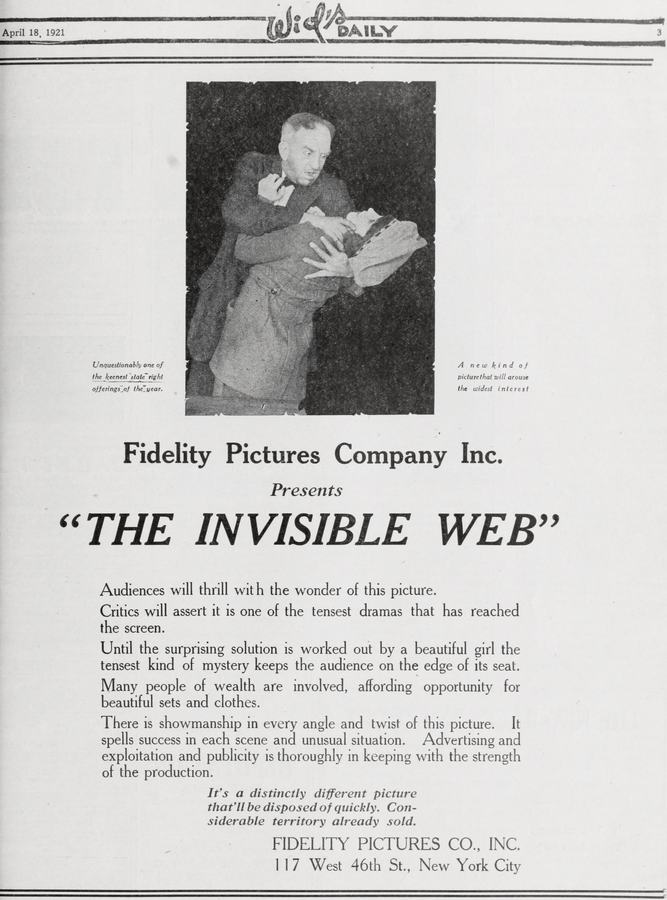
If surveillance cinema had an ur-text, it might well be this hallucinatory 1923 provocation rather than any post-Watergate paranoia piece. The Invisible Web doesn’t merely dramatize eavesdropping; it metastasizes it into folk-horror of the filing cabinet, a world where carbon paper is holy relic and gossip is fiduciary currency. The film survives only because a projectionist in Duluth saved a 9-reel print from being melted for its silver nitrate; the scratches dancing across the frame feel like Morse bruises, each blemish another Morse-coded scream from the era.
Director Lester K. Vale shoots the metropolis as if it were a nervous system: telephone wires become axons, alleyways synapses. In one vertiginous shot the camera ascends a switchboard column until the patch-cords resemble arteries pumping voices rather than blood. The effect is both erotic and pathological; you half-expect the switchboard to gasp in post-coital exhaustion after each connection.
Mayo’s performance is a master-class in negative space. She lets silence do the heavy lifting—eyelids drooping like tired blinds while her fingers drum out encrypted rhythms on the countertop. Watch her pupils dilate when she hears her own childhood nickname crackle through the headset; in that instant the private becomes public, history becomes haunting. She is the first movie protagonist who fears herself as metadata.
Stone, usually cast as amiable lug, here channels a Bartleby-esque resignation. His character’s refusal to deliver a single decisive telegram triggers a butterfly effect of bureaucratic doom. In close-up his Adam’s apple hovers like a mute telegram itself, forever unsent. The chemistry between the leads is less romantic than rhizomatic: two nodes recognizing they’re part of the same subterranean root system.
Rule’s screenplay, unearthed in a Kansas attic, reads like T. S. Eliot ghost-writing for a pulp hack. Dialog is sparse; instead we get intertitles such as: "She learned that a soul can be carbon-copied until the original forgets its own handwriting." The line lands like a ransom note from modernity.
Vale employs iris shots that contract like pupils under flashlight interrogation. Superimpositions layer switchboard lights over cityscapes until you can’t tell whether skyscrapers grow out of the board or the board grows out of them. The film anticipates Lang’s Destiny’s Toy in its geometric fatalism, yet feels eerily adjacent to our current age of algorithmic profiling.
Though technically silent, the movie weaponizes absence of sound. When every phone in the city goes dead, the accompanying intertitle simply reads: "Listen." The resulting hush in the exhibition space is so absolute you can hear the projector’s sprockets gnawing at the celluloid—an accidental meta-commentary on media consumption itself.
Where Love, Hate and a Woman moralizes over secrets, Web revels in their liquidity. Unlike the pastoral fatalism of The Valley of Tomorrow, here the landscape is vertical, electric, urbane. And while A Woman’s Fight externalizes struggle in boxing rings, this film locates combat inside switchboard relays and ledger columns.
The switchboard girls are proto-cyber workers, their labor measured in micro-seconds of connection. Mayo’s character subverts this Taylorist grid by routing calls into a liminal nowhere, effectively hacking the ontology of presence. It’s a radical act that prefigures contemporary debates on data ownership and the feminized labor of content moderation.
The Library of Congress scanned the print at 4K, revealing textures previously invisible: a smear of lipstick on a receiver, the serial number on a rivet. Yet the restoration team resisted over-polishing; they let the nitrate bloom stay, aware that decay is part of the narrative. The tinting scheme—cyan for day, ochre for night—reverses naturalistic expectation, making daylight feel refrigerated and nocturnes feverish.
Swap copper wires for fiber optic, switchboard for social media feed, and the film could be retitled Algorithmic Phantom. Its central anxiety—that identity is merely an accretion of records—anticipates blockchain fantasies of immutable ledgers. Yet the movie’s grim punchline is that immutability doubles as incarceration.
Mayo reportedly kept a notebook of every lie she told in daily life, charting them like stock prices. She channels that private ledger into her role; you sense an autobiographical undertow tugging at each micro-expression. Stone, conversely, claimed he based his character on a post-office clerk who once told him, "I only feel real when nobody’s looking." The meta-echo is spine-tingling.
The film’s cut-rate budget becomes aesthetic asset. Jump-cuts mimic dropped calls; missing frames feel like redacted dossiers. At one point the image freezes while the intertitle continues, as though the visual track has been subpoenaed into silence. It’s avant-garde happenstance that feels chillingly premeditated in the age of deepfakes.
Web stages Heidegger’s das Man as literal switchboard: the anonymous "they" who route your calls, file your taxes, erase your birth. The horror lies not in being watched but in being administrated, in discovering that the bureaucratic unconscious has a death certificate with your name mistyped in 11-point Courier.
Contemporary trade papers dismissed it as "a gimmick for stenographers on lunch break," yet Variety’s 2023 reissue called it "the missing link between Murnau and metadata." The pendulum swing reveals less about shifting taste than about culture finally catching up to the movie’s prophetic wavelength.
The restored edition streams on Criterion Channel in a double bill with Madame Récamier, a pairing that makes perverse sense: both probe how portraits can imprison subjects. 35mm prints tour repertory houses; if it screens near you, attend. The communal hush during the unplugging sequence is the closest cinema gets to group astral projection.
Great films often feel like they dreamed you rather than vice versa. The Invisible Web is that rare night-phantom whose circuitry still hums in your bones long after the end card. It doesn’t ask who’s watching; it asks who’s filing, who’s coding, who’s pressing your voice into a ledger you’ll never read. And like all oracles, it’s both laughably archaic and terrifyingly awake.
Verdict: 9.7/10 — A nitrate-flaked prophecy that turns surveillance into sublime folklore. Not just a rediscovered curiosity but a foundational text for the digital age, proving that privacy anxiety predates the microchip by half a century and already wore lipstick.
IMDb 5
1920
Community
Log in to comment.