DbcultAccessing Vault...
6.6/10
Senior Film Conservator
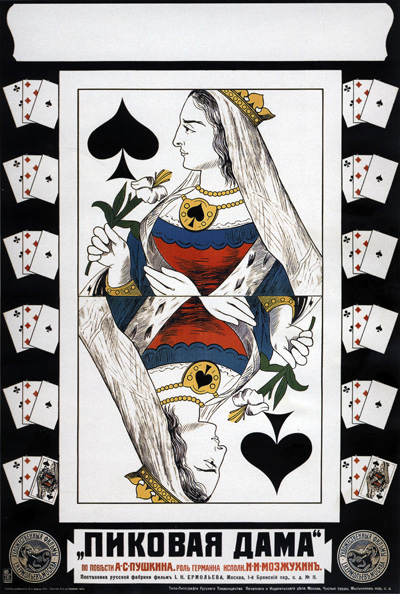
A definitive 6.6/10 rating for a film that redefined the boundaries of cult cinema. Queen of Spades remains a cornerstone of transgressive art.
Few silents shimmer with the sulfurous foreboding of Yakov Protazanov’s Queen of Spades (1916), a film that deals the viewer a hand of gothic chiaroscuro long before the term noir was minted. Adapted from Pushkin’s 1834 parable of avarice and predestination, the picture transposes the poet’s sardonic cadence into visual grammar: every iris-in feels like a tightened garrote, every subtitle card a whisper from the grave.
Set decorator Nikolai Suvorov transforms the Countess’s palace into a mausoleum of baroque detritus—faded tapestries dangle like flayed skin, and candelabra cast shadows that crawl up the walls like spiders made of night. The camera, manned by Konstantin Kuznetsov, glides through these corridors with predatory stealth; it is not merely recording space, it is stalking souls. When German first trespasses into Lizaveta’s boudoir, the frame halves his face with a mirror: one side luminescent with desire, the other swallowed by darkness—an omen of the moral bifurcation about to rupture him.
Ivan Mozzhukhin—the era’s supreme matinee idol—plays German not as a mustache-twirling cad but as a man whose spine is slowly petrified by obsession. Watch the micro-muscles around his cheekbones when Narumov utters the phrase three cards; the actor’s face becomes a battlefield where curiosity and terror skirmish for dominion. His descent is charted through increasingly rigid posture: shoulders square in early reels, then gradually hinged forward like a marionette whose strings are yanked by invisible creditors. By the climactic card table scene, his eyes have the glassy fixity of a man who has already gambled away his reflection.
Though devoid of synchronized dialogue, the film orchestrates an aural hallucination. During the first flashback to the Countess’s youth in pre-revolutionary Paris, the intertitles instruct orchestras to unleash a powdered-wig minuet; in Soviet screenings, live percussionists hammered out a heartbeat-like thump-thump each time the queen of spades surfaces, conditioning audiences to flinch at pasteboard royalty. Contemporary viewers relying on home-video silence still hear those phantom drums—such is the Pavlovian dread the imagery engineers.
Pushkin’s original parable indicts a society where aristocracy treats mathematics as parlor trickery; Protazanov amplifies that critique by juxtaposing German’s clockwork determinism with the Countess’s necromantic pragmatism. She treats probability like a lapdog; he worships it like a wolf. The film’s most subversive cut juxtaposes the engineer’s geometric blueprints fluttering in his garret with the crumbling parchment on which the Countess once scribbled her tri-card sequence—science and superstition, twin paper boats set adrift on the same black river.
Tamara Duvan imbues the ward with bruised luminosity. Notice how she peels an orange in medium close-up: each spiral of rind lands on the table like a dropped promise. Her seduction is framed through doorways—thresholds of escape forever slamming shut. She believes love can be bartered for sanctuary; German believes sanctuary is just another ante. Their tryst occurs off-screen, yet the aftermath—a single glove left on a chair—carries more erotic charge than most modern sex scenes precisely because the absence gnaws at us.
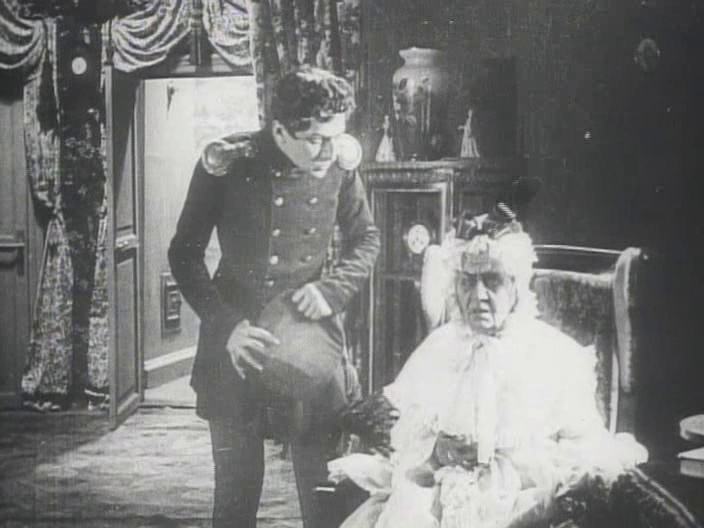
Actress Vera Orlova was only thirty-five when cast as the octogenarian cardsharp; under pounds of rice powder and india-rubber wrinkle appliances, she gives a masterclass in geriatric grotesquerie. In her death scene, the camera tilts upward, letting chandelier prisms cast rainbows across her face—like a fallen seraph receiving last rites from the spectrum itself. The moment German later violates her crypt, Protazanov superimposes her cadaverous grin over the gambler’s shoulder, a double-exposure rebuke that feels uncannily modern.
At 63 minutes, the narrative hurtles with bullet-train momentum, yet never sacrifices atmospheric respites. Note the 40-second silent tableau where snowflakes drift past a streetlamp while German paces below—time enough for the viewer to contemplate the flakes as metaphors for unique chances, each melting upon contact with skin. Then, without warning, the film smash-cuts to roulette wheels spinning like buzz saws, a rhythmic assault that leaves one gasping.
Though shot on orthochromatic stock, the picture achieves chromatic suggestion through tinting: candlelit interiors bathe in amber, gambling halls pulse in venous crimson, and the outdoor scenes flicker with cyanotype winter blues. When the queen of spades finally appears, the card is hand-painted an infernal vermilion on the negative itself—a visual shriek that sears the retina.
Compare the film’s treatment of hereditary sin with Beatrice Cenci or the commodification of femininity in A Prisoner in the Harem. Where The Gentleman from Indiana valorizes moral certitude, Queen of Spades delights in its corrosion. Meanwhile, the fatalistic love triangle anticipates the amour-fou tragedies of Amor Fatal, though Protazanov’s cynicism feels colder than Arctic marble.
The 2018 Mosfilm 2K restoration from a 35mm Czech print removes decades of chemical blemish while retaining the flicker of nitrate fever dream. The tinting scheme adheres to contemporary distribution notes discovered in the Hermitage archives. Home viewers can stream it on Lenfilm’s official YouTube channel with modernist piano score by
Modern algorithmic gambling apps deploy the same dopamine-feedback loops that German falls prey to; the only difference is pixels replace pasteboard. Protazanov intuited how capitalism metastasizes superstition into science and then back into superstition—a Möbius strip where data analytics becomes the new three-card monte. Watch the film today and you’ll sense the Countess whispering through your phone screen each time a push-notification promises to beat the odds.
Queen of Spades is not merely a cornerstone of Russian silent cinema; it is a prophetic treatise on the psychopathology of risk. Between Mozzhukhin’s ghost-trailed gaze and the Countess’s tarot-scarred grin lies a hall of mirrors where every viewer confronts their own hunger for the unbeatable system. Place your bet, spin the wheel, but remember: the queen is always the last to laugh, and she never blinks.
IMDb 6.8
1933
Community
Log in to comment.