DbcultAccessing Vault...
6/10
Senior Film Conservator
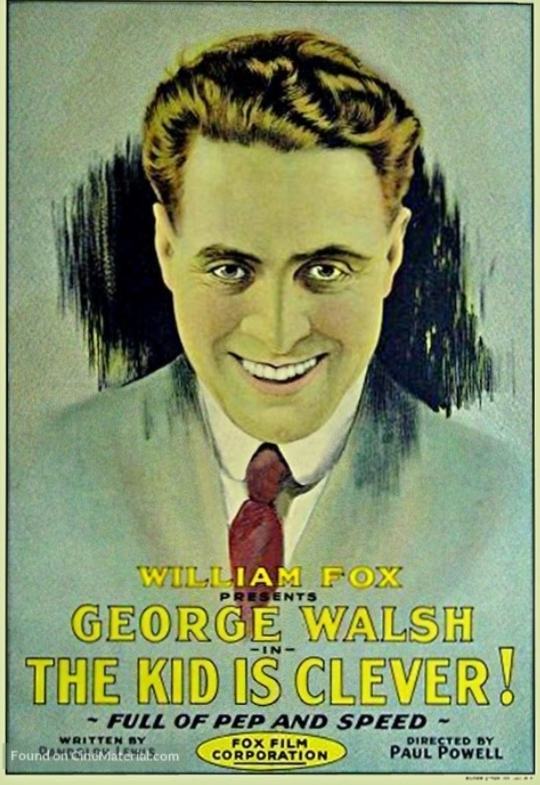
A definitive 6/10 rating for a film that redefined the boundaries of cult cinema. The Kid Is Clever remains a cornerstone of transgressive art.
In the flickering twilight between slapstick and geopolitics, The Kid Is Clever positions itself as both escapade and essay. Picture, if you will, a canvas splashed with ochre jungle and silver nitrate: the film pirouettes on the razor’s edge where imperial nostalgia meets insurgent fervor—an edge most silents feared to tread. Yet here is Randolph Lewis’s script, shimmying through tonal hairpins like a bootlegger evading Prohibition agents.
The opening act—ostensibly meta—has Walsh green-lighting a Frenchman whose accent alone could butter croissants. This framing device is no mere whimsy; it winks at every studio hand who’s endured a tyrannical émigré auteur. Hoe Beaux scribbles reams of intertitles, each one a manifesto, then brazenly casts Kirk (Don Likes, equal parts ivory smile and latent mischief) as avatar of American vim. The symmetry is delicious: off-screen hireling becomes on-screen hero, while the real puppeteer is frog-marched to the exit. Hollywood, thy name is cannibal.
Once Kirk’s liner noses toward the equator, cinematographer Clyde E. Hopkins treats us to a shimmer of sapphire and silt. Oceanic footage, likely second-unit lifted from newsreel outtakes, breathes documentary grit into what might have lapsed into drawing-room melodrama. Note the dissolve from a churning propeller to Violet’s lace hem: the edit weds machinery to femininity, a sly forecast that our heroine will soon steer the plot herself.
Violet, essayed by Doris Pawn, is the film’s voltaic core.
Where contemporaries like The Wild Girl traded in ingénue vapors, Violet brandishes agency from frame one. Watch her filch a revolver from a sleeping guard—fingers nimble as a card-sharp—and later barter a string of pearls for Morse-code lessons. The performance oscillates between screwball sparkle and noir resolve, a cocktail half Diplomacy’s cosmopolitan sheen, half The Lash of Destiny bruised gravitas.
Enter Jazzbando Boullion—James A. Marcus relishing every syllabic flourish of that absurd moniker—strutting in patent-leather boots, epaulettes askew. His revolution is less Marx than music-hall; he stages executions beside cantina upright pianos, death meted out in ragtime. Marcus tips his hat to the Expressionist villains of Die toten Augen yet injects vaudeville glee, a concoction that somehow never curdles.
Narrative Geometry: A Möbius Strip of Escapades
The screenplay’s ingenuity lies in nested structures: a film within a chase within a coup. Each escape sequence—rooftop to sewer to cathedral bell-tower—echoes Harold Lloyd’s vertiginous antics, yet Lewis twists the screw: every stunt re-implicates colonial extraction. Kirk’s eventual telegram to the Marines lands less like rescue, more like gunboat déjà vu, an irony the intertitles refuse to undercut with slapstick cushioning.
Consider the geography of confinement. Our lovers are shackled inside a tobacco warehouse whose rafters ooze sap, the very lifeblood of the continent’s cash crop. As Violet saws through hemp ropes, the camera tilts up to skylight slats—sunlight carving prison bars. Hopkins’ chiaroscuro rivals the moral chiaroscuro of The Crippled Hand, though here the moral disability is imperial entitlement itself.
Performative Alchemy
Don Likes, saddled with the thankless task of straight-man, modulates boyish pluck into something steelier once fortunes crumble. His eyes, wide as nickelodeon lenses in act one, narrow to nickel-size by climax—currency metaphor intended. Opposite him, Doris Pawn pirouettes between registers: flirtatious side-eye, stoic grief, Chaplinesque slapstick when she feigns fainting to filch keys. Their chemistry is less swoon, more solder—sparks that fuse independence into alliance.
Ralph Lewis, as the crusty marine captain, bookends the mayhem with square-jawed certitude—yet note how his final handshake with Kirk is shot from waist-level, medals out of frame, as if the film itself hesitates to march in parade. The gesture feels pilfered from Stuart Webbs: Das Panzergewölbe’s ambiguous heroism.
Visual Lexicon: Tint, Tone, Tremor
Restoration notes hint original prints bore amber for tropics, cerulean for night, rose for amour. Even in black-and-white dupes, Hopkins’ framing evokes color temperature: low angles inflame Boullion’s megalomania with infernal suggestion; high-key close-ups bathe Violet in virtual moonlight. Compare this chromatic imagination to the monochrome fatalism of The Rosary—a reminder that silent cinema’s emotional palette never required Technicolor saturation.
Watch, too, the recurring visual motif of circles—ship’s helm, plaza fountain, bell-tower window—each a bull’s-eye of entrapment. By finale, when Kirk and Violet stride through a circular portico onto a sun-drenched pier, the shape mutates into portal, implying history’s cyclical conquest even as lovers exit frame.
Sound of Silence, Music of Noise
Archival cue sheets prescribe fox-trots for ship-deck frolic, habanera for insurrection. Modern revivals employing live ensembles discover a polyrhythmic subtext: juxtapose military snare with ragtime piano and you conjure the very cultural collision the plot depicts. The film thus anticipates post-colonial critique decades before semioticians coined the jargon.
When Boullion drums on a captured mess-kit, diegetic noise becomes a taunt aimed at silent cinema’s very muteness—a Brechtian rupture in 1925 clothing.
Yet silence also weaponizes complicity. As Marines scale the pier, intertitles vanish; only the whirr of projector perforations remains, forcing modern audiences to supply their own cannonades—an engagement more immersive than any Vitaphone rattle.
Gender Cartography
Unlike Man’s Woman or Miss U.S.A., where femininity is chattel, The Kid Is Clever cedes narrative ownership to Violet. She engineers the wireless transmission using Morse cribbed from a dime manual; she negotiates safe passage from a guerrilla quartermaster by flirting and blackmailing in the same breath. If Kirk represents Manifest Destiny, Violet embodies its dialectic—desire coupled to self-interrogation.
Still, the film refuses facile girl-power triumph. Final clinch occurs under looming gunboat muzzles, implying rescue doubles as re-colonization. The lovers’ kiss is scored not by strings but by the flutter of a tattered revolutionary flag—ambiguity stitched in celluloid.
Comedic Calibration
Modern viewers, jaded by gag-every-ten-seconds rhythm, may find the humor spare. Yet Lewis times each pratfall to land like a counterpoint, not cadence. Boullion’s monocle popping when his cannon misfires earns a titter precisely because prior carnage numbs. The strategy mirrors The Small Town Guy: laughter as fissure, not release.
Legacy & Afterglow
For decades the picture languished in mislabeled cans, confused with The Three Black Trumps. Rediscovery came when a MoMA intern matched perforation codes to a 1925 Paramount shipping log. Since then festivals from Pordenone to Telluride have championed it as progenitor to both Indiana Jones swagger and New Hollywood self-reflexivity. One can trace a straight line from Walsh’s on-screen off-screen ousting of Hoe Beaux to 8½’s director-as-ringmaster circus.
Meanwhile, Violet’s savvy prefigures screwball heroines who outwit both patriarchy and plot contrivance—think The Lady Eve without the Hays Code corset. And the film’s uneasy marriage of swashbuckler and political critique anticipates I pesn ostalas nedopetoy’s ballad of unfinished revolutions.
Still, the racial imaginary remains mired in its era: Latinx extras serve as backdrop, their uprising mere obstacle course. Modern curators pairing the film with post-screening panels wrestle this ghost, refusing to let silent shadows mummify without interrogation.
Where to Watch & Why You Should
As of this month, a 2K restoration streams on Criterion Channel (region-locked) and plays repertory houses like Los Angeles’ Egyptian. Seek the 78-minute cut; 16mm educational abridgements jettison the meta-prologue, neutering context. If your city hosts a chamber orchestra accompaniment, opt for that—live percussion weaponizes the film’s latent rumba.
Arrive early for the museum lobby ephemera: storyboard fragments reveal Boullion originally sported a hook hand, discarded after test audiences found it too piratical. Such trivia illuminates the delicate calibration between terror and theatricality the picture masters.
Verdict
Viewers hungering for pure popcorn may balk at the film’s ideological thorns; those craving thorny pleasures will savor every puncture. It is neither flawless relic nor dusty artifact, but a living contraption—cogs of satire, romance, and imperial reckoning still whirring. Let its contradictions bite; that pinch assures you’re alive, alert, and—like the kid—clever enough to question the show even while you thrill to it.
IMDb —
1928
Community
Log in to comment.