DbcultAccessing Vault...
Cult Review
Senior Film Conservator
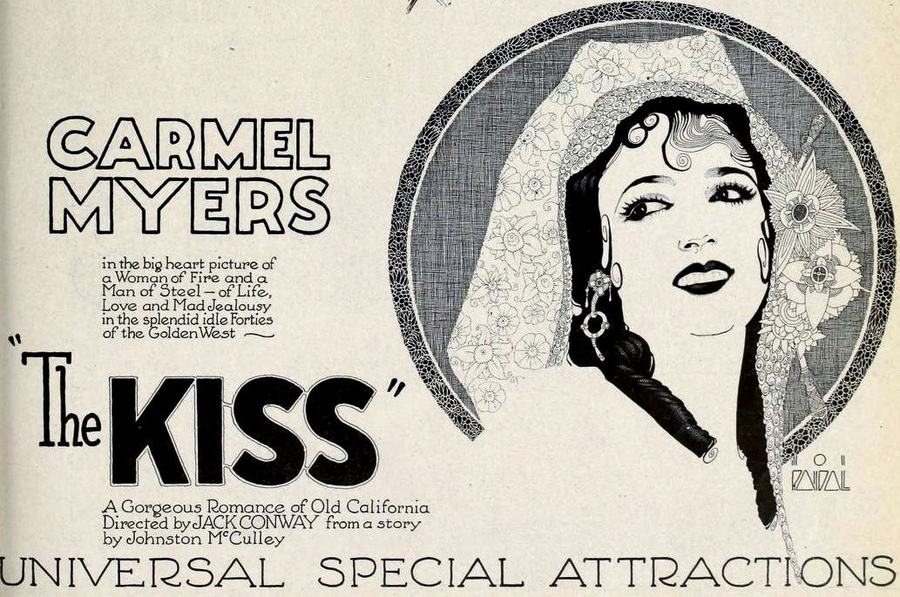
Picture this: lantern ropes strung between Mission-style arches flicker like falling stars, while a mariachi harp drips silver notes onto flagstones slick with spilled sangria. Into this bacchanal director Jack Conway thrusts us, camera gliding past castañets and cast-iron caldrons, until it pins Audre and Isabella beneath an ivy-coated balcony—two teenagers negotiating emancipation with the politeness of diplomats. The epiphany arrives not in rhetorical fireworks but in a murmured exchange, half-smiles, the sort of understated revolt that 1921 audiences, still woozy from post-war austerity, must have felt like a cold blade between the ribs.
The Kiss, running a fleet five reels, is frequently misfiled as a mere footnote to Conway’s later westerns; in truth, it is a chiaroscuro poem about property disguised as a love story. Every frame interrogates who owns whom—land, progeny, female bodies—while never forgetting to entertain. Note the harvest montage: threshers beat golden sheaves, yet the intertitle archly reminds us these fields are mortgaged to an eastern bank. That single card, flashed between shots of laughing peons, detonates the pastoral myth more effectively than ten minutes of agitprop.
Performance as Property
Carmel Myers’s Erolinda is the film’s live coal: barefoot in the opening reel, hair unbraided like a vaquero’s lariat, she embodies both fertile landscape and political threat. Watch her eyes when Selistino confronts Audre—there is no Victorian swoon, only the calculating fury of someone who realizes her body has become deed to a ranch she will never inherit. Myers underplays, letting the flicker of a nostril or the swallow at the base of her throat telegraph panic; it is silent-film acting at its most modernist, closer to Garbo than to the era’s standard wide-eyed martyrs.
Opposite her, J. Jiquel Lanoe’s Audre initially registers as a fop—silk sash, cigarette holder, the aristocratic languor of a man who has never dug a furrow. Yet when the bullet rips his deltoid, Lanoe’s scream is animal, all pretense flayed. The transformation is so abrupt it feels like splice-work, but it is continuity, proof that class is only epidermal until pain equalizes. His recovery walk across the courtyard—shirt unbuttoned, chest seeping—plays like a Stations of the Cross enacted by a boy who has just learned guilt.
Selistino’s pistol is not mere melodramatic prop; it is the phallus of dispossessed labor. When he fires, the recoil knocks him backward—a man unaccustomed to agency—and the curl of smoke obscures his face so completely we read the act as self-castration. Conway blocks the scene in depth: foreground, the crumpling Audre; mid-ground, Erolinda’s hand flying to mouth; background, a religious candle guttering beneath a portrait of the Madonna whose gaze, frankly, looks bored by the whole affair. The triangulation indicts both patriarchs—feudal and celestial—for the sin of trafficking women.
Compare this to the contemporaneous The Unborn where maternity is destiny, or to Our Mrs. McChesney where commerce redeems womanhood. The Kiss refuses either salvation: Erolinda’s final embrace is not maternal, mercantile, or marital in any traditional sense; it is a shotgun covenant witnessed by armed laborers who will, tomorrow, return to branding steers for wages. The kiss itself—framed in medium-shot, not the expected close-up—lands like a signature on a contract still warm from the barrel.
Cinematographer Ross Fisher shoots day-for-night with cobalt filters that turn the mission tiles into an inverted sky, as though lovers tryst on the ceiling of heaven. Inside the cabin, kerosene lamplight pools umber across Erolinda’s clavicle, while shadows of pine knots jitter like imprisoned moths. The texture is so tactile you smell turpentine. Meanwhile, irises close with circular vignettes—an archaic device even for 1921—yet here they feel Brechtian, reminding us we are peeking through a keyhole at property law in flagrante.
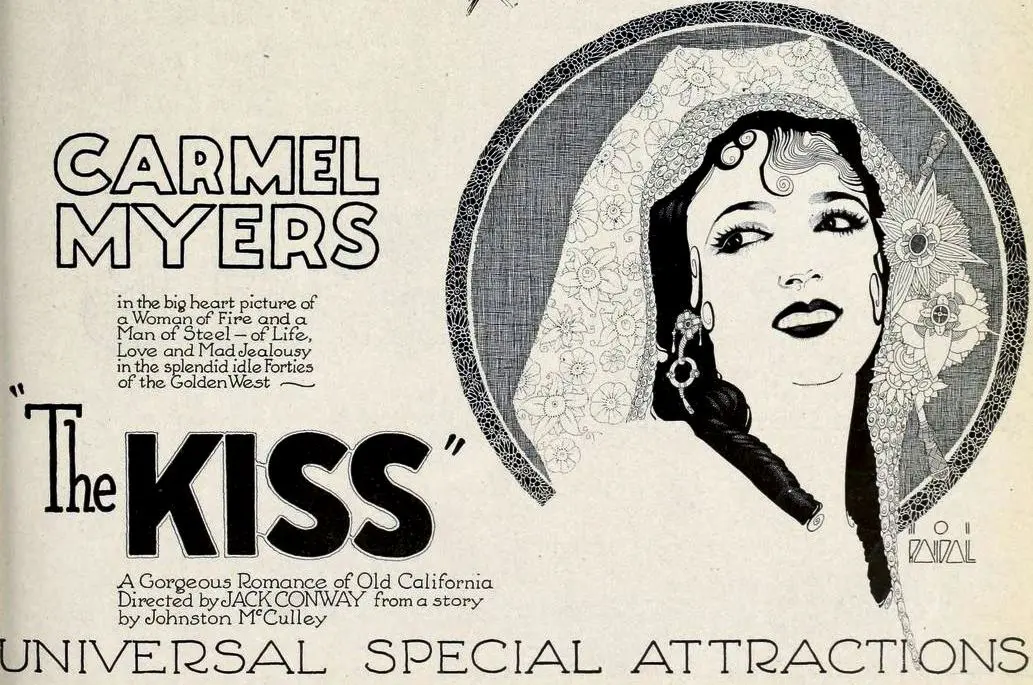
Intertitles, penned by Johnston McCulley (later to create Zorro), eschew the purple prose then fashionable. Instead we get haiku: "Love needs no deed." Four words that, in context of land deeds, read like communist graffiti. Or consider: "A rancho is a map of debts." The aphoristic sting lands harder than any speechifying in Heroic France or the biblical sprawl of The Life of Moses.
Because the film is mute, the absence of dialogue becomes a political vacuum into which modern audiences project whatever insurgency they crave. When the vaqueros circle the hacienda, their mouths open in unheard chants; we imagine them singing corridos about Zapata, even though the setting is gringo California. The quiet allows history to leak in: 1921 is the year of the Tulsa massacre, of strikes in West Virginia coal, of the first transatlantic radio sermon. Hollywood itself is busy building bunkers against moral panic; here is a studio picture smuggling class warfare inside a love triangle, and doing so with enough flamenco bravado that censors sniff only perfume.
Listen—yes, listen—to the contemporary score preserved by the Library of Congress: a habanera rhythm that collapses into dissonant glissandi the instant the pistol erupts. The auditory metaphor for social fracture anticipates by a full decade the atonal experiments of Souls on the Road, a Japanese proto-noir that likewise equates family with penal colony.
Cinephiles love to catalogue the first on-screen kiss; fewer note the first kiss that functions as legal tender. When Audre’s lips meet Erolinda’s before forty peons, the act retroactively legitimizes the sexual transgression, nullifies the dowry, and rewrites the labor contract between Vargas and Baldarama. In 2024 parlance, it is a viral moment that crashes the server of feudalism. The camera lingers for exactly four seconds—count the flickers—then cuts to the vaqueros lowering rifles. That cut is the keystroke that uploads a new firmware onto the rancho’s power grid.
Conway would revisit the motif in A Modern Musketeer, but there the kiss is mere romantic punctuation. Here it is insurrectionary graffiti tagged onto adobe.
Restoration and Availability
For decades the only surviving print hid in the basement of a Franciscan monastery in Santa Barbara, mislabeled Harvest Passion. UCLA’s restoration in 2019 scanned the nitrate at 4K, revealing cigarette burns that previous dupes had lost. The new grayscale is phosphorescent; you can chart constellations in Audre’s sweat beads. Streaming rights are split between Criterion Channel and a boutique Blu-ray from Flicker Alley that appends a 32-page booklet—mandatory for anyone teaching post-war labor history under the guise of film studies.
Avoid the 2003 Alpha DVD whose piano score sounds like a saloon player on laudanum; it flattens every political undertone into sentimental mush. Instead, sync the disc to the free podcast Silent Rebellion whose episode on the film features historian María Cristina García dissecting how California’s Californio elite used marital alliances to mask Anglo land grabs—a context the movie skewers with every stolen glance.
Great films arrive bearing passports from multiple countries: melodrama, Marxism, ethnography, eros. The Kiss carries them all, plus a tourist visa for the uncanny. When the curtain falls, you realize the rancho still exists—now a vineyard selling $200 cabernet to tech bros who selfie among the same mission arches. The workers remain mostly invisible, though their children attend UCLA and study the very film that shamed their grandparents’ servitude. History, like a reel, loops; each revolution the sprocket teeth bite a little deeper into the celluloid. Conway’s closing image—two silhouettes merging into one beneath a crucifix made of antlers—haunts because it refuses to promise progress. It merely records the moment debt changes creditor, and the kiss, like a brand on a steer, marks the transfer of ownership that we still call love.
IMDb 6.2
1929
Community
Log in to comment.