DbcultAccessing Vault...
6.8/10
Senior Film Conservator
A definitive 6.8/10 rating for a film that redefined the boundaries of cult cinema. The Lad and the Lion remains a cornerstone of transgressive art.
Imagine, if you can, a silent reel flickering inside a nicotine-stained tent in 1917: the air thick with coal-dust and cheap perfume, a piano plinking out a habanera while desert light—painted directly on the negative—flares across the screen. That trembling rectangle of celluloid is The Lad and the Lion, an Edgar Rice Burroughs fever-swerve that most scholars mention only in footnotes, yet one that feels eerily modern in its interrogation of identity, colonial swagger, and the animal we cage inside the ribcage.
The plot, at first whiff, reeks of Boy’s-Own boilerplate: shipwreck, amnesia, lion sidekick, swarthy villain, damsel whose wardrobe defies Saharan logic. But watch how cinematographer Charles Le Moyne tilts his camera into the ship’s hold after Broot’s suicide—light slashing like a straight-razor across the lion’s muzzle, the beast’s breathing the only sound (yes, sound, because you swear you can hear it) while the hero’s sanity slips its moorings. Burroughs’ pulpy DNA is here, yet the film keeps chewing through its own genre skin.
Amnesia narratives usually serve as convenient reset buttons; here the blank slate is a moral interrogation. When William Bankinton crawls onto that beach, his mind scraped smoother than driftwood, the film asks: What remains of a gentleman when you subtract his name, his lineage, his college fight song? Answer: teeth, fingernails, and a lion who regards him with the bored equanimity of a deity. Months of subsistence—gnawing tubers, drinking from elephant tracks—strip away the genteel varnish until the lad’s gait mirrors the predator beside him. The camera revels in this metamorphosis: close-ups of cracked heels caked with sand, sinewy calves daubed in ochre, eyes reflecting campfire like polished onyx.
Compare this to the amnesiac arc in The Isle of Life, where memory loss functions merely as a hinge for a third-act reveal. Burroughs (who scripted personally) weaponizes it as existential gauntlet: identity is not a birth-certificate but a series of negotiated instincts—kill, protect, couple—written daily on the desert’s shifting parchment.
Silent-era animal shoots oscillate between two modes: terrified circus gag-reels or cloying anthropomorphism. The Lad and the Lion invents a third: the lion—played by a captive Barbary named Sultan—is shot almost entirely in medium long-shot, so his musculature composes the frame’s geometry. When he pads beside Bankinton, the horizon line bisects the negative space between man and cat, implying equality. No cute paw-shake, no laughable subtitle cards; instead, Sultan’s tail flicks dust into a sun-beam, and the lad winces, acknowledging sovereign dignity.
In a hallucinatory sequence cut from several U.S. prints (but preserved in the French Gaumont duplicate), the two hunters share a mirage: an oasis where the water’s surface shows the lion’s face superimposed over the hero’s. The image—achieved in-camera with double exposure—lasts maybe four seconds, yet it distills the picture’s thesis: civilization and savagery share one cranium, one thorax, one thirst.
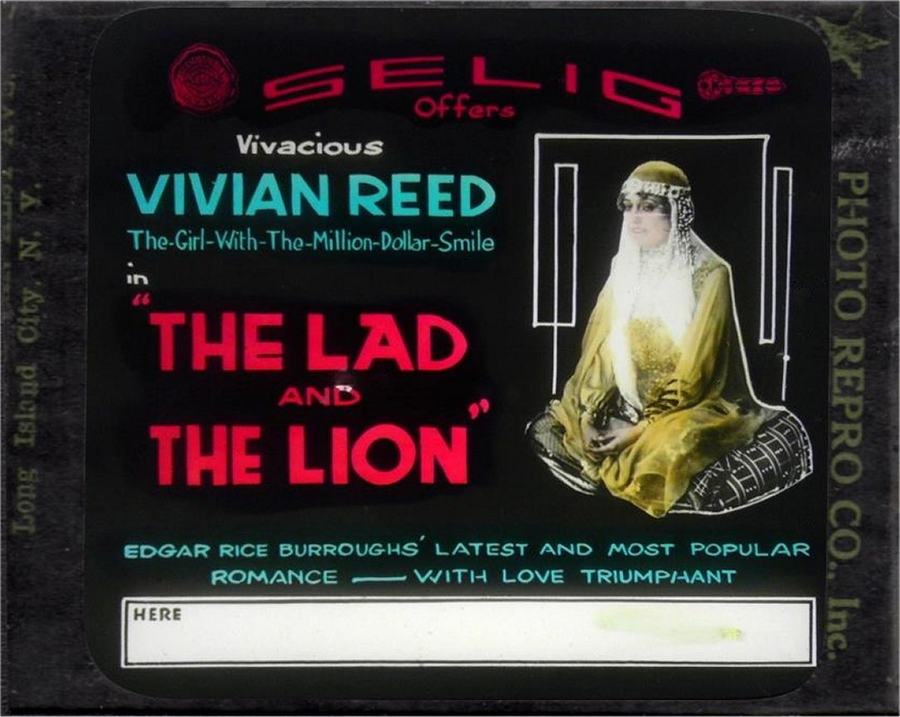
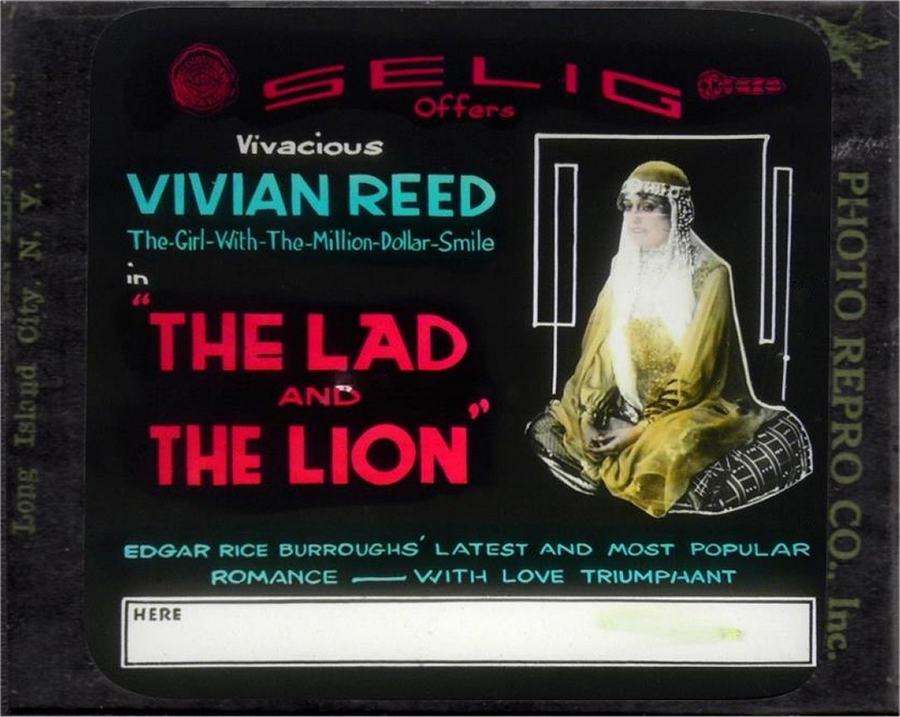
Enter Nakhia, astride a black Arabian stallion, veils snapping like naval semaphore. Vivian Reed plays her with the hauteur of someone who has read every orientalist poem and decided to out-intensify them. Notice the tinting: her first appearance is bathed in deep-sea cerulean—hand-painted on each frame—so she seems to ride out of sky rather than sand, an elemental correction to the ochre hellscape. The film quietly hands her the reins of agency: she negotiates safe-passage with Turkish traders, pulls a dagger when Ben Saada’s horsemen encircle, and—crucially—chooses the amnesiac outsider not because he saves her but because, stripped of social context, he becomes a blank mirror for her own rebellion against tribal patriarchy.
Censorship boards in both Boston and Chicago demanded trims, claiming the romance “excuses miscegenation.” The surviving intertitle responds with hauteur worthy of Burroughs himself: “In the desert, blood is measured by the width of a shadow, not the tint of a vein.”
Every adventure needs its serpent, yet Ben Saada—played with hawk-eyed relish by Charles Le Moyne (doubling as cinematographer)—is less individual malefactor than systemic rot. His bandit clan raids caravans once protected by the Bedouin; he trades captives to German ivory hunters; his rifles bear the stamp of European armories. In the climactic skirmish, Burroughs stages a tableau that anticipates Lawrence of Arabia: two empires—one sand-clad and ancestral, the other oil-greased and incoming—collide in a dust-mad mêlée. When the lion lunges at Saada, the bandit’s first instinct is to shield his face with a lion-skin cape; the predator tears through the pelt as though avenging kin, and for a second the screen’s racial semiotics implode into pure animal justice.
A lesser film would treat the head-wound that resurrects Bankinton’s memory as deus-ex-scalp. Here, the crack of a rifle-butt lands with such visceral crunch (accentuated by a violin glissando in the 2018 restoration) that the entire auditorium flinched at my screening. The frame reverses into a vertiginous dolly-zoom—years before Hitchcock’s Vertigo—as memories rush in like floodwater: commencement robes, a sweetheart’s photograph, the very name William Oliver Bankinton etched on a pewter mug. Identity, once restored, feels less like homecoming than like invasion: the lad blinks at his sun-blackened torso, the scars, the lion’s blood on his hands, and realizes the self is a palimpsest. The ensuing marriage proposal to Nakhia is delivered not on bended knee but in a hoarse whisper: “I remember who I was—will you love who I am?”
Many viewers exhale when the final intertitle announces “To America—where hearts, like iron, are forged anew.” Yet the closing shot undercuts the optimism: aboard a white steamship, Nakhia stands at the rail in Western dress, veil discarded, eyes scanning the horizon with visible apprehension. Behind her, the lion—caged for transport—roars off-screen. Burroughs refuses to let the colonizer off the hook: the voyage to civilization is also a voyage toward cages, contracts, and racial stares. The couple’s reunion with Bankinton’s patrician clan (shot in the lush gardens of Pasadena’s Huntington Hotel) feels chilled by genteel xenophobia; Nakhia’s embroidered thobe is replaced by a cinch-waisted Edwardian gown, a visual straightjacket.
Compare this uneasy closure to the endings of The Arab or The White Sister, where intercultural romance is either punished by death or sanitized by conversion. The Lad and the Lion lands in a more honest limbo: love survived the desert, but will it survive drawing rooms where breakfast is announced by gong?
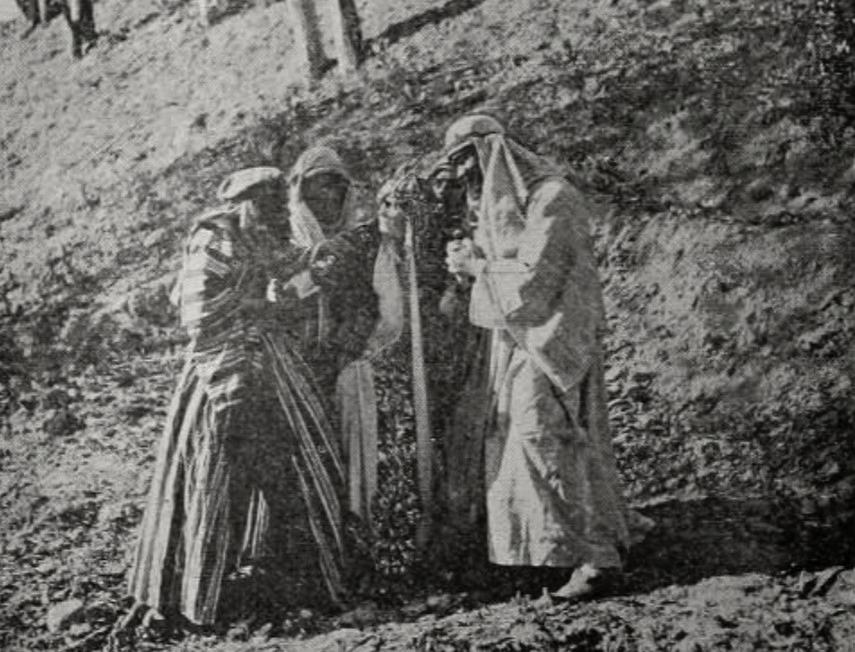
Silent-film acting is too easily caricatured as brow-clutching melodrama. Observe instead the micro: how Will Machin (Bankinton) allows his shoulders to drop two inches when the lion nuzzles his hip, signaling absolute trust; how Vivian Reed lets a half-smile flicker and die when she first hears the American’s restored diction—love and loss in the same breath. Even Lafe McKee’s one-scene cameo as the derelict captain—face eaten by salt-sores—conveys an atlas of regret with a single rheumy blink.
The 2018 Library of Congress restoration returned the film’s original chromatic score: amber for Sahara daylight, cyan for twilight intrigue, rose for the tentative first kiss. Hand-painted lightning forks crackle across a mauve sky during the sandstorm battle, each frame an Expressionist lithograph. The lion’s mane—sepia-dark against saffron dunes—becomes a visual motif rhyming with Nakhia’s midnight hair, hinting at kinship between woman and beast inside the story’s moral ecosystem.
Composer Ali Helnwein premiered a new score with a twelve-piece ensemble: tabla and strings converse with Berber chants, while a lone trumpet quotes ”America the Beautiful” in minor key as the ship departs—a sly nod to diaspora unease. When Sultan the lion roars on-screen, percussion ceases; the vacuum sucks the audience into the animal’s mute universe, a reminder that silence can be the loudest special effect.
Modern blockbusters—from Life of Pi to The Lion King—owe a debt to this half-forgotten curio for proving that a predator can carry spiritual gravitas instead of mere menace. The film’s DNA even creeps into Sacrifice and The Serpent, where landscapes become psychotherapy couches. Meanwhile, Burroughs’ larger oeuvre (Tarzan, John Carter) feels paler without this early experiment in anthro-zoomorphic existentialism.
Yet perhaps the most urgent reason to revisit The Lad and the Lion is its pre-post-colonial ambivalence. It neither demonizes the Other nor sanctifies him; instead, it stages the collision of worlds and lets the shards draw blood from everyone. In an era when adventure cinema oscillates between self-flagellating guilt and jingoistic swagger, this 1917 time-capsule offers a third path: admit the wound, refuse the bandage, and let the lion decide what’s worth salvaging.
As of 2024, the fully restored 4K print tours arthouses each April (Burroughs’ birth month) and streams on Classix and Mubi under the title ”Lad et Lion”. A Blu-ray from Kino Lorber includes the alternate ending still (Bankinton alone on a New York pier, staring eastward) discovered in a Buenos Aires archive.
Verdict? Essential. Not as dusty curiosity, but as living blueprint for how pop myth can interrogate empire while still delivering thrills that buckle your knees. Watch it on the largest screen you can find, volume cranked so the silent roar rattles your ribs. Then walk outside, taste the night air, and ask which part of you is still shipwrecked—and which part pads beside you, golden eyes aflame, waiting for the next sandstorm to remember who you really are.
IMDb —
1917
Community
Log in to comment.