DbcultAccessing Vault...
Cult Review
Senior Film Conservator
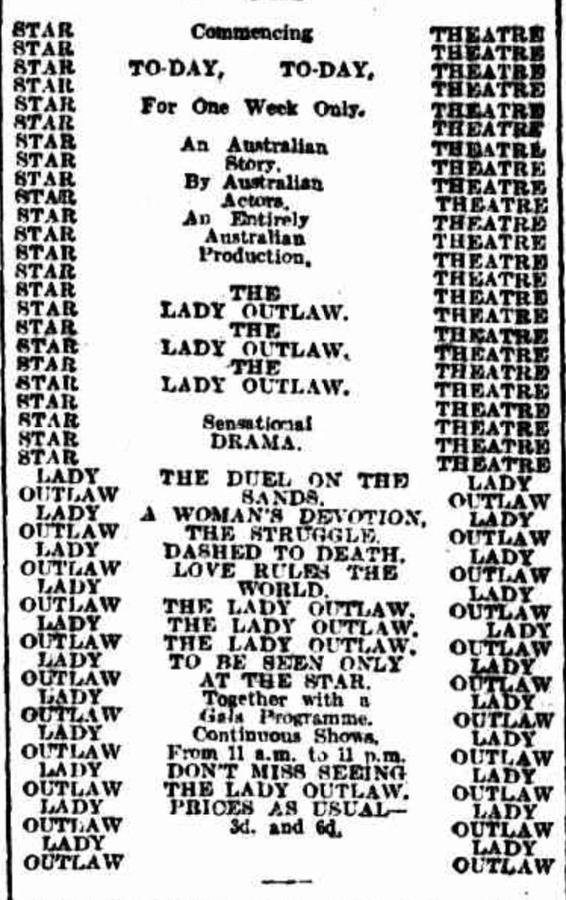
The year 1911 stands as a monumental juncture in the annals of antipodean cinema, a period when the burgeoning Australian film industry was grappling with its own identity through the lens of the 'bushranger' genre. Among these flickering relics, The Lady Outlaw emerges as a fascinating, albeit frequently overlooked, specimen of early narrative ambition. While much of the global cinematic output of the time was preoccupied with religious hagiography—such as The Life of Moses—or literary adaptations like the haunting Dante's Inferno, the Australian screen was busy carving out a rugged, secular mythology rooted in the grit and dust of the outback.
The cinematic fascination with the outlaw didn't begin here, of course. One cannot discuss this film without acknowledging the seismic impact of The Story of the Kelly Gang, which effectively birthed the feature-length narrative. However, The Lady Outlaw pivots away from the hyper-masculine bravado of Ned Kelly to present a far more subversive figure: the female bushranger. In an era where the suffragette movement was gaining momentum, seeing a woman on screen wielding a revolver and outmaneuvering the constabulary was nothing short of revolutionary. It offered a stark contrast to the more traditional depictions found in works like The Bushranger's Bride, where the female presence was often relegated to the role of a romantic catalyst or a victim in need of rescue.
Charles Villiers, a name synonymous with the theatrical vigor of early Australian stage and screen, brings a grounded gravitas to the production. His performance serves as a vital anchor, preventing the film from drifting into the realm of mere pantomime. In the early 1910s, acting for the camera was still an evolving craft, often burdened by the exaggerated gestures of the Victorian stage. Yet, in this film, there is a burgeoning sense of naturalism, particularly in the way Villiers interacts with the environment. The rugged terrain is not just a backdrop; it is a collaborator. The dust seems to cling to the actors with an authenticity that transcends the primitive technical apparatus of the time.
Technically, The Lady Outlaw is a masterclass in utilizing limited resources to achieve maximum atmospheric effect. The cinematography captures the harsh, high-noon light of the Australian bush with a starkness that feels almost modern. Unlike the controlled environments of European studios, the Australian filmmakers had to contend with an unpredictable sun that created deep, obsidian shadows and bleached-out horizons. This aesthetic of 'harsh reality' distinguishes it from the more polished, 'staged' look of contemporary documentaries like Birmingham or the early sporting records like The Corbett-Fitzsimmons Fight. There is a sense of movement and 'on-the-fly' composition that lends the action sequences a visceral, urgent quality.
The Lady Outlaw doesn't just depict a crime; it depicts a rebellion against the very fabric of colonial expectation, using the vastness of the Australian landscape to mirror the internal liberation of its protagonist.
Consider the staging of the robberies. There is a rhythmic pacing to these scenes that suggests an early understanding of narrative tension. While it lacks the sophisticated editing of later decades, the sheer physicality of the horse-riding and the choreography of the standoffs are impressive. It shares a certain DNA with other 'outlaw' biopics of the time, such as Dan Morgan or Captain Starlight, or Gentleman of the Road, yet it stands apart by virtue of its gender-bending lead. The film asks the audience to sympathize with a character who has consciously stepped outside the law, a theme that would eventually lead to the banning of bushranger films by the New South Wales police in 1912, fearing they would incite public disorder.
To watch The Lady Outlaw today is to witness a society in flux. Australia was a young nation, still defining its moral compass. The bushranger was a complicated symbol—part hero, part villain, part social martyr. By placing a woman in this role, the film explores the intersection of class and gender in a way that feels surprisingly contemporary. The protagonist’s descent into outlawry is framed not as a moral failing, but as a response to an environment that offers her no other path to autonomy. This narrative depth is a significant step up from the simpler morality plays of the era, such as Robbery Under Arms.
The film’s pacing is surprisingly brisk, avoiding the lethargic staginess that often plagued early silent features. There is a kinetic energy to the chase sequences that rivals the early 'scenic' films like At Break-Neck Speed. The director utilizes the depth of field effectively, often placing the 'Lady Outlaw' in the foreground while her pursuers appear as mere specks on the distant ridge, emphasizing her isolation and the sheer scale of the wilderness she must conquer. This visual metaphor of the individual against the infinite is a recurring trope in Australian art, and its early manifestation here is particularly potent.
Returning to Charles Villiers, his role in the film cannot be overstated. While the lead actress (whose name is often lost to the vagaries of time in these early credits) provides the emotional heart, Villiers provides the professional scaffolding. His ability to convey complex motivations through a single look or a shift in posture is remarkable. In a scene where he confronts the outlaw, the tension is palpable. There is no need for dialogue cards to explain the mutual respect—and the inevitable tragedy—that exists between the hunter and the hunted. This level of psychological nuance was rare in 1911, making the film a pioneer in the development of cinematic character studies.
It is also worth noting the film's place in the global landscape of 1911. While Europe was producing grand historical epics like Jane Eyre or the early versions of Hamlet, the Australian industry was focused on a more immediate, visceral form of storytelling. There is a raw, unpretentious quality to The Lady Outlaw that makes it feel more 'alive' than many of its more prestigious international contemporaries. It doesn't hide behind elaborate costumes or theatrical sets; it relies on the honesty of the sunlight and the dirt.
The tragedy of The Lady Outlaw, like so much of our early cinematic heritage, is its fragmentary nature. Much of the original nitrate has succumbed to the ravages of time, leaving us with only glimpses of its former glory. Yet, even in these fragments, the film’s power is evident. It serves as a vital link in the evolution of the Australian 'Strong Woman' archetype, a lineage that stretches from these early bushrangers to the modern heroines of Mad Max. It challenged the status quo, not through didactic lecturing, but through the sheer force of its narrative conviction.
In conclusion, The Lady Outlaw is more than just a historical curiosity. It is a bold, defiant piece of filmmaking that deserves to be celebrated for its technical ingenuity and its progressive thematic core. It captures a moment in time when the screen was a frontier of its own—a place where new myths could be forged and old rules could be broken. For any serious student of cinema, or anyone who simply appreciates a well-told tale of rebellion, this film is an essential piece of the puzzle. It reminds us that even in the earliest days of the medium, filmmakers were pushing boundaries, asking difficult questions, and finding beauty in the most rugged of places. The Lady Outlaw remains a ghost in the machine, a flickering reminder of a woman who chose the gun over the gown and the bush over the parlor, forever etched into the celluloid soul of Australia.
Final Verdict: An essential, grit-infused relic that proves early Australian cinema was decades ahead of its time in terms of gender dynamics and environmental storytelling. A masterclass in frontier minimalism.
IMDb 6.1
1932
Community
Log in to comment.