DbcultAccessing Vault...
Cult Review
Senior Film Conservator
T
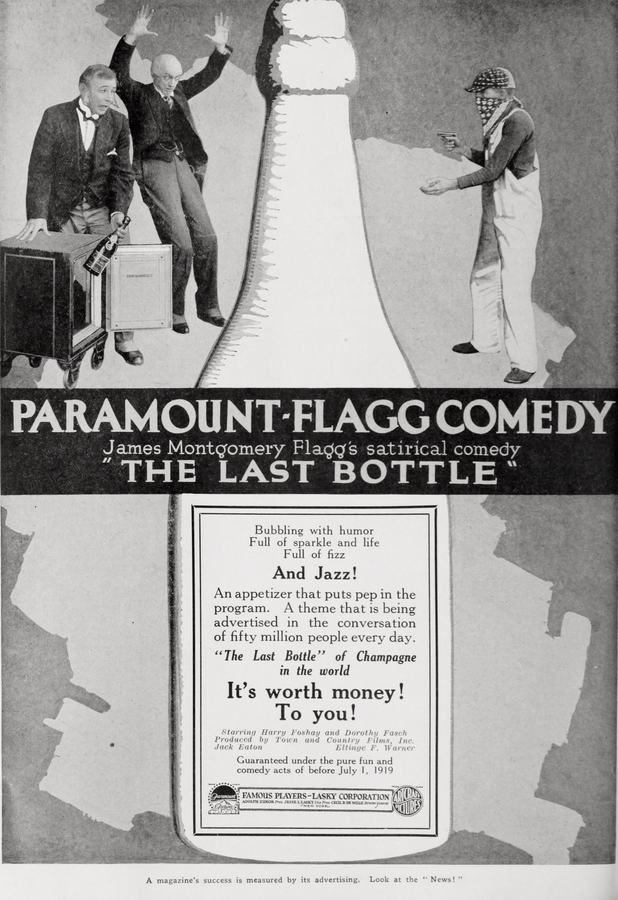
here is a peculiar, almost haunting irony in viewing a film from 1923 that purports to be set in a 'future' 1923. James Montgomery Flagg, a man whose name is synonymous with the iconic visage of Uncle Sam, pivots from wartime recruitment to a far more bubbly form of propaganda in The Last Bottle. This film is a fascinating artifact, a comedic time capsule that captures the collective anxiety of a world teetering on the edge of the Volstead Act's shadow. While many films of the era dealt with the moral decay of the 'Jazz Age,' Flagg takes a detour into the absurd, imagining a global drought so severe that a single bottle of champagne becomes the most coveted treasure on Earth.
The narrative center of this whirlwind is Harold Foshay, an actor whose physical vocabulary is perfectly suited for the frantic energy of the early twenties. Foshay plays a man possessed, a vestige of the old world who refuses to let the light of the vineyard go out. His performance is a masterclass in silent desperation; every twitch of his mustache and every widen of his eyes communicates a profound terror of a world without effervescence. Beside him, Dorothy Fasch brings a sense of grounded charm, acting as both a foil and a co-conspirator in this bacchanalian heist. Unlike the heavy melodrama found in contemporary works like El beso de la muerte, Flagg’s work here is light, airy, and intentionally superficial, yet it carries a weight of social commentary that is impossible to ignore.
What makes The Last Bottle stand out in the crowded field of 1920s cinema is its commitment to its central conceit. The world Flagg builds is one where the law has successfully scrubbed the planet of its 'spirits,' leaving behind a sterile, humorless void. This isn't the gritty underworld of bootlegging we see in later talkies; it is a cartoonish dystopia where the protagonist’s struggle feels almost mythological. The quest for the bottle is treated with the same reverence one might expect in a search for the Holy Grail, albeit with more pratfalls. This elevated stakes approach creates a tension that is both hilarious and strangely poignant.
When we look at the thematic landscape of international cinema from the same period, we see a recurring obsession with the struggle for existence. In the Hungarian film Küzdelem a Létért, the struggle is literal and often tragic. Flagg, however, chooses to frame the 'struggle for life' through the lens of luxury. To his protagonist, life without the finer things isn't life at all. It’s a fascinatingly elitist, yet relatable, perspective that mocks the austerity of the era. The film suggests that human nature cannot be legislated out of existence; our desires will simply find more frantic outlets.
James Montgomery Flagg was an illustrator first, and that sensibility bleeds through every frame of The Last Bottle. The compositions are often framed like living posters, with a clear focus on the protagonist’s silhouette and the central MacGuffin—the bottle itself. There is a crispness to the visual storytelling that bypasses the need for excessive title cards. The way the light catches the glass of the champagne bottle makes it appear as a glowing beacon in an otherwise matte world. This visual reverence for the object of desire reminds me of the atmospheric density found in The Mysteries of Souls, though Flagg uses that focus for levity rather than existential dread.
The pacing is relentless. Flagg understands that comedy is a matter of rhythm, and the film beats like a frantic heart. The obstacles placed in Foshay’s path are increasingly surreal, reflecting a world that has gone mad in its attempt to be 'good.' This sense of societal madness is a theme explored with far more gravity in Urteil des Arztes, where professional ethics and societal expectations collide. In The Last Bottle, the only 'judgment' that matters is the one passed by a man on his own right to a glass of wine.
To truly appreciate the subversive nature of this film, one must look at how other cultures were handling themes of heritage and resistance. While Mexico was exploring the roots of its identity in Cuauhtémoc, Flagg was exploring the 'heritage' of the cocktail hour. It sounds trivial, but in 1923, the loss of social drinking was seen by many as a loss of civilization itself. The film acts as a 'Feast of Life' in its own right, much like the film The Feast of Life, celebrating the sensory experiences that make the human condition bearable.
There is also a subtle exploration of class and lineage. Foshay’s character feels like a man out of time, perhaps the 'son' of a different era, not unlike the protagonist in The Squaw Man's Son, who must navigate a world that doesn't quite know where he fits. Our hero in The Last Bottle is a nomad in a dry desert, seeking an oasis that the law has declared a mirage. His journey has the romantic, albeit misguided, flair of a wandering spirit, similar to the nomadic themes in La gitana blanca.
For a silent film, The Last Bottle is incredibly 'loud.' You can almost hear the bubbling of the wine and the chaotic shouting of the crowds that eventually pursue our hero. It stands in stark contrast to the evocative stillness of Silence of the Dead. Flagg uses the medium to amplify the sensory deprivation of the setting; because we cannot hear the 'pop' of the cork, the visual anticipation of it becomes almost unbearable. This is cinema as a tease, a flirtation with the forbidden.
The film also flirts with the tropes of the Western, though in a metropolitan setting. Foshay’s dogged pursuit of his goal has the grit of Sandy Burke of the U-Bar-U, but instead of chasing outlaws, he is outrunning the 'Ruler of the Road'—the law itself. Speaking of which, the kinetic energy of his escape mirrors the vehicular franticness of Ruler of the Road, proving that whether it's a car or a bottle of booze, the 1920s were obsessed with the thrill of the chase.
The slapstick elements in The Last Bottle are sophisticated for their time. There is a sequence involving a hidden compartment that feels like a precursor to the complex mechanical gags of Buster Keaton. It’s far more coordinated than the more primitive humor of Baffled Ambrose. Flagg’s direction ensures that the bottle is always the star; it is moved, hidden, juggled, and nearly smashed, creating a physical comedy that is entirely dependent on the vulnerability of an object. The 'strength' required to keep this bottle safe is a comedic inversion of the rugged masculinity seen in The Strength of Donald McKenzie.
Furthermore, the film avoids the saccharine sentimentality that often plagued early comedies. There is no 'Mayblossom' innocence here (referencing Mayblossom); there is only the primal, sophisticated urge for a drink. It’s refreshing to see a 1923 film that embraces its cynicism so playfully. The protagonist isn't a 'good' man in the traditional sense; he is a man who wants what he wants, and in the world of Prohibition, that makes him a predator of sorts, a comic version of the stalking menace in Tigris.
In the grand tapestry of silent cinema, The Last Bottle remains a vibrant, if slightly overlooked, thread. It is a testament to James Montgomery Flagg’s versatility and a snapshot of a world struggling to reconcile its moral aspirations with its human desires. The film doesn't offer a grand moral lesson; instead, it offers a glass of champagne in a world of water. It celebrates the absurdity of the human condition and the lengths we will go to for a taste of the extraordinary.
Watching it today, in an era where we face our own 'prohibitions' and social regulations, the film feels surprisingly modern. It reminds us that the 'future' is often just a reflection of our current fears, dressed up in the costumes of tomorrow. Harold Foshay’s frantic journey is our own—a quest for that one last bit of sparkle in a world that often feels a bit too dry. If you can find a print of this rarity, do not hesitate. It is a cinematic vintage that has aged remarkably well, retaining all of its original kick and none of the hangover.
IMDb 6
1934
Community
Log in to comment.