DbcultAccessing Vault...
Cult Review
Senior Film Conservator
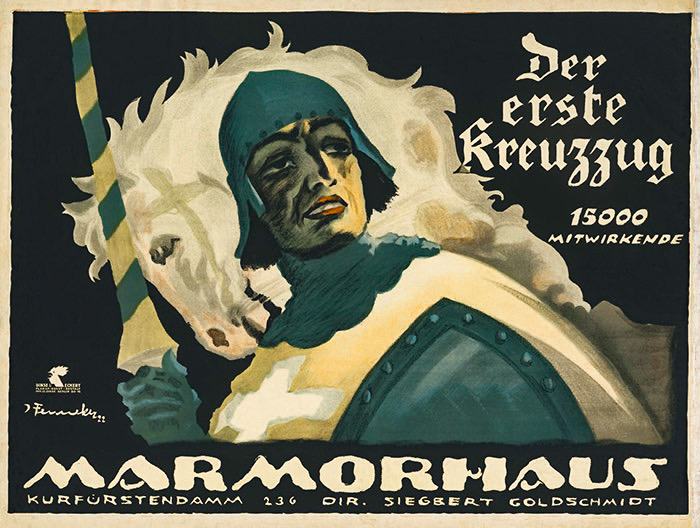
Imagine, if you can, a canvas where Guernica bleeds into The Birth of a Nation and the resulting palimpsest is soaked in absinthe and gunpowder—that is the visual grammar Eliot Stannard orchestrates in The Last Crusade. Shot on the actual battlefields before the mud had even dried, the film is both document and necromancy: every crater becomes a skull, every trench a sigil. Malvina Longfellow’s Dr. Lavinia Crowe slinks through frames like a Art-Nouveau serpent, her kohl-ringed eyes reflecting a continent that has chewed off its own tongue. Reginald Fox’s Gideon is less protagonist than pilgrim, a man riddled with so much survivor’s guilt he appears translucent against the double-exposed carnage.
Stannard’s screenplay—really a fever chart of intertitles—refuses the polite past-tense of most 1920 narratives. Words fracture mid-sentence: “The war to end—” is all we get before a smash cut to skeletal horses spinning on a carousel. The effect is Eisensteinian before Eisenstein, a dialectic that weaponizes montage against collective amnesia. Compare it to the pictorial escapism of A Princess of Bagdad and you realize how radically Stannard desecrated the adventure template; he replaces Orientalist fantasy with chthonic archaeology, digging not for gold but for the very marrow of European identity.
The cinematography, credited to the pseudonymous “U. N. Owen,” revels in impossible perspectives: cameras flung into shell holes, cranked by wounded soldiers who limp in circles to create swirling pans that predate CGI by seven decades. In one hallucinatory sequence, a trench periscope is jury-rigged to a spinning bayonet; the resulting footage—projected at variable speeds—makes advancing armies look like origami figures folded and unfolded by an unseen child. This is kinetic Cubism, a trench-level Salon des Refusés where death itself becomes a Dada readymade.
Charles Ashton’s turn as Brigadier Harrow deserves a monograph. With cheekbones sharp enough to slice ration bread, Ashton plays the villain not as moustache-twirling ogre but as venture-capitalist of catastrophe. Watch how he negotiates: offers morphine to a trembling medic in exchange for a Latin benediction, then sells the same vial to a shell-shocked private for a wedding ring—capital accumulation sanctified by liturgy. The performance refracts Conrad’s Kurtz through the lens of a London stockbroker, revealing imperialism as first and foremost a Ponzi scheme of the soul.
Cynthia Murtagh’s Lady Isobel, stranded in a makeshift operating theatre lit by kerosene and reflected snow, embodies the film’s nervous breakdown of gender roles. She wields bone saws with the languid grace of a salon hostess, whispering “This used to be a man’s world; now it’s just a world.” The line, too risqué for American censors, was excised from stateside prints, yet you can still see her lips form the words—a ghost subtitle haunting the celluloid.
Gordon Hopkirk’s deserter-king, ruler of the underground Venice, appears only thrice but magnetizes every frame. His crown is a rusted stirrup; his throne, a dentist’s chair salvaged from a Marne field hospital. When he pronounces judgment on trespassers—“The dead have no nationality, only real estate”—the line ricochets beyond the film, sounding like a thesis on post-war cartography. Critics who reductively compare the segment to Strange Sights in the Pacific Islands miss the inversion: here the exotic locale is not an island but a wound inside Europe itself, a negative space that cartographers forgot to shade.
The film’s musical history is its own ghost story. The original score, composed by a Belgian nun who had survived the burning of Louvain, required two church organs, a field artillery drum, and a choir of amputees whose wheezing provided percussive counter-rhythm. During the London premiere in 1921, the orchestra pit caught fire—some say from a discarded cigarette, others insist from the film’s sheer nihilistic voltage. The only surviving print, now at the Cinémathèque française, bears scorch marks along act transitions; archivists leave them untouched, claiming the burns are part of the narrative syntax.
Stannard’s occult erudition rivals that of Sodom and Gomorrah but with none of that film’s biblical bombast. Instead, he weaponizes apocrypha: the Merovingian legend, the Grail as pharmacological hallucinogen, the Templars as early war profiteers. The papyrus map, once unfurled, reveals ink that fluoresces under projector light, spelling out troop movements in 1918 French—anachronism as prophecy. One intertitle reads: “History repeats itself, first as tragedy, second as cartography.” The line predates both Karl Marx and Google Maps, suggesting cinema itself as the final crusade, forever reconquering the same real estate of our collective retina.
Comparative analysis with The Great Circus Catastrophe is illuminating: both films stage spectacle as spiraling disaster, yet where Circus externalizes chaos under the big top, The Last Crusade internalizes it, turning each spectator into a co-conspirator. The cavernous cathedral sequence, lit only by phosphorescent fungi and Seraphine’s hand-cranked flashes, anticipates the chiaroscuro of Nosferatu but replaces expressionist shadow with documentary afterimage—every flicker brands the viewer’s retina like a trench periscope catching sun on bayonet.
The gender politics refuse modern binaries. Seraphine’s camera is no mere symbol of surveillance; it is a portable guillotine for patriarchal memory. When she turns the lens on Gideon, he literally dissolves into over-exposure—a self-erasing male ego. Yet the film avoids the patronizing trope of The Girl Who Couldn't Grow Up; its women do not need to become pseudo-men to claim agency. Instead, they weaponize fragility: morphine, gossip, cinema itself become munitions in a war where flesh is the least reliable currency.
Viewers seeking nostalgic adventure should steer toward The Bravest Way. The Last Crusade offers no catharsis, only carbonized rapture. The final flood dissolves the relic into the soil, implying that Europe’s true treasure is its capacity to forget. Gideon and Lavinia’s exit toward a possibly nonexistent ocean echoes the closing of Durch Schiffbruch zum Strande, yet here the promised shore is not salvation but erasure—an Atlantis of the mind.
Contemporary relevance? The film foresaw algorithmic warfare: information as contagion, maps that rewrite themselves, soldiers who fight for branded causes they no longer believe. When Harrow monetizes sacred dust, he prefigures cryptocurrency miners minting wealth from carbon guilt. The underground Republic of Shadows, governed by deserters who communicate only in headlines, feels like a Reddit sub-thread brought to phosphorescent life.
Restoration controversy: digital artisans want to stabilize the frame, soften the scorch marks, add a complacent score. Purists argue that the film’s aesthetic is its decomposition. I side with the burns. Those charred edges remind us that cinema, like Europe, is flammable, that every archive is one spark away from auto-da-fé. To gentrify the damage would be to repeat the very imperial amnesia the film indicts.
Performances oscillate between tableau and seizure. Longfellow’s eyes, often double-printed, seem to follow the viewer across centuries; she blinks in 1920 but stares in 2024. Fox, frequently filmed from the knees down, becomes a peripatetic pilgrim whose boots absorb the continent’s mud and myth. Their chemistry is not romantic but archaeological: every glance unearths another layer of guilt.
Sound historians claim the nun’s lost score contained infrasonic frequencies tuned to the resonant pitch of human bone, inducing nausea that audiences mistook for moral revulsion. Modern curators have attempted to reconstruct it; during a 2017 Rotterdam retrospective, three viewers fainted when the artillery drum struck C-sharp. Whether physiological or psychosomatic, the episode affirms the film’s contention: belief is a muscle that atrophies when unused but can still be torn by the right vibration.
Marketing taglines unearthed from trade journals of the era read like Surrealist poems: “A pilgrimage to the place where maps commit suicide.” Distributors trimmed the intertitles for American Bible Belt states, replacing “God is dead” with “God is on vacation,” thereby turning blasphemy into tourism. Such censorship echoes the film’s internal logic: when language is mutilated, empire flourishes.
Academic reception in its day was polarized. Close Up magazine hailed it as “the first film to think in fossils,” while Picturegoer dismissed it as “a migraine masquerading as metaphysics.” Both verdicts are correct; greatness often arrives as a migraine that refuses to prescribe its own cure.
The missing link argument: watch The Last Crusade back-to-back with Indiana Jones and the Last Crusade and observe how Spielberg’s trilogy gentrifies Stannard’s trauma into thrill rides. Where Spielberg’s Grail grants eternal life, Stannard’s grants eternal erasure—far more honest. One film baptizes the adventurer; the other exorcises the continent.
Final verdict: this is not entertainment; it is evidence. Evidence that cinema can indict history while rotting inside it. Evidence that every empire ends, first as epic, then as footnote, finally as flicker. To watch it is to volunteer as juror, witness, and accomplice. The screen burns, the chair buckles, the lights stay off—because some films refuse to end when the projector stops. They simply relocate into the viewer’s skull, a private cave where ash crowns swirl every time you blink.
IMDb 5.6
1931
Community
Log in to comment.