DbcultAccessing Vault...
5.7/10
Senior Film Conservator
A definitive 5.7/10 rating for a film that redefined the boundaries of cult cinema. The Life and Works of Verdi remains a cornerstone of transgressive art.
Imagine a film that refuses to speak yet makes every frame vibrate like the tremolo of a cello. Camillo De Moro’s The Life and Works of Verdi—released in Italian cinemas during the autumn of 1908—does exactly that, distilling the seismic emotions of nineteenth-century opera into a silent black-and-white cantata that runs a brisk twenty-five minutes but feels, paradoxically, as expansive as a four-act spectacle at La Scala.
Shot on 35 mm nitrate stock whose surviving print flickers like a candle in an archive in Cinecittà, the picture belongs to that feverish moment when Italian cinema was inventing the biopic template before the term itself existed. Think of it as a visual aria: every tableau is lit like a Caravaggio, every intertitle a libretto line you can almost hear. The film predates Abel Gance’s Napoleon by fourteen years yet anticipates its operatic sweep; it postdates Méliès’s fairy extravaganzas by a decade but swaps whimsy for blood-and-thunder nationalism.
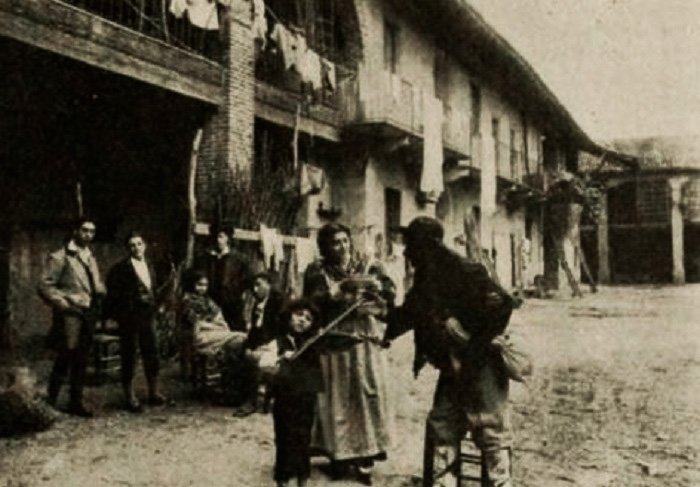
De Moro structures the narrative like a symphonic movement: exposition in the bucolic key of Roncola, development amid the repressive corridors of Austrian-dominated Milan, recapitulation in the plush salons where crowned heads murmur bravo. The opening riot—musket flashes, villagers scattering like startled quavers—sets tempo for a life scored by political upheaval. We meet Giuseppe as a seven-year-old, eyes wide as timpani, transfixed by the parish organ whose pipes tower above him like copper cypresses. The camera dollies in (an ambitious feat for 1908) until the child’s profile fills the screen, backlit so that his curls form a halo: the first visual motif equating Verdi with secular sainthood.
Fast-forward a decade: the spinet arrives, a wounded baroque beast with yellowed ivory keys. In close-up, Verdi’s fingers caress the keyboard; the film jump-cuts between this moment and the mature maestro conducting at La Scala, a match-cut across time that Soviet montage theorists would later claim as revolutionary. Yet De Moro is already there, intuitively stitching past and future through pure kinetics.
Milan’s Conservatory—here a stern palazzo with iron gates—becomes the film’s first antagonist. The admission board, shot from a low angle so their top hats scrape the ceiling, wag gloved fingers. Verdi pivots, silhouette shrinking against the massive doors. Intertitle: “They refused the son of a tavern keeper; he would refuse them immortality.” This is not historical accuracy (Verdi was actually denied entry due to age restrictions) but myth-making at its most succinct.
Cue the Barezzi household in Busseto: sun-drenched interiors, lace curtains billowing like choral staves. Marguerite, played with tremulous luminosity by Annita Archetti-Vecchioni, materializes at the piano, her gown pooling like ink on the parquet. Their courtship is rendered entirely through overlapping dissolves: hands touching, sheet music swapped, a candle snuffed. The sequence lasts maybe forty-five seconds yet distills an entire operatic romance into pure visual ligature.
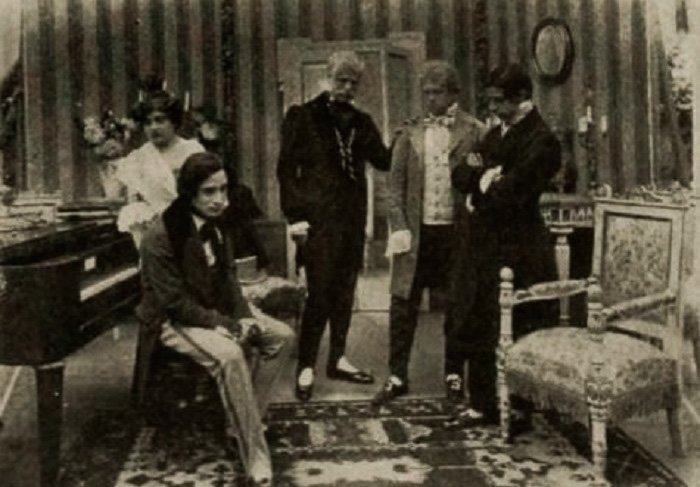
The death of Verdi’s wife and infant children—historically staggered across three years—collapses into one operatic blow. De Moro stages it inside a candlelit bedroom where shadows claw the walls like demon altos. Marguerite’s hand slips from her husband’s; the camera irises out to black, then in again on Verdi seated at the spinet, now draped in crepe. He slams the keyboard; the resulting chord is implied by a jump-cut to lightning ripping across matte-painted clouds. Cinema becomes synesthetic: we hear silence as thunder.
For modern viewers raised on Dolby Atmos, this silence is voluptuous. The absence of sound forces the eye to scour every crevice of the frame: the frayed cuff of Verdi’s coat, the cracked portrait glass, the way candlewax pools like frozen tears on a score sheet marked Oberto. Grief ossifies into work ethic; the film skips two years in a single title card: “He wrote through nights that tasted of iron.”
The premiere of Nabucco is staged as a civic orgasm. De Moro intercuts three spatial planes: backstage chaos (chorus robes flapping like revolutionary banners), auditorium anticipation (aristocrats fanning themselves, middle-class patrons clutching libretti), and the stage itself where performers stride in hieratic poses. When the famous Va, pensiero chorus begins, the camera assumes a godlike crane shot ascending above the footlights. We never hear the hymn, yet the image of unified Italian spectators—eyes glistening, lips moving in silent unison—transmutes melody into manifest emotion. It is one of the earliest examples of cinema weaponizing absence to amplify presence.
Enter Giuseppina Strepponi, radiant in velvet traveling cloak, her entrance timed precisely after Verdi’s first ovation. De Moro shoots their meeting inside a rehearsal room dusted with stage snow; shafts of limelight cut diagonally, foreshadowing the crossed destinies of La traviata. A two-shot frames them against a backdrop of scenery flats—Roman temples, Egyptian pyramids—implying that for Verdi, life and spectacle are twin proscenia. Their subsequent marriage is implied by a dissolve from shared sheet music to a shared balcony overlooking Lake Como, moonlight dappling the water like arpeggios.
De Moro’s final reel luxuriates in the Doria Palace, its baroque halls reimagined as a panopticon of memory. Verdi wanders through cavernous galleries; superimposed images of his characters glide beside him—Aida’s bronze crown, Rigoletto’s motley, Desdemona’s blood-spotted veil. These are not ghostly visitations but living extensions of the composer’s psyche, a chorus of alter-egos harmonizing the dialectic between creator and creation. The camera tracks laterally, following Verdi toward a window where the Ligurian sea crashes in slow motion, waves pixelated by age into almost Impressionist lattices. The film’s tinting shifts from sepia to aquamarine, as though the celluloid itself is drowning in turquoise sonority.
In a triumphant crescendo, De Moro stages the inauguration of Milan’s Casa di Riposo. Elderly choristers, one-armed violinists, consumptive contraltos line up beneath a triumphal arch. Verdi, now silver-bearded, stands beneath a banner reading ARTIS IMMORTALITAS. The camera assumes a low angle, turning him into a colossus. Yet the film undercuts hagiography: an insert shot reveals his trembling hand gripping a balustrade, hinting at mortality’s stealthy advance. A final iris closes on the old composer silhouetted against sunset clouds—an anthropomorphic fermata. Intertitle: “The curtain falls; the music never.”
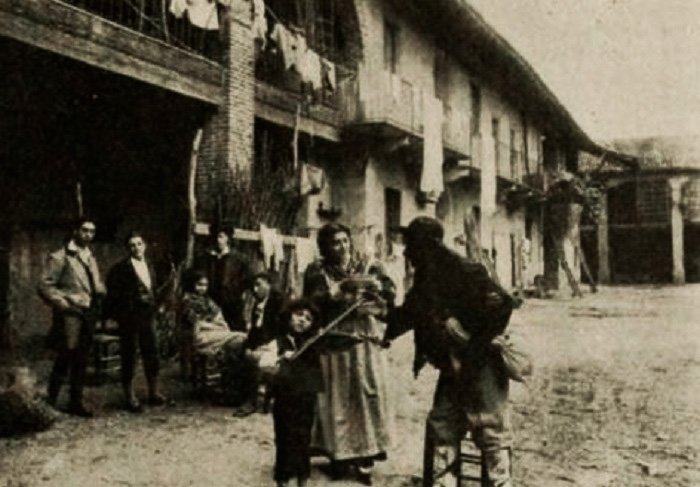
Egisto Cecchi, a veteran of the Turin stage, plays Verdi with the stoic volatility of a Roman statue learning to breathe. Watch how he modulates posture: youthful rigid resolve softens into a stoop that straightens only when conducting, as if baton were spinal extension. His hands—large, scarred, pianist-knuckled—become the film’s visual leitmotif, photographed in chiaroscuro close-ups that anticipate Sergio Leone’s pistoleros.
Annita Archetti-Vecchioni’s Marguerite is all tremolo glances; she dies in a fade-out that feels like a held note released too soon. Elda Bruni’s Giuseppina provides contrapuntal vigor, striding through frames with proto-feminist swagger, her eyes flashing prima donna authority. Together the women embody the twin poles of Verdi’s emotional compass: loss and fulfillment, both shot through with operatic extremity.
De Moro’s visual vocabulary brims with audacious experiments. Superimpositions layer storm clouds over sheet music, turning meteorology into notation. Reverse motion shows a shattered portrait reassembling, metaphorizing artistic resurrection. Deep staging positions Verdi foregrounded against receding rows of choristers, creating perspectival crescendos. The film even prefigures Welles’s ceilinged interiors: low-angle shots of chandeliers dwarfing human anxiety.
Tinting follows emotional tonality: amber for rustic Roncola, cerulean for Milanese intrigue, rose for marital bliss, sickly green for deathbeds. These chromatic modulations function like key signatures, guiding the spectator’s emotional ear through visual pitch.
Place The Life and Works of Verdi beside later composer portraits and its innovations gleam. Compare it with The Life of Richard Wagner (1913), whose static tableaux feel embalmed, or with the histrionic excesses of Parsifal adaptations that tilt toward mystic bombast. De Moro’s film is leaner, fleeter, more modern—it eschews pageantry for psychological incision, predicting the intimate historicism of Ken Russell’s Elgar (1962) and the kinetic swirl of Amadeus (1984). Yet unlike Forman’s Salieri-centric reimagining, De Moro keeps Verdi front-and-center, a black-clad colossus against the swirling canvas of Risorgimento history.
Surviving prints exist in two versions: a 1973 Cineteca di Bologna restoration with newly commissioned piano accompaniment, and a 2018 4K scan that stabilizes the endemic nitrate buckle. The latter reveals textures previously smothered in emulsion decay—the glint of Marguerite’s brooch, the frayed edge of Verdi’s cuff—details that humanize the icon. Silent film devotees can stream the 2018 scan via Cinecittà’s virtual archive (Italian intertitles, English subtitles). Seek the Editione Rossiniana Blu-ray if you crave the optional audio commentary by maestro Riccardo Muti, who explicates how De Moro’s editing rhythms mirror Verdi’s tempo markings.
In an age when biopics ossify into Oscar-bait clichés—montage of crumpled scores, addiction, redemptive comeback—De Moro’s silent miniature feels radical. It dispenses with three-act screenwriting manuals and instead composes in visual movements, trusting viewers to decode ellipsis like seasoned librettists. You will exit the film humming not a tune but an image: Verdi’s silhouette dissolving into a horizon where sea and sky share the same cobalt ink. That afterimage lingers, persuading you that art is not a career but a country, and every note, every frame, every silent gasp is its contested passport.
Verdi once claimed that “tornate all’antico e sarà un progresso”—return to the past and you will find progress. Watch this 1900s relic and discover how futuristic true archaism can feel when sculpted by light, sorrow, and the audacity of silence.
IMDb —
1933
Community
Log in to comment.