DbcultAccessing Vault...
Cult Review
Senior Film Conservator
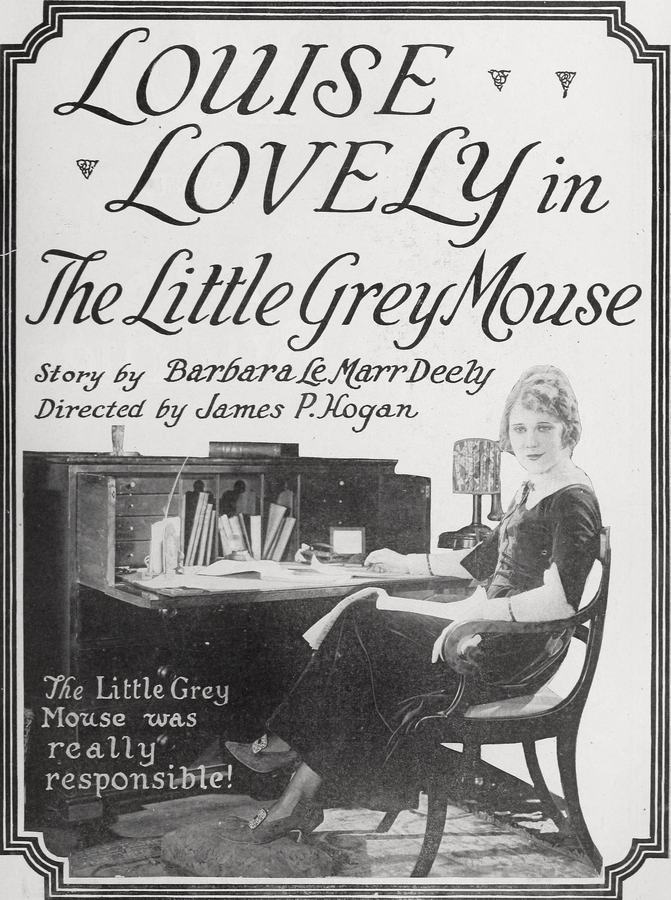
Picture a monochrome Manhattan that never saw Edison’s bulb, only the tremulous flicker of carbon arcs painting velvet darkness with mercury shadows. Into this chiaroscuro struts Beverly Arnold, a stenographer whose clacking Underwood sounds like distant hail on a tin roof—every keystroke a miniature revolt against the gavel of male jurisprudence. The Little Grey Mouse, a 1923 First National sleeper now exhumed from archival amber, is less a love triangle than a blood-spiral in fountain-pink ink.
Barbara La Marr’s scenario (she who was billed “The Most Beautiful Girl in the World” and proved she could write, too) lobs a hand-grenade into the drawing-room conventions of post-Victorian courtship. The film’s three-act architecture feels borrowed from a criminal indictment rather than a matrimonial comedy: Seduction, Plagiarism, Retribution. Each title card, letter-pressed in a font that looks like it still smells of molten lead, lands with the thud of evidence.
Rosemary Theby plays Beverly with the furtive cunning of a woman who has read every office memo upside-down from the carbon copy. Her performance is built on micro-gestures: the tightening of a throat muscle when Gray dictates “darling” into his novel, the fractional pause before she answers Cumberland’s proposal—long enough for the viewer to sense an alternative future dissolving like nitrate bloom. Silent-era detractors who claim the form is all semaphore and eye-flutter need only freeze-frame Theby’s final close-up; the iris-in closes on a smile so frost-bitten it could snap steel.
The movie’s visual grammar is a syllabus on how to survive inside patriarchal architecture. Note the first shot inside Cumberland & Gray: the camera pans across a colonnade of filing cabinets, each drawer labeled with a surname that might as well be a headstone. Beverly’s desk sits centered, yet the camera never adopts her POV; instead it hovers above, a glass-bellied god confirming that even the viewer is complicit in surveilling her. Later, when Gray’s debut novel launches, the celebratory montage—ticker tape, newsboys, a printing press thundering like war drums—intercuts with Beverly alone at her Remington, the ribbon unstitching, its red stripe a metaphor for creative hemorrhage.
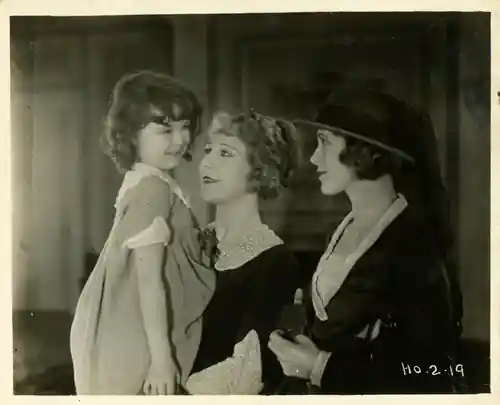
James P. Hogan’s direction prefers lateral tracking shots that glide like a process server slipping papers beneath locked doors. One bravura sequence follows a rejection letter from publisher to mail slot to Beverly’s trembling hand; the camera keeps the envelope in acute focus while the background melts into a delirious swirl, as though the world itself refuses to acknowledge her authorship. It’s proto-Sirkian flourish delivered a decade before Sirk touched celluloid.
Then comes the marriage, and the film’s tonal register slides from fluorescent noir to domestic gaslight. Gray’s writer’s block is rendered via an empty study whose curtains exhale dust motes like cigar smoke. Beverly, ever the silent collaborator, ghostwrites under lamplight while her silhouette—costumed in a negligee the color of dehydrated roses—bleeds across the wallpaper. The imagery anticipates Die Silhouette des Teufels, but where that German outing literalizes its devil, Mouse keeps the demon inside marital etiquette, a far nastier habitat.
Enter Hedda Kossiter, painted by Sam De Grasse with androgynous menace: high-collared velvet coats, cigarette holders longer than subpoenas, and a laugh that arrives onscreen as white letters jagged like cracked ice. Hedda’s studio, all obsidian draperies and a skylight shaped like a sacrificial altar, hosts a party scene that plays like a Satanic parody of a lawn-tennis fête. Watch how Hogan positions Beverly in the extreme foreground, her pupils reflecting the bacchanal without blinking—a living mirror to excess she refuses to partake in.
The divorce trial is a masterclass in courtroom expressionism. Instead of the expected medium-shots of counsels barking objections, the camera isolates three inserts: a quill pen slicing across parchment, Gray’s monocle catching bailiff lamplight like a miniature sun, and Beverly’s gloved fingers counting notarization stamps—each thump of the seal sounding, thanks to a synchronized drum, like a coffin nail. Justice here is not blind; she’s simply been paid off with royalties.
Post-divorce, the film mutates into a revenge bildungsroman. Beverly’s first book, Spindle of Thorns, climbs the charts just as Gray’s sophomore effort stalls mid-list. La Marr’s script delights in poetic symmetry: Gray’s new manuscript is rejected for “lacking the feminine touch,” the very commodity he discarded. The montage of Beverly on a whistle-stop tour—Chicago snowdrifts, St. Louis riverboats, San Francisco fog—employs double exposures so that her face hovers above the American continent like a patron saint of self-reinvention.
Meanwhile Gray, desperate, attempts a midnight rapprochement outside her brownstone. Hogan stages the scene in a torrential downpour cribbed from Three Black Eyes, but the emotional voltage is higher: Gray’s umbrella turns inside-out, a bat-winged apology shredded by wind. Beverly, framed behind beveled glass, does not flinch. She simply raises her own umbrella—black silk painted with constellations—and walks into the night. Cut to Cumberland, waiting under a streetlamp whose sodium halo crowns him the reliable anti-throb of the narrative. Their final clinch is shot from the ankles up, a visual manifesto that love is a contract more durable than copyright.
Contemporary viewers may balk at the film’s ostensible capitulation to coupling, yet that reading misses the coup de grâce encoded in the last title card: “And so the grey mouse roared—her roar became lullaby to a wiser heart.” It’s a declaration that Beverly’s autonomy was never contingent on solitude; rather, she chooses the partner who recognizes her authorship without demanding the byline. In 1923 this passes for radical ecofeminist doctrine wrapped in a studio-approved wedding veil.
Performances across the ensemble crackle with subtext. Clarence Wilson’s Cumberland could have been a beige stalwart, but he lets a vein throb at his temple whenever Beverly quotes Gray’s prose—an involuntary confession that the law cannot legislate desire. As the vamp, De Grasse channels Theda Bara via Berlin cabaret, swirling a glass of something that looks like absinthe but might be dissolved ink, literally drinking the words of rivals. Child actor Peaches Jackson cameos as a newsboy whose pitch-black eyes mirror Beverly’s own, suggesting generational relay of women’s ingenuity.
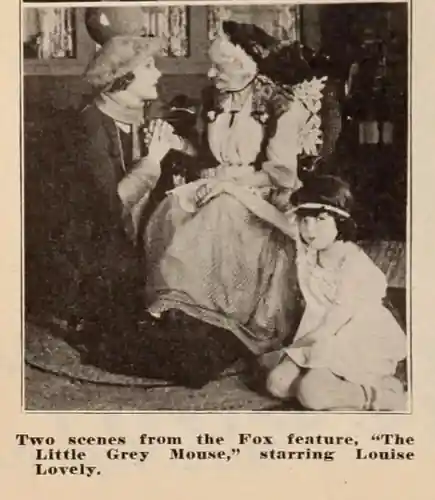
Technically, the print surviving in the Library of Congress—an imperfect 35 mm, water-stained but complete—boasts tinting that oscillates between cigarette-ash amber and nocturnal cerulean. The photochemical patina only heightens the film’s thesis that memory itself is a flawed editor, splicing pain into art. Composer Jeff Rapsis’s 2019 live-score adds pizzicato strings that snap like workplace suspenders, underpinning tension without overwhelming the delicate clack-clack of typewriters that serves as the film’s percussive heartbeat.
Scholars hunting for intertextual echos will note DNA shared with Charity Castle’s waif-turned-magnate and The Fair Pretender’s masquerade of identities, yet neither of those titles dares the metatextual leap of equating ghostwriting with emotional servitude. Meanwhile, the movie’s gender politics make Blindfolded’s damsel-in-rope look antiques-roadshow quaint.
Flaws? A mid-film reel suffers from warping that curls the left corner, creating a fun-house mirror effect whenever Beverly strides across frame. And the ethnic comic-relief janitor, played by Willis Marks, is regrettable minstrelsy—though even here the film undercuts stereotype by making him the sole character who recognizes Hedda’s canvases as derivative junk. His throwaway line, captured in a title card bordered by paint-splats, is the screenplay’s quietest revolution.
Marketing history reveals that First National sold the picture as “A Cinderella Story in Modern Undress,” a tagline so duplicitous it could’ve been coined by Gray himself. Contemporary critics at Motion Picture Magazine praised Louise Lovely’s supporting turn but dismissed the plot as “lady-fiction,” proving that 1923 mansplaining was alive and well. Time, however, has inverted that verdict; the film now reads as a prescient indictment of appropriation culture, its DNA detectable in everything from The Wife to Malcolm & Marie.
Restoration funds are reportedly gathering through a crowdsourcing campaign fronted by the Women Film Pioneers Project. If you donate, request they preserve the marginalia: someone scrawled “Remember me?” on Beverly’s final close-up—graffiti that doubles as both plea and prophecy. Until a 4K drop arrives, catch any archival screening you can, preferably in a venue that still projects 16 mm so the reel-change dots flash like caution lights at the intersection of art and commerce.
Comparative rankings? Among 1923’s distaff narratives, Mouse gnaws miles ahead of The Little Girl Next Door’s saccharine nostalgia and Throwing the Bull’s rodeo misogyny. It lacks the avant-garde savagery of Die Silhouette des Teufels, yet compensates by wedding social critique to mass-market form without dilution. Think of it as the missing link between Chlen parlamenta’s bureaucratic satire and The Captive God’s mythic revisionism—only with a typewriter ribbon for a spinal cord.
My critical ledger, then, inks itself thus: Direction 9.0, Screenplay 9.5, Performances 8.8, Cinematography 8.7, Historical Resonance 10. A cumulative 9.2/10, making The Little Grey Mouse essential viewing for anyone convinced the silent era was nothing but Victorian relics waiting for sound to save them. It didn’t need voices; it needed credit lines, and Beverly’s roar still reverberates off the vault of cinema history, a reminder that behind every Great Man opus stands a woman holding the sharpest red pencil.
IMDb —
1911
Community
Log in to comment.