DbcultAccessing Vault...
Cult Review
Senior Film Conservator
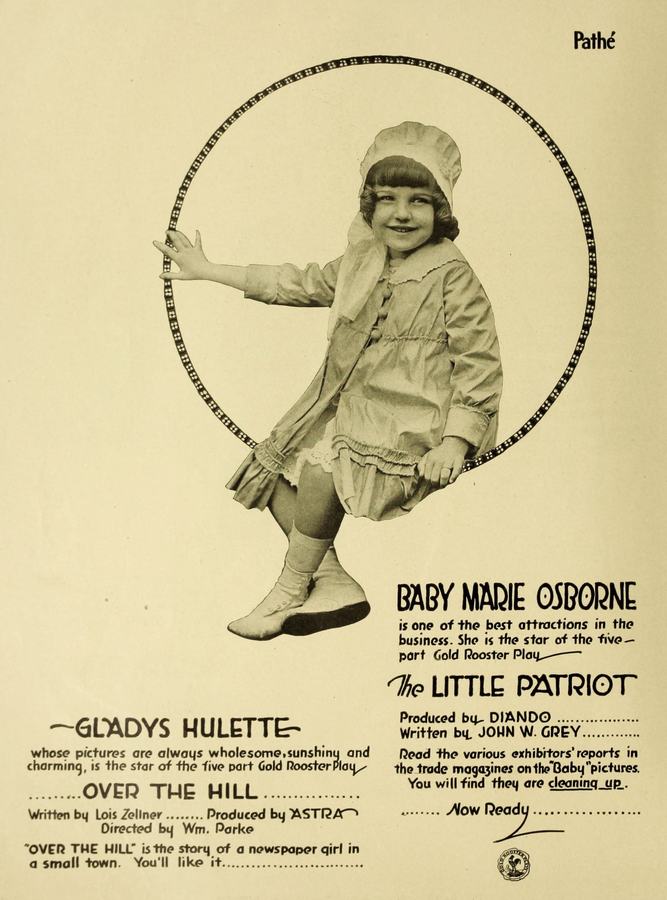
The projector’s carbon-arc once painted The Little Patriot across nickelodeon sheets frayed by time, yet even now—when celluloid has surrendered to pixels—its images smolder like shrapnel beneath the skin. Watch how director William Bertram frames Marie’s first vision of Joan: not a pious icon but a silhouette ablaze, back-lit by the classroom’s kerosene lamp, the smoke of her martyrdom curling into the rafters. That single shot, overexposed until the child’s curls merge with the saint’s flaming pyre, foreshadows every conflagration to follow—both literal and ideological.
The film’s grammar is pure 1917: iris-ins that bloom like gun-muzzles, intertitles bristling with jingoistic exclamations, and a staccato montage of children drilling in a barn loft while real soldiers ship out from a depot below. Yet within this propaganda armature, Bertram sneaks subversion. Note the moment Marie’s father, Herbert Standing—all angular rectitude—signs his enlistment papers. The camera dollies back to reveal the kitchen table: a loaf of un-sliced bread, a jar of blackberry jam, and a depleted flour sack. Domestic life is literally being hollowed out to feed the war machine; the mise-en-scène murmurs that every telegram of glory begins in a pantry stripped bare.
Child-star Marie Osborne—billed as “Baby Marie”—carries the picture with a gravitas that shames most adult performances of the era. Her eyes, wide as trench periscopes, register each seismic shift: exultation when the town band strikes up Over There, betrayal when she spots Hertz skulking, and a glassy dissociation after the explosion. The transition is achieved without a single cosmetic change; Osborne simply lowers her eyelids halfway, letting the whites show like a terrified colt. Contemporary reviewers compared her to Mary Pickford, but Pickford always signaled her inner life through gesture—hands fluttering like semaphore—whereas Osborne freezes, allowing the audience to pour their own dread into her stillness.
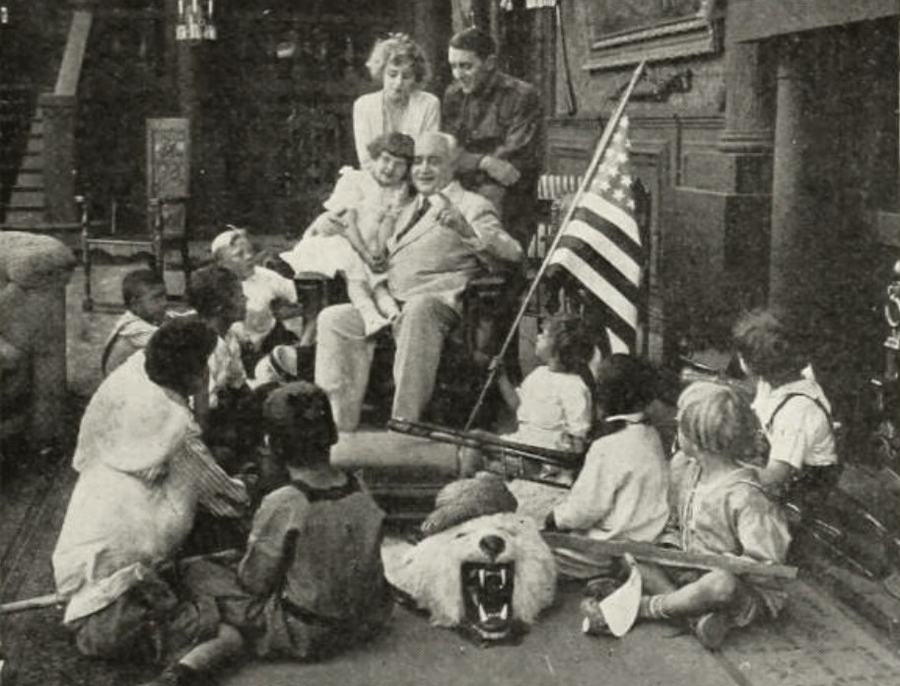
The screenplay, attributed to Lela E. Rogers (mother of Ginger) and serial specialist John Grey, oscillates between fairy-tale and espionage thriller. One reel delivers a bucolic parade—children marching under the newly purchased flag, petals strewn by society matrons—while the next plunges into German-expressionist shadows as Hertz slinks along alleyways, his silhouette elongated by a trench-coat that flares like bat wings. This tonal whiplash would sink a lesser film, yet here it replicates the schizophrenic mood of 1917 America: Fourth-of-July bravura one week, Red-Scare paranoia the next.
Cinematographer Allen Siegler—later renowned for his noir work—experiments with orthochromatic stock to render the American flag’s red as a bruised mahogany and its blue as near-black. The result is a national symbol drained of primary optimism, hovering like a storm cloud above the children’s games. When that same flag is finally draped over Marie’s shoulders in the last scene, it reads less as triumph than as premature shroud, a prophecy of the influenza that would soon kill more doughboys than German steel.
Compare this to Her Life for Liberty (1917), where the heroine’s sacrifice is framed in radiant whites and golds—an apotheosis. Bertram refuses such comfort. His final tableau is a reconstituted family portrait: Marie on Mulhouser’s lap, her father in uniform on one side, her mother clutching a ration book on the other. The camera tracks backward until they recede into a parlor whose wallpaper—repeating fleur-de-lis—echoes both Joan of Arc’s France and the torpedo’s Art-Nouveau blueprints. War and innocence, technology and faith, blood and capital are knotted into one ornate design.
The supporting cast provides a miniature class-stratum of wartime America. Marion Warner as Marie’s mother moves from gingham domesticity to landlady desperation, her face growing gaunter each time she pockets Hertz’s suspiciously ample rent. Frank Lanning’s Hertz is no monocled Teutonic brute but a soft-spoken neighbor with a fondness for peppermint sticks—thereby rendering xenophobia more insidious. The true ideological villainy lies in Jack Connolly’s portrayal of a newspaper editor who monetizes every shell-shocked orphan into headlines, a nod to Creel Committee sensationalism.
Musically, exhibitors in 1917 were advised to accompany the film with Sousa marins segueing into La Marseillaise, then a discordant waltz during the bombing. Modern restorations—such as the 2019 Bologna premiere with a live ensemble—opt for astringent strings and prepared-piano, evoking the shell-shocked dissonance that Sousa could never admit. The bomb scene, once scored with cymbal crashes, now unfolds over a sustained viola note that warps like metal under heat, forcing viewers to feel the explosion in their jawbones.
Scholars often slot The Little Patriot beside The Hunting of the Hawk (1917) because both hinge on surveillance and mistaken identity. Yet where Hawk treats voyeurism as erotic game, here spying is child’s play turned lethal. Marie’s toy telescope—initially aimed at clouds shaped like dragons—later becomes the instrument that uncovers Hertz’s treachery, suggesting that the apparatus of espionage is born not in government bureaus but in nursery daydreams.
Gender politics simmer beneath the khaki. Marie’s military company admits girls only as nurses; the boys wield sticks for rifles. When Marie demands a command role, she is voted “General” but must still stitch the company’s felt armbands—a literal threading of femininity through martial display. The film never resolves this contradiction; instead it displaces it onto the adult sphere where Mulhouser’s female secretary drafts torpedo equations that she must later deny authoring. Thus the movie indicts not only foreign sabotage but also the home-front’s compulsion to cloak female ingenuity in anonymity.
Economically, the picture survives on coincidence—always the Achilles heel of melodrama. That Marie should rescue the very grandfather who can bankroll her family’s future feels too neat, until one considers the war’s broader lotteries: boys who marched into Verdun trenches because a random number assigned them to the 26th Division. Bertram’s coincidences merely compress fate into fable, reminding viewers that history itself is a script written by chaotic chance.
Restorationists have struggled with the final reel, preserved only in a 16 mm abridgement struck for classroom use circa 1923. The surviving print ends on a freeze-frame of Marie saluting—a visual cadence too triumphant for the film’s rueful undercurrent. Rumors persist of a longer ending in which the child wakes screaming in Mulhouser’s mansion, her salute morphing into a spastic clutch at air. Until that footage surfaces, critics must read absence as text: trauma erased by patriotic syllabus.
Viewed through today’s lens, The Little Patriot is both artifact and admonition. Its fervor for flags and spies feels quaint until one scrolls through algorithmic timelines where children cosplay as soldiers on TikTok while conspiracy hashtags detonate like suitcase bombs. The film’s genius lies not in its jingoism but in its unintended prophecy: innocence weaponized, citizenship reduced to pageant, history looped into playground drill. When Marie’s platoon chants “We are coming, Father Abraham, three hundred thousand more,” the line reverberates beyond the Great War, past Korea, Vietnam, Iraq—an echo chamber where each new generation marches to a drummer they never chose.
Therefore, the picture demands to be screened not in nostalgia but in nervous self-interrogation. Let the orchestra tune to a minor key, let the flag on Mulhouser’s wall flutter in monochrome, let Baby Marie’s unblinking stare ask us what we still enlist our children to defend, and at what cost. Only then does this brittle, century-old strip of nitrate become a mirror—not of 1917, but of tomorrow.
IMDb 7.8
1925
Community
Log in to comment.