DbcultAccessing Vault...
Cult Review
Senior Film Conservator

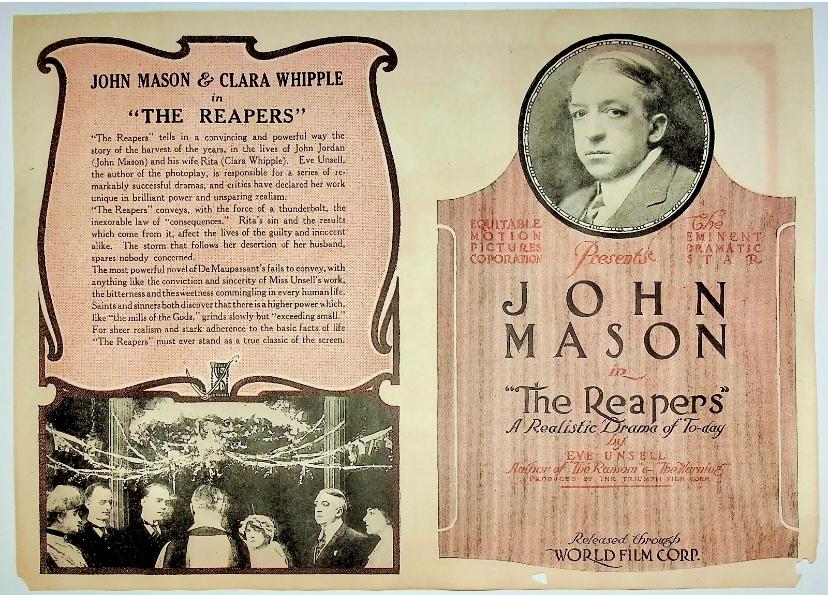
Stepping into the cinematic world of "The Reapers" (the-reapers) is akin to unearthing a forgotten moral tapestry, rich with the threads of human frailty, divine intervention, and the enduring power of forgiveness. This isn't merely a film; it's a profound journey into the very crucible of the human spirit, where personal tragedy meets spiritual awakening, and the specter of past transgressions casts long, unsettling shadows. Its narrative, penned by the insightful Eve Unsell, navigates the tumultuous waters of betrayal and redemption with a gravitas that resonates far beyond its silent era origins, offering a searing commentary on the societal and personal costs of our choices. The film challenges its audience to look beyond superficial judgments, urging a deeper understanding of the complex interplay between fate, free will, and the transformative potential of grace.
At its core, "The Reapers" masterfully sketches the life of Albert Jordan, a man whose existence is initially defined by an almost idyllic devotion to his family. As a publishing house manager, he channels his entire being, and indeed, his earnings, into creating a sanctuary for his beloved wife, Rita, and their innocent daughter, Edna. His home isn't just a dwelling; it's a sacred space, a personal cathedral where his family serves as his unwavering deity. This portrayal of Albert's early life is crucial, establishing a baseline of profound goodness and familial commitment that makes his subsequent trials all the more agonizing. It highlights the vulnerability of human happiness, how quickly even the most steadfast foundations can crumble under the weight of unforeseen circumstances.
The narrative takes a brutal turn when Albert, with a father's innate instinct, lunges to save Edna from the jaws of an oncoming automobile. His heroic act, a testament to his selfless love, comes at a devastating cost: a debilitating injury that leaves him a half-paralytic. This moment is not just a physical blow but a spiritual one, stripping him of his role as provider and protector, and plunging his family into economic uncertainty. The irony is palpable; the very act of love that saves his daughter simultaneously cripples him, becoming the catalyst for his world's unraveling. This stark reversal of fortune sets the stage for a profound exploration of human endurance and the unexpected pathways to despair.
With Albert incapacitated, Rita, portrayed with nuanced complexity by Clara Whipple, is thrust into the unfamiliar and unwelcome role of breadwinner. Her resentment, simmering beneath the surface, eventually boils over, fueled by the temptation of a past dalliance with Jim Shaw, a charming but ultimately dissolute race-track follower. Her defection, a raw act of abandonment, shatters Albert's world completely. It transforms his personal sanctuary into a desolate wasteland, leaving him not only physically broken but spiritually ravaged. The film doesn't shy away from depicting the ugliness of this betrayal, painting Rita's choice as a stark consequence of her own burgeoning selfishness and inability to cope with hardship. This phase of the story, reminiscent of the moral quandaries explored in films like The Gilded Spider, delves into the corrosive effects of personal weakness on family bonds.

Albert's subsequent descent is harrowing. He becomes an embittered blasphemer, his faith in family and, by extension, in any higher power, utterly shattered. Reduced to selling newspapers and pencils at an elevated station, a mere shadow of his former self, he embodies the profound despair that can grip a soul stripped of everything it holds dear. Here, the film introduces a pivotal figure: a "splendid woman with a deathless faith." This character, though perhaps archetypal, serves as a beacon of hope, leading Albert out of his spiritual wilderness. She teaches him a creed of life rooted in prayer and belief, gently guiding him towards a path of self-acceptance and spiritual renewal. This remarkable transformation, from utter despondency to a burgeoning hope, culminates in a miraculous healing, underscoring the film's central tenet: that God's ways often diverge from the limited understanding of men. This segment of the film, with its emphasis on spiritual rebirth, echoes the themes found in narratives like A Child of God, where faith becomes the ultimate lifeline.
The narrative then masterfully employs a parallel structure, charting Albert's remarkable resurgence alongside Rita's gradual, but inevitable, decline. Years pass, and Albert, revitalized by his newfound faith and restored health, flourishes. He rebuilds his life with new strength and purpose, cultivating new friendships and achieving significant success in business. His daughter, Edna, now a beautiful young woman, mirrors his upward trajectory, marrying Frank Rollins, an assistant district attorney from an aristocratic family. This union not only solidifies Edna's social standing but also provides a stable, loving home for Albert, who makes his residence with the young couple. This period of prosperity and contentment for Albert and Edna serves as a powerful contrast to the unfolding tragedy of Rita's life, emphasizing the film's exploration of cause and effect, and the idea that one truly does "reap what one sows."
Rita's journey, conversely, is a stark spiral downwards. After an initial period of superficial luxury with Jim Shaw, her life progressively deteriorates. Shaw, played with a compelling blend of charm and menace by Pierre LeMay, descends into heavy drinking and physical abuse, turning their glamorous facade into a living hell. Their return from Paris, marked by the opening of a flashy tango hall, is less a sign of renewed prosperity and more a desperate attempt to maintain appearances amidst a decaying reality. This depiction of Rita's fate is unflinching, showcasing the bitter harvest of her earlier choices—a life devoid of genuine affection, plagued by violence, and ultimately defined by the very selfishness that drove her away from Albert. Her character arc stands as a cautionary tale, illustrating the destructive power of unchecked desires and the illusion of fleeting pleasures. The film, in its portrayal of Rita's gradual degradation, touches upon themes found in works like Lola, where characters grapple with the consequences of their life choices and the harsh realities of their circumstances.
The narrative's brilliance lies in its meticulous construction of the inevitable confrontation between Albert and Rita. A few months after Edna's marriage, Albert is asked by Rollins to accompany him on a vice crusade. This seemingly innocuous request places Albert squarely in the path of his past, a twist of fate that feels both predestined and profoundly dramatic. While in a bustling dance hall, amidst the chaotic energy of the crusade, a quarrel erupts between a man and a woman. Albert, ever the intervenor, steps forward, only to come face to face with Rita. The shock of this encounter, the collision of their vastly divergent lives in such a public and morally charged setting, is a masterstroke of dramatic irony. It forces both characters, and the audience, to reckon with the choices that led them to this moment.
The subsequent night of anguish for Albert is palpable. The film allows us to feel the weight of his past pain, the resurfacing of old wounds, and the profound moral dilemma he faces. His decision to seek out Rita, to offer her not judgment but a path to redemption, is the ultimate testament to his spiritual growth. He speaks to her of his own journey, of Edna's well-being, and most importantly, of the "light" he has found—a metaphor for spiritual clarity, forgiveness, and the peace that comes from surrendering to a higher purpose. This scene, rendered with remarkable emotional depth by the actors, particularly John Mason as Albert Jordan, is the heart of the film's message. It's an invitation to Rita to shed the shackles of her past and embrace a new beginning, a testament to the boundless nature of compassion.
Rita's reaction is portrayed with subtlety and complexity. Confronted by Albert's unwavering willingness to forgive and forget, a latent goodness, long buried beneath layers of bitterness and self-preservation, begins to stir within her. This moment is not a sudden, convenient conversion but a fragile awakening, a flicker of hope in a life consumed by darkness. The film leaves the audience on a precipice, poised to witness how Rita ultimately repays Albert's extraordinary act of grace. Will she grasp the lifeline he extends, or will she remain tethered to the destructive patterns of her past? This deliberate ambiguity in the climax elevates the film from a simple morality play to a nuanced exploration of human agency and the profound challenges of true redemption. It asks us to consider the true cost of forgiveness and the arduous path to spiritual healing, a journey not unlike that depicted in The Way Back, which explores personal atonement.
The cast of "The Reapers" delivers performances that, even in the silent era, convey a remarkable depth of emotion. John Mason, as Albert Jordan, anchors the film with a portrayal that transitions seamlessly from devoted family man to broken blasphemer, and finally, to a man imbued with serene strength and unwavering faith. His physical transformation, from vigorous health to paralytic despair and then to renewed vigor, is convincingly rendered, allowing the audience to viscerally experience his character's arduous journey. Mason's eyes, often the primary vehicle for emotion in silent film, convey a spectrum of human experience, from the deepest sorrow to the most profound peace.
Clara Whipple, as Rita, faces the challenging task of portraying a character who elicits both sympathy and condemnation. She expertly navigates Rita's internal conflict, from her initial resentment and succumbing to temptation with Pierre LeMay's Jim Shaw, to the gradual degradation of her life. Whipple avoids making Rita a mere villain, instead presenting her as a complex figure, flawed and vulnerable, whose choices lead her down a path of self-destruction. The moments where Rita's latent goodness stirs, particularly in her final confrontation with Albert, are handled with a delicate touch, hinting at the possibility of redemption without guaranteeing it. Pierre LeMay, as Jim Shaw, is suitably charismatic and ultimately menacing, embodying the seductive yet destructive force that pulls Rita away from her family. His portrayal adds a necessary layer of villainy, making Rita's temptation and subsequent suffering all the more believable.

The supporting cast, including Rene Delting, Joan Morgan, and Warner Oland, contributes significantly to the film's rich tapestry. Joan Morgan, as the grown Edna, radiates a quiet dignity and happiness that underscores the film's theme of positive familial continuity. The "splendid woman with a deathless faith," though a smaller role, is pivotal, serving as the spiritual guide for Albert. Her presence, often serene and unwavering, provides the moral compass that steers the narrative towards its redemptive arc. Eve Unsell's screenplay is particularly noteworthy for its intricate plotting and its willingness to tackle complex moral questions without resorting to simplistic answers. She crafts a narrative that is both emotionally gripping and intellectually stimulating, demonstrating a keen understanding of human psychology and the forces that shape our destinies. The pacing is deliberate, allowing moments of despair and triumph to unfold with appropriate weight, ensuring the audience is fully invested in the characters' fates.
"The Reapers" is a film steeped in thematic resonance, exploring concepts that remain profoundly relevant even today. At its core, it is a powerful treatise on the nature of faith—not merely religious dogma, but an unwavering belief in goodness, in redemption, and in the possibility of a better future. Albert's journey from embittered blasphemer to a man of profound spiritual conviction is the film's beating heart, demonstrating that even in the darkest hours, hope can be rekindled. This spiritual awakening is not presented as a facile solution but as a hard-won victory, earned through suffering and introspection.
Forgiveness, particularly Albert's astonishing capacity to forgive Rita, stands as another central pillar of the narrative. It transcends mere sentimentality, becoming an act of profound spiritual courage. His willingness to extend a hand to the woman who betrayed him, to offer her the "light" he has found, speaks volumes about the transformative power of compassion. It challenges the audience to consider the true meaning of grace and the societal pressures that often demand retribution over reconciliation. This theme of profound forgiveness and societal judgment can be seen in other complex dramas, like The Reckoning, where characters must confront their past and seek a path forward.
The film also delves into the stark consequences of personal choices. Rita's trajectory serves as a potent cautionary tale, illustrating how fleeting pleasures and selfish decisions can lead to a life of misery and degradation. Conversely, Albert's resilience and commitment to a moral path ultimately lead him to renewed prosperity and peace. The title itself, "The Reapers," is a direct invocation of the biblical principle: "whatsoever a man soweth, that shall he also reap." This message, though ancient, is delivered with a fresh urgency, urging viewers to reflect on their own actions and their long-term repercussions.
Furthermore, the film offers a glimpse into the societal values and moral anxieties of its era. The "vice crusade" undertaken by Frank Rollins and Albert Jordan speaks to a period of heightened moral awareness and reform movements. The depiction of dance halls as places where moral decay can take root reflects contemporary concerns about urban life and its potential for corruption. Yet, even within this moral framework, the film manages to transcend simple preachiness, opting instead for a humanistic exploration of sin and salvation. Its ability to navigate these complex themes with such emotional depth ensures its enduring appeal, positioning it not just as a historical artifact but as a timeless piece of storytelling.
In conclusion, "The Reapers" is a compelling and thought-provoking cinematic experience that deserves renewed attention. Its intricate plot, powerful performances, and profound thematic explorations make it a standout example of early filmmaking. It reminds us that even after the most devastating betrayals and personal failures, the human spirit possesses an extraordinary capacity for resilience, forgiveness, and ultimately, redemption. The open-ended nature of Rita's final choice, while potentially frustrating for some, is precisely what imbues the climax with such power, inviting viewers to ponder the true meaning of transformation and the arduous, yet ultimately rewarding, journey toward self-reclamation. This is a film that lingers long after the credits roll, prompting introspection and a deeper appreciation for the complex tapestry of human existence.

IMDb 5.1
1935
Community
Log in to comment.