DbcultAccessing Vault...
Cult Review
Senior Film Conservator
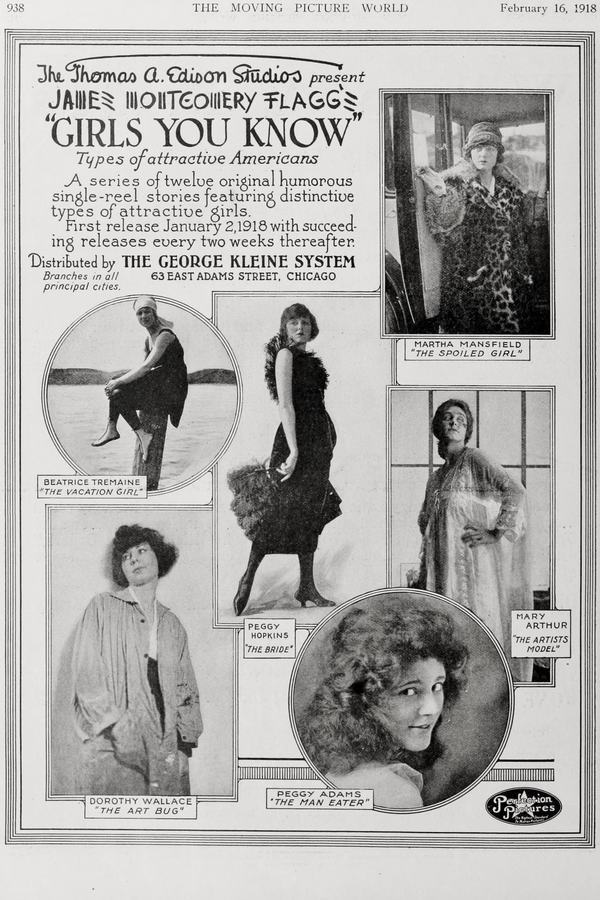
In the nascent days of cinema, when the silver screen was still finding its voice and defining its grammar, certain films emerged as audacious provocateurs, challenging societal norms and sketching character archetypes that would echo through decades of storytelling. James Montgomery Flagg’s 1915 silent feature, 'The Man-Eater', stands as a fascinating, if somewhat overlooked, artifact from this period. It’s a film that, despite its seemingly simplistic premise, delves into the complex dance of attraction, fidelity, and feminine agency with a surprising degree of insight for its era. Far from a mere melodrama, Flagg’s work, penned and helmed by the celebrated illustrator, offers a vibrant, albeit silent, commentary on the perennial battle of the sexes, rendered with a dash of playful cynicism.
At the heart of this cinematic exploration is Peggy, portrayed with an arresting magnetism by Claire Adams. Peggy is no shrinking violet; she is a force of nature, a veritable siren who, even after a seemingly tender farewell to a soldier beau, wastes no time in re-engaging with her primary pursuit: the art of 'man-eating.' This isn't a tale of villainy, but rather a compelling character study of a woman utterly confident in her allure, unapologetically wielding it as her primary tool for navigating the social landscape. Adams imbues Peggy with a captivating blend of innocence and cunning, her wide eyes and subtle smiles conveying volumes without the aid of dialogue. Her performance is a masterclass in silent film acting, where every gesture, every tilt of the head, every fleeting expression, contributes to the construction of a character who is both desirable and, to some, dangerously disruptive.
The film introduces us to Peggy at a lively picnic party, a pastoral setting that quickly becomes a battleground for romantic conquest. Here, her 'talons' find ample opportunity. She effortlessly captures the admiration of the unmarried men, many of whom are already entangled in other romantic commitments. But Peggy's ambitions extend beyond mere bachelors; she sets her sights on the party's sole married member, a transgression that immediately elevates the stakes and injects a potent dose of social scandal into the narrative. This audacious move positions Peggy not merely as a flirt, but as a genuine disruptor of the established order, a woman who dares to tread where others fear to even glance. Her actions resonate with a certain proto-feminist defiance, even if unintentional, as she asserts her desires without regard for conventional boundaries. One might draw a faint parallel to the rebellious spirit found in films like The Girl from Bohemia, where a woman navigates a world with her own distinct set of rules, though Peggy's motivations here seem purely driven by personal gratification and the thrill of the chase.
The film's most intriguing narrative turn arises from the collective indignation of the other women at the picnic. Witnessing Peggy's unparalleled success, particularly her audacious pursuit of the married man, they band together in a conspiracy born of resentment and a desire to restore perceived order. While the men are off swimming, enjoying a moment of masculine camaraderie and oblivious to the unfolding drama, the women devise a scheme: they hire a local farmhand to 'accidentally' stumble upon Peggy during a game of blind man's bluff, hoping to expose her in a compromising situation and thus diminish her magnetic appeal. This segment of the film offers a pointed, if somewhat cynical, commentary on female solidarity. Rather than finding common ground or challenging the patriarchal structures that might enable such 'man-eating' behavior, the women turn their ire inward, attempting to shame and ostracize one of their own. It’s a tragicomic depiction of the 'best laid plans of mice and women,' destined for failure.
The execution of their plot is where the film truly highlights its underlying themes of human unpredictability and the futility of trying to control natural forces, particularly those of attraction. The planned 'exposure' goes awry not because Peggy is particularly clever in evading it, but because she reacts with genuine fright. This moment of vulnerability, rather than diminishing her, ironically serves to heighten her appeal. Her frantic rush to the stream where the men are swimming, seeking refuge in their presence, instantly re-establishes her as the focal point of masculine attention. The very act intended to disgrace her instead reinforces her power, demonstrating how effortlessly she can command male focus, even in distress. This ironic twist underscores the film's central thesis: that certain individuals possess an innate charisma that defies conventional social engineering and the machinations of others. It’s a stark reminder that while society might attempt to dictate behavior, the raw forces of attraction often operate on a different, more primal, plane. This subversion of expectations is a hallmark of good storytelling, allowing the film to transcend its simple premise and offer a more nuanced observation on human nature, an aspect often explored in the more complex character dramas of the era, such as Her Greatest Performance, though with different thematic aims.
James Montgomery Flagg, primarily known for his iconic 'I Want You for U.S. Army' Uncle Sam poster, brings a distinctive visual sensibility to his directorial and writing debut here. The film benefits from his artist's eye, with compositions that are often striking and expressive, even within the technical limitations of early cinema. The narrative pacing, while deliberate by modern standards, effectively builds tension and allows for the development of character through visual cues and the actors' nuanced performances. Claire Adams, as Peggy, is undeniably the film's anchor. Her ability to convey coquetry, vulnerability, and an almost predatory confidence without a single spoken word is remarkable. She embodies the 'man-eater' not as a malicious figure, but as a woman simply living out her nature, a charming force that others find irresistible, for better or worse. Her performance is central to the film's success, making Peggy a compelling, rather than merely scandalous, character.
The supporting cast, including Flagg himself in an uncredited role, effectively rounds out the ensemble, each actor contributing to the vibrant atmosphere of the picnic party. Their reactions, ranging from the starry-eyed admiration of the bachelors to the indignant fury of the wives, serve as a vital counterpoint to Peggy's central performance. The film's use of intertitles is economical yet effective, providing necessary plot points and occasional sardonic commentary that enhances the overall tone. While silent films often relied on exaggerated gestures, 'The Man-Eater' finds a balance, allowing for moments of subtlety that belie its seemingly straightforward title. It’s a testament to the power of visual storytelling that, even without dialogue, the film manages to convey complex emotional states and social dynamics. Comparing it to another film of the era dealing with romantic complications, such as Married in Name Only, one can appreciate Flagg's more direct and less overtly moralistic approach to marital fidelity.
Beyond its surface narrative of romantic intrigue, 'The Man-Eater' offers a rich vein of thematic material for contemporary audiences. It’s a fascinating glimpse into early 20th-century gender dynamics, exploring the perceived threat of a woman who operates outside conventional expectations. Peggy’s character can be viewed as an early iteration of the 'femme fatale' archetype, though perhaps a more playful and less destructive version. She is not driven by malice or revenge, but by an almost innocent, yet potent, desire to engage and conquer. Her conquests are not about breaking hearts, but about the sheer thrill of the chase and the validation of her own power. This contrasts sharply with the often more tragic or morally condemned 'fallen women' characters prevalent in other films of the period, offering a more nuanced portrayal of female agency and desire.
The film also subtly critiques the fragility of male fidelity and the superficiality of societal judgments. The ease with which Peggy captures the attention of both single and married men speaks volumes about the inherent vulnerabilities within the male psyche and the often-tenuous nature of commitment when faced with overwhelming charm. The women's conspiracy, in its desperation and ultimate failure, highlights the societal pressure placed on women to uphold moral standards and police each other, rather than addressing the root causes of their collective anxieties. It’s a narrative that, despite its age, feels remarkably modern in its exploration of these complex power dynamics. One might even see echoes of this struggle for social capital and romantic success, albeit in a more lighthearted vein, in films like Easy Money, where characters navigate elaborate schemes to achieve their desires.
The film's enduring appeal lies in its willingness to portray a woman who is both alluring and unsettling, a character who refuses to conform to the docile or virtuous ideals often projected onto female figures of the era. Peggy’s unapologetic pursuit of male attention, and her uncanny ability to turn even a moment of fright into an opportunity for renewed masculine focus, solidifies her as a memorable figure in early cinema. Her story isn't about moral lessons, but about the sheer, undeniable force of personality and attraction, a force that can upend carefully constructed social orders and expose the underlying currents of desire that motivate human behavior. In this sense, 'The Man-Eater' serves as a playful yet profound commentary on the eternal game of love, lust, and social maneuvering, reminding us that some forces, much like Peggy herself, simply cannot be contained or outmaneuvered by the 'best laid plans.' The simplicity of the plot belies a deeper, more universal truth about human nature, making it a piece that transcends its silent film origins to offer a timeless reflection on the intricacies of attraction and societal response.
While not as overtly dramatic as some contemporary releases like The Little American, which tackled wartime anxieties with Mary Pickford, 'The Man-Eater' carves its own niche by focusing on domestic, yet equally potent, conflicts of desire and social standing. It’s a film that encourages us to look beyond the surface of its lighthearted premise and appreciate the subtle critiques embedded within its silent frames. The power of a captivating individual, the futility of collective schemes against raw charisma, and the ever-present tension between societal expectations and personal desires are all woven into this engaging cinematic tapestry. Flagg’s work, therefore, remains a compelling watch, not just for historians of early cinema, but for anyone interested in the enduring complexities of human relationships and the magnetic pull of an unapologetically self-assured woman.
IMDb 5.9
1926
Community
Log in to comment.