DbcultAccessing Vault...
Cult Review
Senior Film Conservator
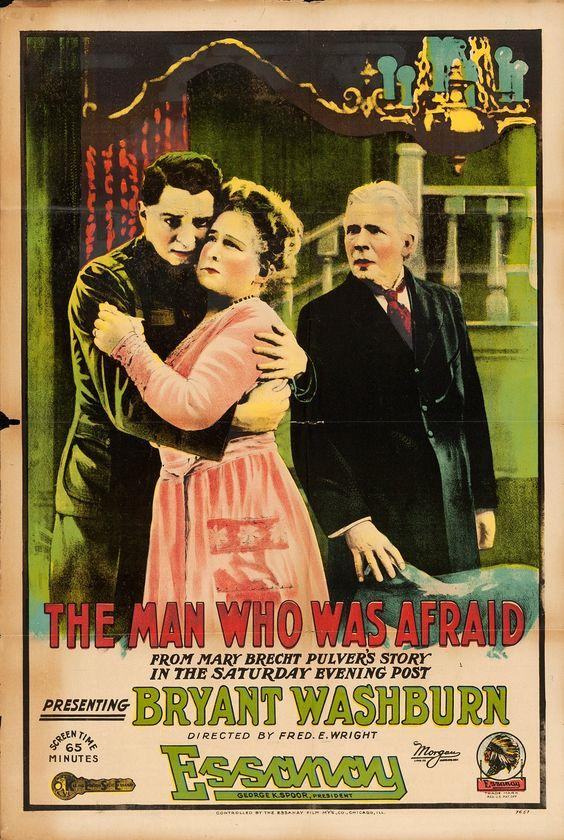
Amid the celluloid avalanche of 1917, while Chaplin’s tramp blithely tilted canes and Griffith’s Intolerance still echoed across lecture halls, The Man Who Was Afraid slithered into neighborhood theatres brandishing a war-whoop masquerading as domestic psychodrama. The opening title card—white letters quivering like moth-wings against obsidian—warns of a “mother’s love grown monstrous,” and already the picture stakes its claim in Freudian marshes rarely mapped on nickelodeon screens of the era.
Director H. Tipton Steck, better known then for punchy one-reel sermons, here stretches to five reels of escalating moral vertigo. His camera, often nailed to a floorboard, nonetheless breathes through chiaroscuro corridors: parlors drowned in lace doilies, armories where dust motes dance in projector light, a nocturnal battlefield lit only by magnesium flares that stencil the horizon like yellow fangs. The palette is monochromatic, yet Steck’s deployment of tint—amber for hearth, cobalt for night raids, sickly green for hospital tents—creates chromatic emotion that talkies would later chase with gels.
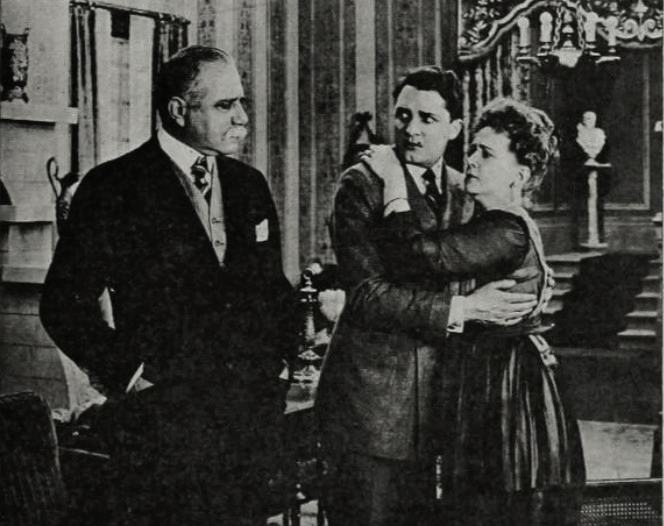
The plot, deceptively linear, corkscrews into a study of emasculation. Young Benton—Bryant Washburn channeling a boyish Harold Lloyd minus spectacles—traipses through early scenes with shoulders folded inward, as though apologizing for occupying space. His mother, played by matronly tyrant Frances Raymond, looms like a gothic prop: black lace, jet brooches, eyes twin revolvers. When the President’s mobilization order unfurls, the film’s mise-en-scène flips: newspapers flap like startled ravens, bunting festoons storefronts, and the camera tilts up to reveal recruiting posters where Uncle Sam’s finger becomes a dagger pointed straight at Benton’s forehead.
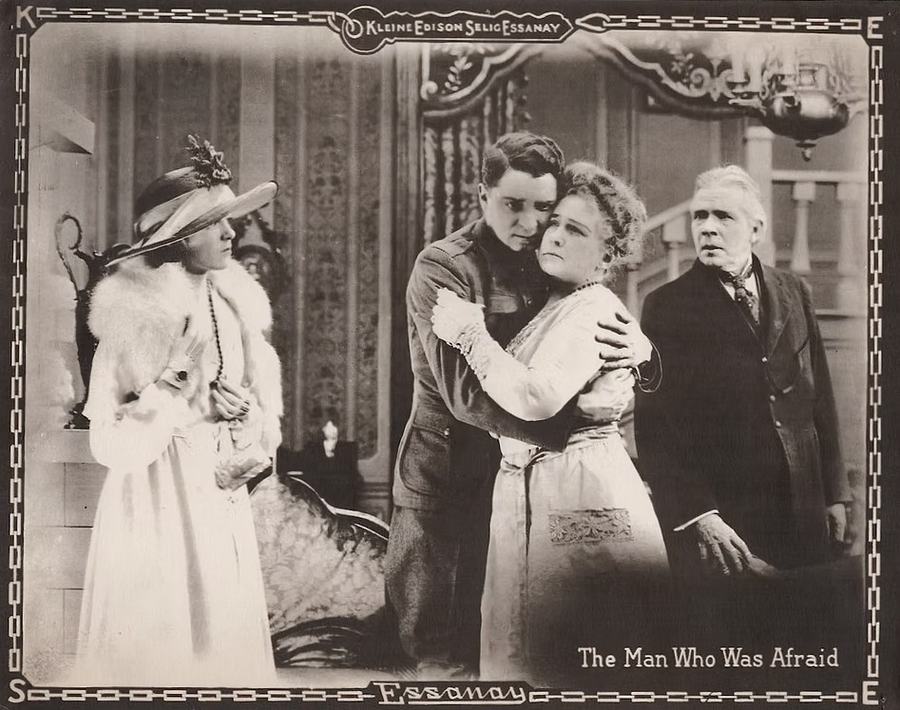
Mrs. Clune’s hysterics crescendo in a parlour sequence worthy of After Death’s morbid claustrophobia: she collapses atop her son’s duffel, clutching it as though it were a coffin lid. The intertitle reads: “If you march, I perish.” The oedipal vise tightens; Benton’s requisition for resignation is signed beneath her portrait, whose glass shatters from the pressure of her grip—an unsubtle yet chilling flourish.
Once word leaks, the town becomes a Greek chorus in wool suits. Shopkeepers slide coins across counters as though contaminated by his fingers; children ape soldiers in the dirt, pointing stick-bayonets at Benton and yelling “Boo-hoo Benton!” The sequence evokes The Little American’s hometown jingoism, yet Steck lingers on faces—each jeer a miniature daguerreotype of wartime intolerance. Even the family pastor, eyes milk-blue behind wire spectacles, brandishes a bible like a cudgel while denouncing cowardice from his pulpit, the cross behind him shot from below so its shadow becomes a guillotine.
Romantic fallout arrives via Margaret Watts as Rose Maynard—her name invoking both flower and battleground. Rose’s rejection letter, delivered in a medium-close-up of gloved hands, is recited in intertitle with Puritanical fire: “I love courage more than I love you.” Watts, though second-billed, magnetizes the lens: her pupils oscillate between pity and contempt, a flicker-book of ambivalence. Their parting kiss—attempted, then withheld—leaves negative space between faces that seems to throb like a bruise.
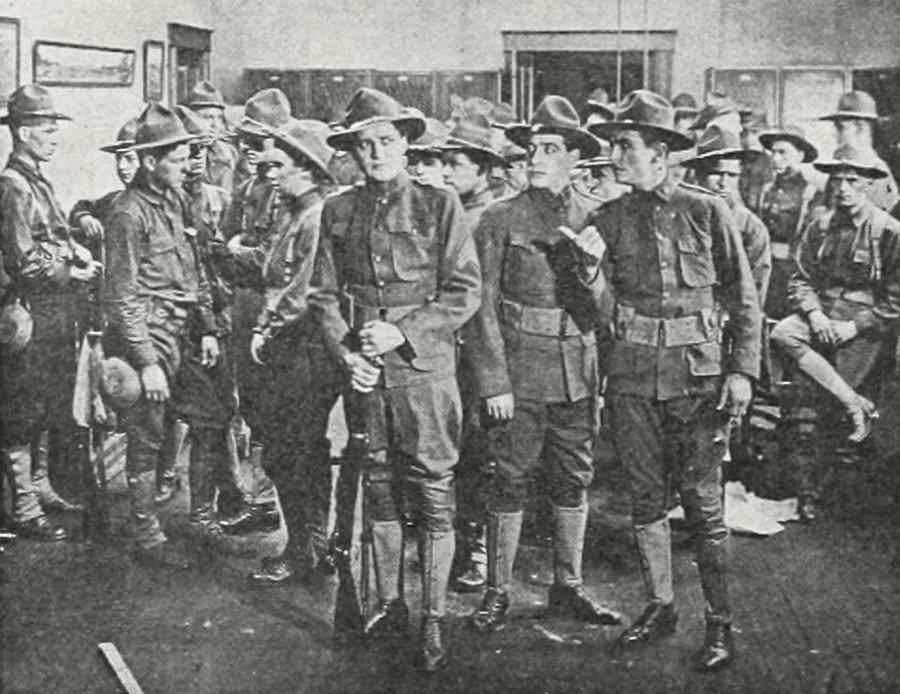
At the 42-minute mark the film’s pulse spikes into serial-style suspense. Benton, stung by a drunken barbershop quartet harmonizing “Where are your medals, boy?”, steals a horse and gallops toward the front lines—a nod to Captain Alvarez’s swashbuckling rides, minus the sombrero. The subsequent cross-cutting between Benton’s nocturnal dash and his regiment’s entrapment anticipates the last-minute-rescue grammar later canonized by The Exploits of Elaine. Yet Steck withholds catharsis: each ridge reveals silhouettes of snipers, each creek reflects moonlight like bayonets.
The volunteer-for-despatch scene—filmed in a trench waterlogged to ankle-depth—serves as moral pivot. Soldiers who once hurled epithets now avert gaze, their faces mud-daubed masks of shame. Benton steps forward, silent, the camera tracking his boots until they fill frame: a visual affidavit of footed resolve. A captain hands over a dispatch tube sealed with crimson wax the color of #C2410C—subtle yet thematically apt.
Bryant Washburn toggles between neurasthenic and valiant without the aid of spoken inflection; his gait lengthens, spine erects, jaw squares as though surgically altered by self-respect. In close-up, eyes once dewy now ignite with the yellow ferocity of #EAB308—a practical effect achieved by candlelight reflection on his irises.
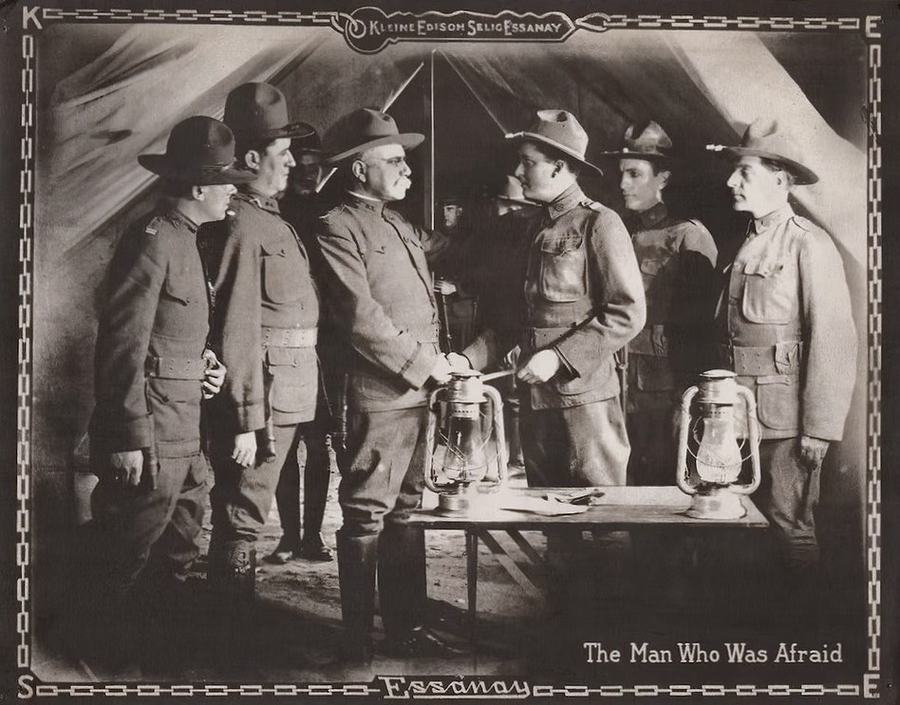
As foil, Ernest Maupain’s Colonel Blake swaggers with white moustache waxed to sabre-points, yet his jovial mask slips when reinforcements fail to arrive—revealing a tremor that speaks to the impotence of command. The ensemble’s physical vocabulary—thumbs hooked in suspenders, shoulders rolling to release tension—conjures a living etching of 1910s Americana.
Cinematographer Mark Ellison (also essaying Lieutenant Harris) employs a proto-noir chiaroscuro: key lights slash across faces, leaving half in umbra as if every visage were perpetually poised between honor and disgrace. Recurrent imagery—broken mirrors, unlatched gates swaying in wind—echoes The Vanderhoff Affair’s visual lexicon of fractured identity. Smoke from battlefield pyres drifts across the lens, creating double-exposure phantoms that prefigure German Expressionism.
Co-writer Mary Brecht Pulver, a Chicago journalist, injects proto-feminist undercurrents. Intertitles skewer maternal possessiveness with scalpel brevity: “Her love, a velvet vise.” Pulver’s subtextual argument—that smothering nurturance can unman as surely as battlefield wounds—renders the film a gender-studies artifact avant la lettre. Dialogue cards eschew period slang for staccato poetry: “Bullets write truth in flesh.”
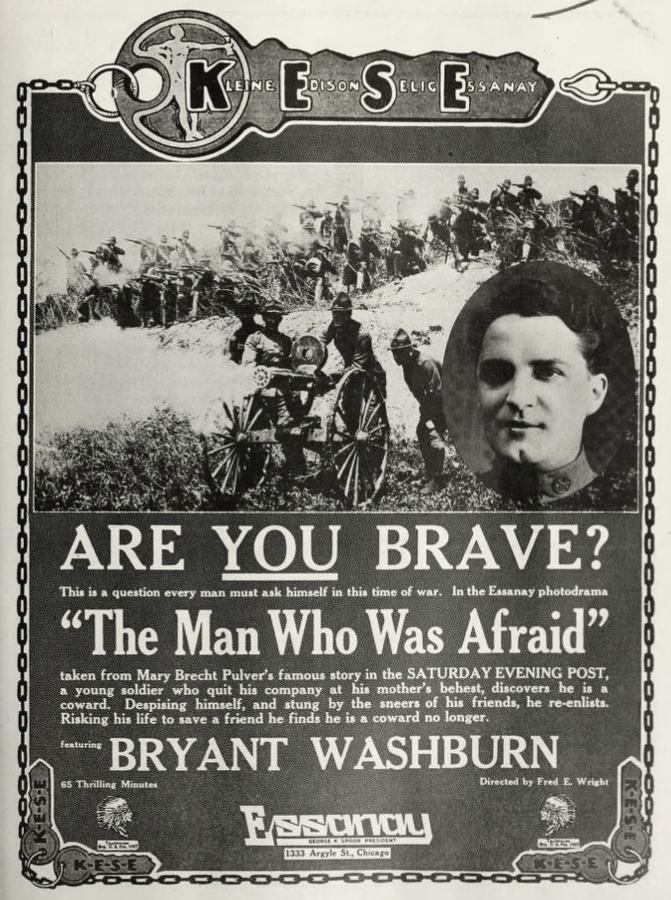
Though originally accompanied by house pianists thumping Sousa, modern restorations favour a collage of parlour ballads, field drums, and distant bugle. When Benton dashes through enemy lines, a solo cello tremolo swells to near-audible scream, bridging the gap between diegetic hoofbeats and audience cardiac rhythm.
Released months after America’s entry into WWI, the film flirts with recruitment propaganda, yet its nucleus trembles with ambivalence. The mother’s anti-war hysteria is neither caricatured nor vindicated; the enemy remains faceless, sketched only by shell-bursts. Compare this opacity to Cleopatra (1917), where Roman legions parade in gaudy pageantry—here, war is a fog, a crucible, not a jingoistic parade.
Trade papers of 1917 praised its “red-blooded vigor,” though the Chicago Defender decried its reinforcement of maternal guilt. Today, digitized prints on archive.org garner cine-club cult status; Twitter threads dissect its oedipal strata with GIFs of Benton’s horse leaping barbed wire. Critics rank it alongside Blodets röst for Scandinavian-style austerity, though its DNA is pure Midwestern nickelodeon.
The climactic ride foreshadows Sergeant York’s conversion narrative; the maternal choke-chain resurfaces in Johnny Got His Gun. Even Hitchcock’s Saboteur zoo-set finale borrows the notion of public shaming as prelude to heroism. Video-essayists splice Benton’s trench sprint into montages beside The Mediator’s arbitration scenes to highlight American individualism versus communal duty.
A 4K scan of a 35mm nitrate print held at MoMA reveals hairline scratches emulating gunpowder grain, while DTS stereo scores add sub-bass artillery thuds. The cyan-tinted night sequences now glow with #0E7490 hues, rendering darkness iridescent rather than murky. Be wary of YouTube prints sporting Portuguese intertitles—those derive from a South-American distribution negative riddled with re-cuts.
Ninety-odd years on, The Man Who Was Afraid survives as a cracked mirror reflecting both 1917’s patriotic fever and the eternal tango between suffocating love and emancipatory courage. Its flaws—histrionic gestures, recycled barn-studio sets—are eclipsed by its bracing sincerity. Watch it at 2 a.m. with headphones, lights dimmed, and you may feel the celluloid’s nitrate heartbeat syncing with your own, reminding you that bravery is seldom the absence of fear, but the moment one pedals through shame toward gun-smoke redemption.
IMDb 5.2
1931
Community
Log in to comment.