DbcultAccessing Vault...
Cult Review
Senior Film Conservator
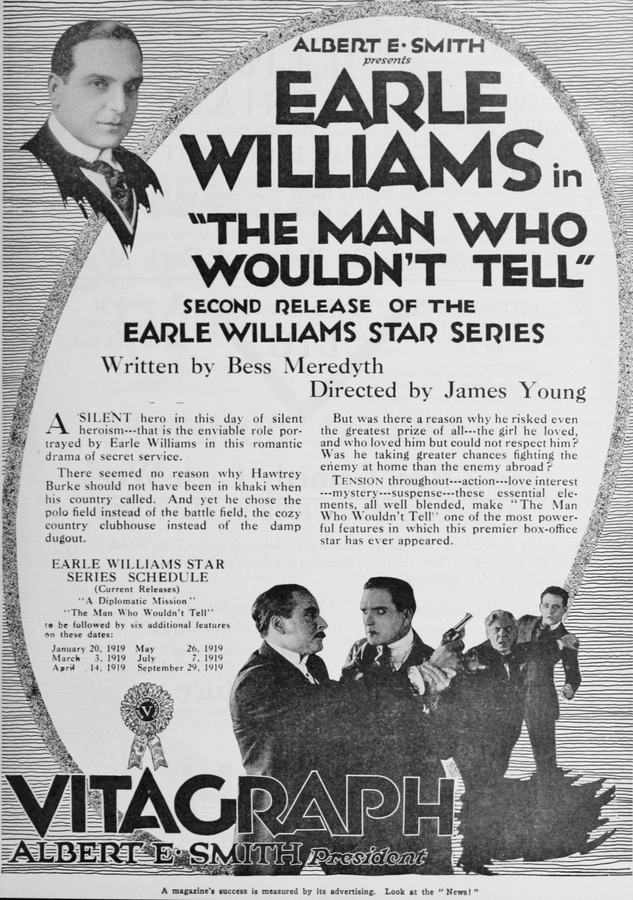
Step back in time to an era when cinematic storytelling was a symphony of light, shadow, and grand gestures, where the eloquence of an actor's gaze spoke volumes beyond any spoken word. We're diving into the heart of The Man Who Wouldn't Tell, a 1917 silent film that masterfully weaves together the threads of wartime intrigue, societal judgment, and a deeply personal quest for vindication. Directed by James Kirkwood and penned by the remarkable Bess Meredyth, this motion picture stands as a fascinating artifact from a period rife with global turmoil, reflecting the anxieties and patriotic fervor of its time through a lens of melodrama and espionage.
At its core, The Man Who Wouldn't Tell is a narrative built on misdirection, a testament to the power of appearances and the often-misguided nature of first impressions. Our protagonist, Hawtrey Burke, portrayed with a compelling blend of nonchalance and underlying gravitas by Edward Cecil, cuts a dashing figure in New York society. His charm is undeniable, his skill at polo legendary, yet beneath this veneer of leisurely aristocracy lies a secret that fuels the film's entire dramatic engine. In a world gripped by the Great War, Burke's conspicuous absence from the front lines is not merely questioned; it's condemned, particularly by Elinor Warden, played by the captivating Grace Darmond. Elinor, a woman whose spirit has been forged in the crucible of war-torn Belgium, embodies the era's fierce patriotism and moral conviction. Her inability to comprehend Burke's perceived idleness sets up a delicious tension, a simmering conflict between her idealism and his enigmatic reality.
The plot thickens with the brutal murder of Joseph Fuhrman, a shipping agent whose demise ignites a chain of events that exposes the underbelly of wartime New York. Elinor's brother, Dudley, a soldier on furlough from the relentless battlefields of France, finds himself ensnared in this web of deceit. Accused of the crime by Eric Werner, a character imbued with a palpable sense of menace by Charles Spere, Dudley's fate seems sealed. Werner's motivations are far from altruistic; his accusations are poisoned by a deep-seated covetousness for Elinor, adding another layer of personal betrayal to the unfolding drama. This isn't just a murder mystery; it's a battle for reputation, for love, and ultimately, for truth itself. The film, much like contemporary melodramas such as Blazing Love or Her Temptation, understands the power of heightened emotion and moral stakes, but elevates them with a timely, international context.
The courtroom scene, a common trope in silent cinema for its inherent dramatic potential, is executed with a flair that keeps audiences on the edge of their seats. As Dudley’s trial reaches its fever pitch, the lights are plunged into darkness, and a gunshot echoes through the tense silence, striking Dudley down. This moment, a masterclass in visual suspense, immediately casts suspicion upon Hawtrey Burke, who is promptly arrested. Yet, in a twist that only deepens the mystery surrounding him, Burke is released on a technicality, leaving both Elinor and the audience to ponder the true nature of this inscrutable Englishman. Earle Williams, though playing a more supporting role, adds a layer of earnestness to Dudley, making his plight all the more poignant.
The true genius of Bess Meredyth's screenplay lies in its meticulous build-up to the grand reveal. The arrival of a British Commission in the United States provides the perfect stage for Burke's clandestine operations to come to light. His wireless message, a lifeline warning the steamer of a lurking U-boat, is the first definitive proof of his active, vital role in the war effort. This isn't a man avoiding duty; he is a man embodying it in its most dangerous, unseen form. The Commission's safe arrival in New York is not just a diplomatic success; it's the moment of Hawtrey Burke's public vindication. He is finally unmasked as a British Secret Service agent, his earlier aloofness and perceived idleness transforming into calculated bravery and strategic genius. This reveal is a deeply satisfying payoff, akin to the unraveling of complex plots in films like The Spoilers, where justice, though delayed, is ultimately served.
With Burke's identity laid bare, the pieces of the puzzle fall into place. Eric Werner, the self-serving accuser, is exposed as the true German spy, the very individual who shot Dudley. The revelation that Dudley had, in fact, been working for Burke all along adds a tragic layer to his sacrifice and underscores the profound personal cost of espionage. It’s a moment that resonates with the themes of hidden loyalties and the sacrifices made for a greater cause, much like the grander narratives found in epics such as War and Peace, albeit on a different scale of conflict. In this moment of truth, Elinor's earlier scorn dissolves into profound penitence and, crucially, a heartfelt confession of her love for the Englishman whose true courage she had so long misjudged. It's a classic romantic arc, where misunderstanding gives way to profound affection, a trope explored in various forms, from The Wildcat to La falena, but given a unique wartime twist here.
Edward Cecil as Hawtrey Burke delivers a performance that is both restrained and intensely expressive. His ability to convey a character living a double life, maintaining an air of detached elegance while harboring vital secrets, is central to the film's success. He doesn't just play a role; he embodies the very concept of the 'man who wouldn't tell,' his eyes often communicating more than any intertitle could. Grace Darmond's Elinor Warden is equally compelling. Her initial indignation and moral certainty are palpable, making her eventual realization and emotional surrender all the more powerful. She is not merely a damsel in distress but a woman of conviction, whose journey of understanding mirrors the audience's own. Charles Spere's Eric Werner, meanwhile, provides a suitably slimy antagonist, his malevolence a stark contrast to Burke's quiet heroism.
Bess Meredyth's writing, even in its silent form, is remarkably tight and purposeful. Each plot point, each character interaction, serves to advance the central mystery and deepen the emotional stakes. Her ability to craft a narrative that balances personal drama with high-stakes espionage, all within the constraints of silent film storytelling, is commendable. The film’s pacing is expertly handled; it builds tension gradually, punctuated by moments of high drama like the courtroom shooting, before delivering a climactic reveal that ties all the disparate threads together. This kind of narrative dexterity is the hallmark of a skilled storyteller, capable of captivating an audience without uttering a single word, similar to the intricate plots seen in films like Toys of Fate or The Child of Destiny, where destiny and hidden truths often intertwine.
The backdrop of World War I is not merely incidental; it is integral to the film's very fabric. Elinor's experience in Belgium grounds her character in the harsh realities of the conflict, making her judgment of Burke understandable, even if ultimately mistaken. The presence of a U-boat, the British Commission, and the German spy all serve to remind the audience of the global conflict raging beyond the comfortable confines of New York society. The film taps into the pervasive fear of enemy agents and the widespread patriotic sentiment that characterized the era. It explores themes of duty, sacrifice, and the hidden heroism that often goes unrecognized, challenging the conventional notions of what it means to serve one's country. This reflection of national sentiment and the exploration of duty can be seen in other films of the period, though perhaps less overtly in the realm of espionage, such as The College Orphan, which deals with personal responsibility and proving oneself.
Moreover, The Man Who Wouldn't Tell subtly critiques societal superficiality. New York society, initially captivated by Burke's charm, is quick to condemn him based on appearances. Elinor, despite her wartime experience, falls prey to similar prejudices. The film ultimately champions a deeper understanding, suggesting that true heroism and character often reside beneath the surface, hidden from plain view. This thematic depth elevates it beyond a simple spy thriller, imbuing it with a timeless message about perception versus reality. It asks us to look beyond the immediate, to question what we see, and to understand that the most significant battles are often fought in the shadows, by those who, for a myriad of reasons, cannot or will not tell their full story. This exploration of hidden identity and eventual revelation connects with narratives like The Lad and the Lion or Masked Ball, where true selves are often concealed until a dramatic climax.
As a piece of silent cinema, The Man Who Wouldn't Tell stands as a testament to the artistry of the era. The reliance on strong visual storytelling, expressive acting, and well-placed intertitles required a different kind of narrative craftsmanship. The film's ability to convey complex emotions and intricate plot details without dialogue is a marvel. The use of dramatic lighting, particularly in the courtroom scene, and the careful framing of shots to emphasize character reactions or crucial objects, showcase the sophistication of filmmaking techniques even in its nascent stages. It's a reminder that compelling narratives transcend technological limitations, proving that a powerful story, well-told, can captivate audiences regardless of the medium's particular constraints. Bess Meredyth, a prolific writer of the silent and early sound eras, demonstrates her enduring talent here, crafting a story that still resonates with its themes of duty, deception, and the ultimate triumph of truth and love. Her work here is as intricate and emotionally resonant as her other notable works, contributing significantly to the landscape of early Hollywood. The film, in its quiet power, stands alongside other dramatic narratives of its time, such as Less Than the Dust or The Fettered Woman, in its exploration of human struggles and societal pressures.
In conclusion, The Man Who Wouldn't Tell is far more than a historical curiosity. It is a vibrant, engaging silent film that offers a rich tapestry of espionage, romance, and wartime drama. Its compelling plot, strong performances from Edward Cecil and Grace Darmond, and expert pacing make it a standout example of early cinematic storytelling. It reminds us that heroism often wears a disguise, and that judgment without understanding can lead to profound regret. For enthusiasts of silent film, or anyone with an interest in the artistic and cultural reflections of the World War I era, this film offers a deeply rewarding experience, a window into a past where silent images spoke volumes and the human heart, in all its complexity, was laid bare. Much like adaptations of enduring literary works such as The Old Curiosity Shop, this film captures the essence of its narrative with a distinctive visual language, proving the power of storytelling across different eras and formats. The film’s lasting impact lies not just in its historical context but in its timeless exploration of human nature, making it a valuable piece of cinematic heritage that continues to intrigue and move audiences even today.
IMDb —
1916
Community
Log in to comment.