DbcultAccessing Vault...
Cult Review
Senior Film Conservator
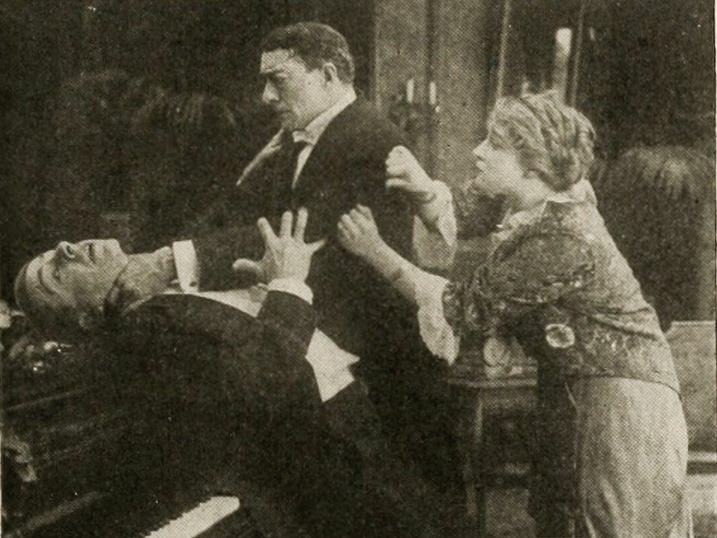
Picture a ballroom chandelier as a glittering spider, each crystal a dew-beaded filament snagging moths in white ties and tiaras. Now imagine the spider’s keeper: Jack Frobisher—sun-leathered stockman who once smelled of lanolin and drought—now reeking of Turkish cigarettes and the metallic after-tang of newly minted gold. He is the richest fly in the web, yet every thread he touches turns to debt. That is the exquisite ache pulsing through The Walls of Jericho, a 1914 melodrama that feels less like period furniture and more like a cracked mirror held up to every gilded cage from The Squaw Man to Der Millionenonkel.
Director Lloyd B. Carleton, usually a studio workhorse, here conducts his scenes like a man wire-walking over a cesspool of etiquette. Observe the first act: Queensland paddocks replaced by velvet-lined salons where a sheep baron’s blunt vowels ricochet off plaster medallions. Stuart Holmes plays Frobisher with the bodily unease of someone who has swapped a saddle for a soup-spoon and still expects the horse to obey. Watch him tug at his white gloves as if they might sprout teeth. The gesture is tiny, but it tells us every colonial nightmare: that civilisation is only glove-deep, and the hand inside still itches for a stock-whip.
Enter the wife—Lady Eva, daughter to a marquis whose estates survive on the life-support of Frobisher’s promissory notes. Claire Whitney turns her into a porcelain grenade: smile painted, eyes timed to detonate at the precise moment the dowry runs dry. Their marriage is a tango danced on quicksand; each step a transaction—her pedigree for his purse—until the music stops and both realise they are barefoot in sinking sand.
The film’s visual grammar is Edwardian opulence shot through with expressionist dread. Interiors are cavernous, echoing like bankrupt cathedrals; exteriors—Scottish moors, Solent mists—breathe with a dampness that seems to rust the very celluloid. Carleton repeatedly frames Frobisher against doorways: a man forever on the threshold, neither colonial pastoral nor aristocratic parasitism willing to claim him. In one stunning iris-shot, the circular mask closes until only the millionaire’s eye fills the screen—an eye that has seen drought-decimated flocks and now watches titled vultures pick at his resolve.
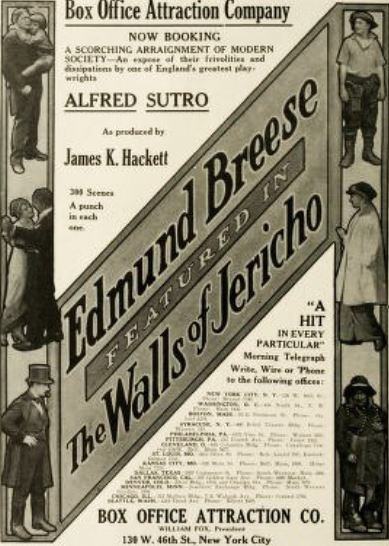
Yet the picture’s true engine is not money but noise—specifically the absence of it. This is a silent film obsessed with trumpets we cannot hear. The biblical metaphor is brazen: Joshua’s horns brought stone ramparts tumbling, and Frobisher’s roar—when it finally erupts—must topple drawing-room ramparts of whispered scandal. The screenplay (by Alfred Sutro and Anthony Paul Kelly) plants the motif early: a children’s fancy-dress parade where a boy brandishes a papier-mâché ram’s horn. Later, during the climactic ball, an off-screen orchestra strikes up a march whose brass section the intertitles describe as “the trumpets of Israel.” We never hear a note; instead we see chandeliers tremble, crystals shimmying like terrified atoms. It is cinema doing what only cinema can: making silence thunder.
Compare this to other 1914 parables of new money colliding with calcified caste—When Paris Loves or The Valley of the Moon. Those films flirt with redemption through love; Jericho is far more nihilistic. Frobisher’s fortune is Midas-cursed: every cheque he writes purchases another inch of moral quicksand. He funds sanitary tenements for East-End dockworkers, but the marquis snorts, “One doesn’t disturb the poor with hygiene—they’ll only grow numerous.” The line, delivered by Edmund Breese with a languid flick of a cigar, is played for laughs yet lands like a death sentence. It exposes philanthropy as vulgar when it threatens the social dividend of misery.
The women are no saints either. Lady Alethea—Eva’s sister, played with serpentine glee by an uncredited actress—embodies the predatory ingenue. She angles to marry Hanky Bannister, Frobisher’s Australian compatriot, as casually as one might bid two spades. Observe her at the croquet lawn: she measures Bannister’s shoulders with the same clinical detachment she applies to mallet angles. Marriage is sport, and sport demands score-keeping. When Frobisher sabotages the engagement by revealing her calculated mercenariness, she retaliates by feeding his wife’s affair with Harry Dallas, a rake whose moustache curls like a question mark asking, “Why not?” Dallas—Walter Hitchcock in velvet lounging jackets—has the physiology of a man who has never once opened a window; pallor clings to him like cigar smoke.
And so we arrive at the film’s centrepiece: the interrupted love-letter scene. Dallas, cornered in the boudoir, must recite his own lyrical filth while Frobisher stands sentinel, arms crossed as though inspecting a diseased carcass. The intertitle drips acid: “‘My dear Eva, last night was a prelude…’” Each word Dallas utters peels another layer of varnish from the aristocratic veneer. Carleton shoots this in chiaroscuro: Dallas’ face half-lit, half-devoured by shadow, the ink-stained letter trembling like a confession soaked in absinthe. When Frobisher finally bellows his verdict—“I’ve had enough!”—the camera tilts upward to the ceiling fresco: cherubs tumbling in a painted sky, as if even putti are routed by the Australian’s fury.
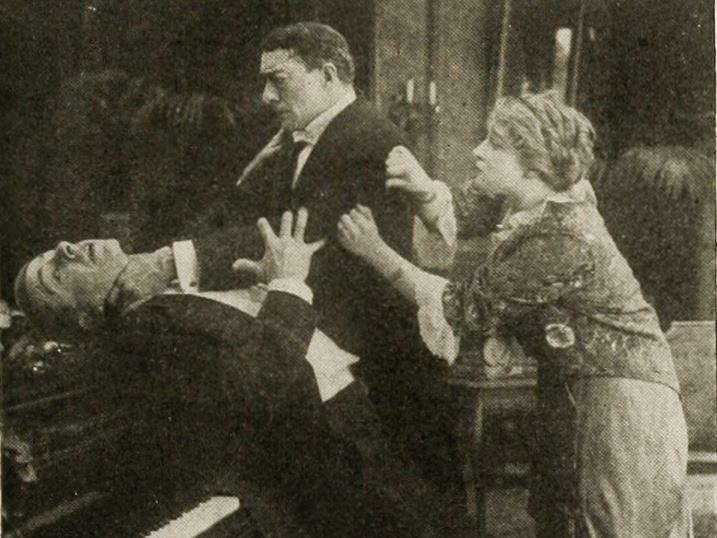
What follows is the most radical narrative gambit of any 1914 domestic melodrama: the husband does not forgive. No third-act reconciliation tendered by a contrite wife, no soft-focus embrace while strings swell. Instead Frobisher auctions his English holdings—Mayfair mansion, Scottish grouse moor, Solent yacht—as swiftly as a station-hand selling drought-starred ewes. The montage is brisk: auctioneers’ gavels, solicitors’ ink, steamship tickets punched with mechanical finality. The last tableau shows the family on an ocean liner deck, infant son clutching a toy ram’s horn. Eva stands beside her husband, eyes hollow, wind whipping her veil like a flag of surrender. Behind them, the white cliffs of Dover recede—not beloved, not mourned, merely dismissed.
Critics of the era, besotted with Edwardian propriety, recoiled. The Bioscope sniffed that the film “encouraged matrimonial desertion under the guise of moral hygiene.” Yet modern eyes will recognise a prescient anatomy of wealth’s Faustian bargain: that to buy entry into ancestral corruption is to mortgage one’s soul, and the price is always repossession. In an age when Russian oligarchs purchase football clubs and Silicon Valley demi-gods collect ducal titles, Frobisher’s exit feels less like melodrama than prophecy.
Technically, the film is transitional. You can still spot the residue of theatrical tableau—actors holding poses until the last foot of film rattles through the gate—but Carleton also experiments with continuity cuts. During the bridge scandal, he cross-cuts between the boudoir table (cards palmed, eyes narrowed) and the ballroom where a violinist, sensing tension, slows his bow. The juxtaposition creates a pre-Eisensteinian dialectic: greed in close-up, art in long-shot, the whole social contract collapsing between notes.
The performances resist the era’s penchant for gesticulatory semaphore. Stuart Holmes underplays; his clenched jaw does more acting than most starlets’ entire torsos. Claire Whitney oscillates between porcelain doll and cracked china without once soliciting sympathy—an astonishing feat in an era that demanded fallen women weep their way to absolution. Edmund Breese, as the marquis, delivers a masterclass in aristocratic entropy: spine curved by centuries of entitlement, voice a drawl that sounds like money rotting.
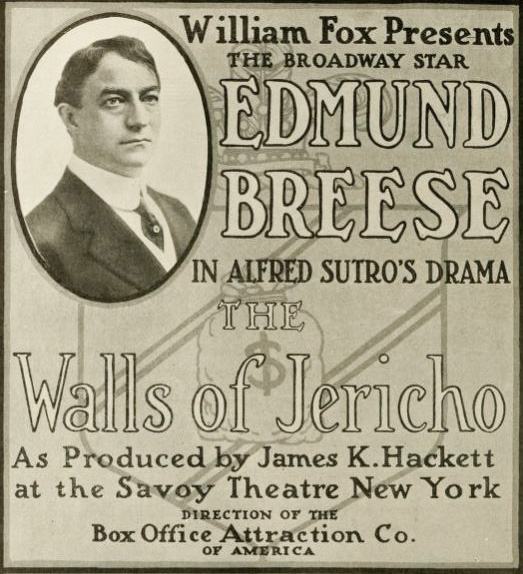
Alas, the film survives only in fragmentary form—roughly 42 minutes at Library of Congress, spliced with Russian intertitles from a 1917 Mosfilm distribution. Nitrate decomposition has chewed the ballroom sequence into a fever dream of phantom limbs. Yet what remains is potent enough to haunt. Watching it is akin to entering a stately home where the portraits’ eyes have been scratched out: you supply the horror.
Comparison with contemporaneous morality plays only sharpens its edge. O Crime de Paula Matos punishes female transgression with death; Satyavan Savitri redeems it through divine intervention. Jericho offers neither damnation nor salvation—only exile. Frobisher’s Queensland ranch, glimpsed in flashback, is no Eden; it is red dust, scorched grass, the hard dignity of labour. Yet exile becomes the sole ethical act left to a man who has tried buying virtue and discovered it non-negotiable.
Some viewers fault the coda: Lady Westerby’s eleventh-hour plea that persuades Eva to accompany her husband. They call it compromise. I read it differently: Eva, stripped of admirers, fortune, and social capital, faces the asylum or the antipodes. Her consent is not reconciliation but survival—a final transaction in a life mediated by nothing else. The true revolution lies in the child clutching that toy horn: second-generation wealth born in exile, too young to inherit either guilt or grandeur.
Criterion devotees will bristle at the absence of a pristine print; cinephiles attuned to mysteries of Edwin Drood or Bjørnetæmmeren will forgive. What survives is a fossilised howl against the gilded cage, a trumpet blast that still reverberates in every modern mansion bought with new-world money and old-world shame.
Verdict? Seek it out, even mutilated. Let its shards cut your complacency. And when next you stroll through Mayfair, past embassies bought by oligarchs and penthouses sealed against daylight, remember Frobisher’s parting roar—words that feel tattooed on the inside of the camera lens: “Done with it all.” The walls may rebuild, but the echo never quite dies.
IMDb 5.2
1933
Community
Log in to comment.