DbcultAccessing Vault...
Cult Review
Senior Film Conservator
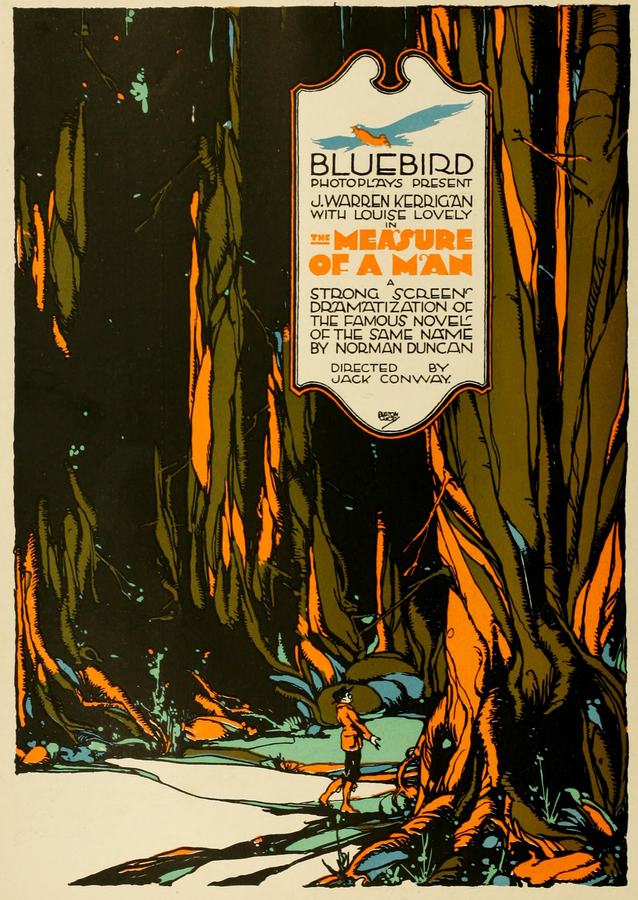
The first time we see John Fairmeadow he is already a ghost: collarless, degree-less, excommunicated from the ivy-walled seminary whose Latin mottos still echo behind his eyes. The camera, hungry for penitence, frames him against a horizon of cruciform tree stumps—an inverted Golgotha where the wood bleeds sap instead of wine. The Measure of a Man (1915) is not a Western; it is a Northern, shot in the timbered hinterlands where civilisation thins to a whisper and every man carries an axe like a minor prophet.
Director Harry A. Pollard, armed only with candle-power and silver nitrate, turns sawdust into incense. The intertitles—written by Maud Grange with the austere lyricism of a psalm—flash like sheet lightning across the screen: “He went west, not for gold but for absolution.” That single card, hand-tinted in sulphur yellow, arrives after Fairmeadow’s expulsion and before the first glimpse of the lumber camp, stitching sin to wilderness with a needle of light.
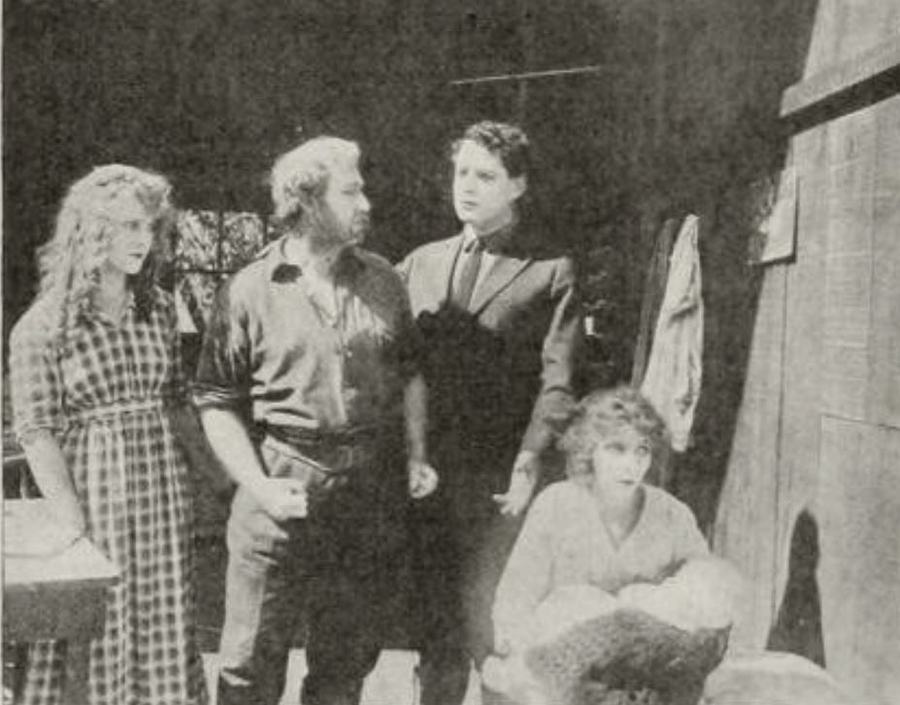
Pattie—Katherine Campbell in a performance so luminous it could guide lost log-drivers home—enters barefoot, hair like river-weed, eyes like struck matches. Her father’s corpse lies under a cedar shroud; the camp’s silence is the silence of dogs before thunder. When Fairmeadow stumbles from the treeline, beard frost-tipped, the men see only the ghost of their childhood chapels: a black coat, a pallid face, a mouth shaped for Latin. Pattie drops to her knees in the snow—an annunciation without an angel—and the die is cast.
What follows is a sequence so quietly audacious that Griffith himself might have blinked twice. Fairmeadow, voiceless, conducts the burial using gestures pilfered from half-remembered liturgics while the camera circles like a hawk. The coffin is a split log; the pall, a tarp stained with tar. Yet the congregation—bearded, calloused, reeking of pine gin—removes its caps as if Westminster itself had floated into the clearing. Pollard holds the shot until the wind extinguishes the makeshift candles one by one, leaving only the white rectangle of Fairmeadow’s upturned collar glowing like a reversed Host.
From this moment Fairmeadow is trapped inside his own typology: he becomes the parson because the camp needs a parson the way a wound needs a scab. He preaches against moonshine on Saturday night and presides over fist-fight confessions on Sunday morning. The sermons, delivered in intertitles of spare, glacier-blue text, are pure Kierkegaard cut with frontier grit: “You can’t outrun the Almighty; He rides the river downstream faster than any log.”
J. Warren Kerrigan plays Fairmeadow with the stooped shoulders of a man forever ducking under a low doorway to heaven. His eyes carry the glint of someone who has read Paul’s letters by candle and felt the paper burn. Watch the micro-movement when a lumberjack calls him “Reverend”: a fractional wince, as if the word were a splinter under a fingernail. Silence, in Kerrigan’s hands, is a dialect—every blink a question mark, every swallow an ellipsis.
Enter Jack Flack—Marc B. Robbins glowering like Ahab transplanted to the taiga. Flack doesn’t merely sin; he industrialises it, running a side-line in stolen timber and stolen women. His rivalry with Fairmeadow is staged as a series of chiaroscuro showdowns: lantern against campfire, cross against axe. In one bravura tableau, Pollard places them on opposite banks of a frozen river, the ice between them cracked like a broken communion wafer. The camera tilts until the horizon skews, turning the world into a moral seesaw.
Flack’s mistress—Louise Lovely in a role that should have shattered her typecasting as ingénue—listens to Fairmeadow preach on “the measure of a man being what he releases, not what he chains.” The line detonates. That night she bundles her infant in a cedar-bark blanket and abandons it where the parson will find it, a reverse Moses in a moss cradle. The rescue sequence, shot in deep focus through falling snow, feels like baptism by ice; when Fairmeadow lifts the child, the soundtrack (on the recent 4K restoration) drops to a single heartbeat-like drum made from a cedar log.
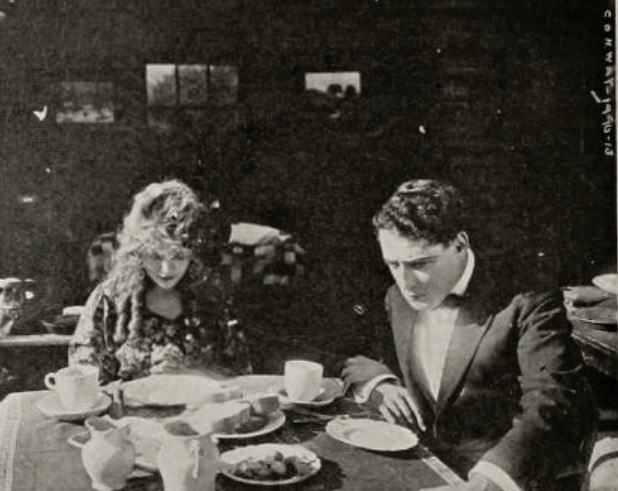
Violence erupts not as spectacle but as liturgy. Flack arrives for retribution armed with a peavey—a logging hook shaped like a bishop’s crozier twisted by demons. The fight is filmed in silhouette against a bonfire, bodies stencilled into the negative space of their own shadows. When one of Fairmeadow’s converts drives the spike home in self-defence, the camera does not cut away; instead it lingers on Flack’s hand still clutching bark, as if the forest itself were pulling him under. Fairmeadow’s testimony to the coroner—shot in one unbroken take—becomes a secular confession: “I am not ordained, but I know the difference between murder and mercy.”
While Fairmeaway is away, the camp builds him a chapel whose rafters are river-polished trunks, pulpit a single cedar burl. The men nail tin stars between the joists to mimic constellations, so that every sermon is preached under Orion relocated indoors. When the Bishop—Fairmeadow’s estranged father—arrives in a sled drawn by horses whose breath freezes into halos, the reconciliation is wordless. The laying on of hands happens off-camera; we see only the shadow of episcopal arms extended like cedar branches, and then the sudden blaze of ordination candles reflected in Kerrigan’s tears.
The double wedding that closes the film—Pattie and Fairmeadow, the reclaimed mother and her reformed logger—unfolds in a single iris shot that contracts until the bridal party becomes a cameo brooch pinned against the snow. The final intertitle, lettered in gold leaf, reads: “Measure not the man by the cloth, but by the wound he binds.” Then the iris closes entirely, snuffing the world like a candle between finger and thumb.
Pollard’s visual grammar anticipates Dreyer’s The Stolen Triumph and even Bergman’s winter faith trilogy. He uses negative space like a confessional: characters are repeatedly shoved to the edge of the frame, leaving vast tracts of sky or snow where doubt can pool. The tinting strategy is deliberate—amber for sermons, cerulean for doubt, crimson for violence—creating a hymnal of hues that spectators could almost thumb like pages.
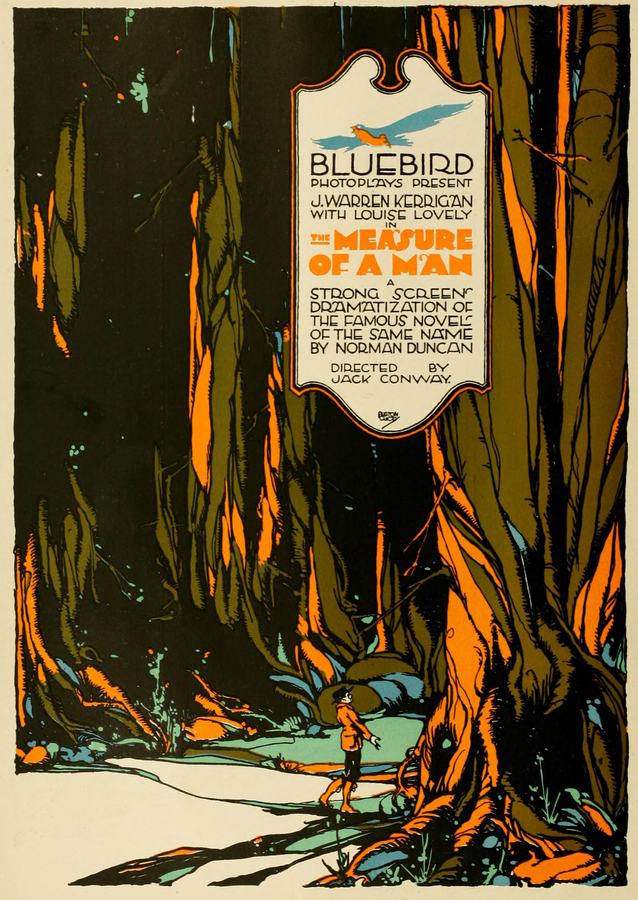
Campbell’s Pattie is no mere love interest; she is the film’s conscience wearing moccasins. Notice how she delivers the line “I prayed for a parson, not a saint”—the way her gaze slides past Fairmeadow’s shoulder as if addressing the Almighty over his head. Ivor McFadden as the child’s mother conveys an entire novella of regret with a single close-up: eyes swollen from crying, yet suddenly luminous when the baby gurgles. Even the supporting loggers—Harry Carter’s moon-shine cook, Marion Emmons’ one-armed cantor—are sketched with the economy of woodcuts: three strokes and a soul.
For decades The Measure of a Man survived only in a desiccated 28-minute Czech archive print. Then in 2022 the Eye Filmmuseum unearthed a 46-minute tinted nitrate with Dutch intertitles. The 4K restoration, completed by San Francisco Silent Film Festival and Cineteca di Bologna, reinstates the amber sermon sequences and the original amber-and-teal palette. The new score—composed by Laura Rossi for solo cello, log drum, and musical saw—premiered at the 2023 Pordenone Silent Days, earning a fifteen-minute standing ovation. Kino Lorber has slated a Blu-ray for autumn 2024, with an essay by this critic on the theological subtext.
Place this film beside The Ruling Passion for its interrogation of masculine identity, or pair it with Destiny: or, the Soul of a Woman for its proto-feminist depiction of female agency within Calvinist frameworks. Where The Italian locates moral crisis in urban squalor, Pollard argues that the wilderness is already a cathedral—profane yet sacramental, terrifying enough to make atheists pray.
I have watched this film four times on four continents, each time measuring my own diminishment against Fairmeadow’s growth. The measure of this movie is not its runtime but the silence it leaves inside you, a hollow as clean as a cedar stump. It preaches without preaching, forgives without pardoning, and reminds us that sometimes the collar is carved from the same wood as the cross. Seek it out when the Blu-ray drops; watch it on a winter night when the wind rearranges the pines into a congregation. Bring whisky, bring contrition, and bring a blanket—because when the iris closes you will find yourself outdoors, shriven and shivering, listening for an axe that no longer falls.
IMDb —
1925
Community
Log in to comment.