DbcultAccessing Vault...
Cult Review
Senior Film Conservator
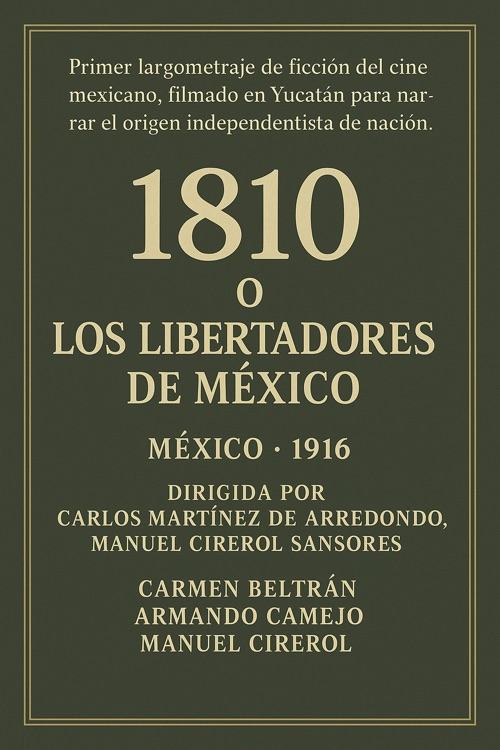
Stepping back into the annals of cinematic history, one encounters '1810 o Los libertadores de México,' a film that, despite its venerable age, resonates with an undiminished intensity, offering a profound meditation on the genesis of a nation. This is not merely a historical recreation; it is an immersive plunge into the very soul of a people on the cusp of self-definition, a meticulously crafted epic that transcends the conventional boundaries of its genre. The film, a monumental undertaking for its era, seeks to capture the tumultuous spirit of the Mexican War of Independence, presenting a narrative woven with threads of fervent idealism, brutal realism, and an unyielding quest for sovereignty. Its significance lies not just in its portrayal of historical events but in its ability to articulate the underlying human drama that fueled one of the most pivotal moments in Latin American history.
The directorial vision, while perhaps constrained by the technological limitations of the time, demonstrates an audacious ambition. It endeavors to encapsulate the vastness of the conflict, from the intimate whispers of rebellion in hushed haciendas to the thunderous clashes on sprawling battlefields. The camera, often static yet remarkably expressive, frames scenes with a painterly precision, evoking the stark beauty and inherent brutality of the Mexican landscape. One might draw a parallel, though anachronistic in terms of production, to the grand sweep of Atlantis, in its ambitious attempt to portray a society in flux, grappling with forces beyond individual control. However, '1810' grounds itself in a more specific, deeply personal struggle for identity.
At the heart of this historical panorama are the performances, which, even through the patina of time, shine with remarkable conviction. Alfredo Varela padre delivers a performance of profound gravitas, embodying the conflicted spirit of a man caught between the rigid structures of the colonial world and the burgeoning aspirations for freedom. His portrayal is nuanced, eschewing simplistic heroism for a more complex, psychologically rich depiction of a figure grappling with immense moral and political pressures. There’s a quiet intensity in his gaze, a palpable weight in his demeanor that speaks volumes about the burdens of leadership during a revolutionary period. This isn't a bombastic performance, but one that builds through subtle gestures and an underlying current of weary determination, making his character's plight deeply relatable.
Similarly, Armando Camejo imbues his character with an almost raw, untamed energy. He represents the fiery zeal of the common people, the unyielding spirit that, once ignited, proves impossible to extinguish. His scenes are often charged with an electric tension, a testament to his ability to convey both fervent idealism and the simmering rage against centuries of oppression. Camejo’s dynamic presence acts as a powerful counterpoint to Varela padre’s more restrained intensity, creating a compelling interplay that mirrors the diverse factions and motivations within the independence movement itself. One could argue his performance has a certain kinship with the rebellious spirit seen in something like The Waif, though '1810' operates on a much grander, more historically significant canvas.
Carmen Beltran, as one of the pivotal female figures, delivers a performance that is both tender and resilient. Her character navigates the perilous landscape of war with quiet strength, offering a vital perspective on the often-overlooked contributions of women to the revolutionary cause. She is not merely a romantic interest or a passive observer; she is an active agent, whose courage and resourcefulness underpin many of the clandestine operations. Her nuanced portrayal adds a crucial layer of humanity and emotional depth to the narrative, reminding us that revolution is fought not only on battlefields but also in the homes and hearts of ordinary people. Her understated power is reminiscent of the quiet fortitude found in characters from films like Bondwomen, depicting resilience in oppressive circumstances.
Elena Vasallo, too, carves out a memorable presence, depicting a character whose journey reflects the profound personal transformations wrought by the conflict. Her evolution from a privileged, somewhat naive member of the elite to a woman deeply committed to the cause of justice is rendered with compelling authenticity. Vasallo’s performance is a poignant exploration of awakening consciousness, showcasing how the harsh realities of colonial rule could shatter illusions and forge new convictions. The internal struggle and eventual commitment she embodies are critical to illustrating the broad appeal and transformative power of the independence movement, drawing individuals from disparate social strata into a shared destiny.
Finally, Manuel Cirerol Sansores rounds out the ensemble with a portrayal that captures the darker, more authoritarian aspects of the colonial regime. His character serves as a formidable antagonist, embodying the entrenched power and ideological rigidity that the liberators sought to dismantle. Sansores brings a chilling conviction to his role, making the forces of oppression feel tangible and truly threatening. His presence underscores the immense odds faced by the revolutionaries, lending an essential dramatic tension to the entire production. The interplay between these diverse characters creates a rich tapestry of human experience against the backdrop of monumental historical change.
The cinematic language employed in '1810 o Los libertadores de México' is, for its time, remarkably sophisticated. While silent cinema often relied on exaggerated gestures, this film manages to convey profound emotion and complex political maneuvering through careful staging and evocative mise-en-scène. The costume design, though perhaps not hyper-realistic by today's standards, effectively distinguishes between the opulent finery of the Spanish elite and the rustic, worn attire of the indigenous and mestizo populations, visually reinforcing the stark class divisions that fueled the revolution. The set pieces, from the bustling markets to the austere halls of power, transport the viewer directly into the heart of early 19th-century New Spain, providing a vivid backdrop for the unfolding drama.
The film’s thematic ambition is perhaps its most compelling aspect. It doesn't merely chronicle battles; it delves into the philosophical underpinnings of the independence movement. Concepts of liberty, self-determination, and the inherent dignity of all people are explored with a gravitas that elevates the film beyond simple historical re-enactment. It asks fundamental questions about justice, governance, and the sacrifices required to forge a new national identity. The film subtly critiques the colonial system, exposing its inherent inequalities and the psychological toll it exacted on the colonized. This intellectual depth, coupled with the visceral portrayal of human struggle, ensures its enduring relevance.
One particularly striking element is the film's depiction of the 'Grito de Dolores.' Rather than presenting it as a singular, triumphant moment, the film illustrates its ripple effect, showing how Hidalgo’s call to arms resonated across different communities, igniting a variegated, often chaotic, but undeniably powerful movement. It acknowledges that revolution is rarely a monolithic force but rather a confluence of diverse grievances and aspirations. This nuanced approach prevents the narrative from becoming a hagiography, instead presenting a more authentic, albeit dramatized, account of a complex historical process. The film's willingness to embrace this complexity is a testament to its artistic integrity.
When considering '1810 o Los libertadores de México' within the broader cinematic landscape of its time, its pioneering spirit becomes even more evident. While many contemporary films, such as Romeo and Juliet (1916), focused on personal dramas or adaptations of literary classics, '1810' boldly tackled a grand historical narrative of national liberation. It’s a testament to the filmmakers’ vision that they chose to immortalize such a pivotal moment in Mexican history with such scope and detail. The ambition here is akin to what one might find in epic German productions of the era, like Der Zug des Herzens, which also sought to explore profound human emotions within a dramatic, expansive framework, albeit typically without the same political charge.
The film's emphasis on the collective struggle, rather than solely on individual heroes, is another commendable aspect. While figures like Hidalgo are central, the narrative consistently reminds us that the movement was propelled by the sheer will of thousands. This democratic spirit in storytelling adds a layer of authenticity. It is a stark contrast to films that might oversimplify history into the actions of a few great men, offering instead a tapestry woven from the lives of many. This approach elevates the film from mere biography to a broader cultural commentary on nation-building.
Furthermore, the emotional resonance of '1810' is profound. Despite the passage of decades, the themes of oppression, the yearning for freedom, and the sacrifices made for a better future remain universally compelling. The film taps into a timeless human desire for dignity and autonomy, making its narrative accessible and moving even to contemporary audiences. The struggles depicted, though rooted in a specific historical context, echo the universal fight against injustice that continues to manifest in various forms across the globe. This emotional core is what truly anchors the film and allows it to transcend its historical setting.
It is crucial to view '1810 o Los libertadores de México' through the lens of early 20th-century filmmaking. The absence of synchronized sound, the limitations of camera technology, and the nascent understanding of cinematic narrative conventions all presented significant hurdles. Yet, the filmmakers managed to craft a coherent and emotionally impactful story. The use of intertitles, while a necessity, is artfully employed to convey dialogue, exposition, and emotional states, guiding the audience through the complex historical landscape without feeling intrusive. The pacing, though slower than modern cinema, allows for a deliberate unfolding of events, permitting the viewer to absorb the gravity of each moment.
The sheer scale of the production, involving large crowds and period accurate (for the time) settings, speaks to an immense logistical effort. Recreating the chaos of battle, the solemnity of political gatherings, and the everyday life of a colonial society required significant resources and ingenuity. This ambition is particularly striking when one considers the global cinematic output of the period, where many films, such as Die Tangokönigin, often focused on more intimate or stylized narratives. '1810' stands as a testament to the early Mexican film industry's capacity for grand storytelling and its commitment to exploring national identity through cinema.
The film also serves as an invaluable historical document in its own right, offering a glimpse into how Mexico viewed its own foundational myth in the early 20th century. It reflects the prevailing nationalistic sentiments and the desire to celebrate the heroes and struggles that led to independence. This meta-narrative, the film as a cultural artifact, adds another layer of appreciation for its importance. It's not just a film about history; it's a piece of history itself, capturing a moment in time when a young nation was still defining its cinematic voice.
In conclusion, '1810 o Los libertadores de México' remains a potent and remarkably engaging cinematic achievement. It is a film that demands patient viewing, rewarding the attentive spectator with a rich tapestry of historical detail, compelling characterizations, and profound thematic explorations. It reminds us that the struggle for freedom is never easy, often brutal, but ultimately a testament to the indomitable spirit of humanity. Its legacy is not just as a historical record but as a timeless narrative that continues to inspire and provoke thought about the nature of nationhood and the price of liberty. For anyone interested in the foundational myths of nations, the complexities of revolution, or simply the evolution of cinematic storytelling, this film offers an indispensable experience. Its power, even through the lens of a century, is undeniable, a vibrant echo of a nation's birth cry.
The film's ability to evoke empathy for its diverse cast of characters, from the most prominent leaders to the anonymous masses, is a significant strength. It humanizes history, transforming abstract concepts of war and politics into tangible experiences of joy, sorrow, triumph, and despair. This emotional accessibility ensures that the film's message of perseverance and the pursuit of justice resonates deeply, regardless of one's familiarity with Mexican history. It’s a compelling reminder that behind every grand historical event lie countless individual stories, each contributing to the larger narrative. The enduring power of '1810' lies in its capacity to tell these stories with both epic scope and intimate detail, creating a work that is both educational and deeply moving.
Even in an age saturated with high-definition digital epics, the raw artistry and earnest conviction of '1810 o Los libertadores de México' hold a unique charm. It’s a film that speaks volumes not only about its subject matter but also about the burgeoning art form of cinema itself, showcasing what could be achieved with passion and vision, even with limited resources. It stands as a proud monument to a pivotal historical moment and a testament to the universal power of storytelling. Its impact on subsequent Mexican historical dramas is immeasurable, setting a benchmark for depicting national identity on screen. This cinematic artifact, far from being a mere relic, remains a vibrant, pulsating heart of a nation's narrative.

IMDb —
1917
Community
Log in to comment.