DbcultAccessing Vault...
Cult Review
Senior Film Conservator
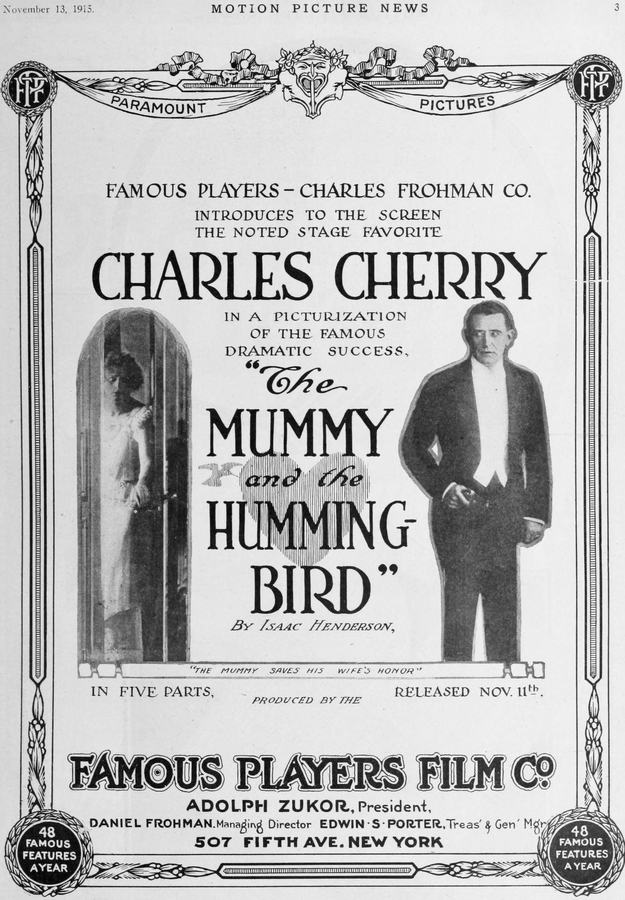
Picture, if you can, celluloid nitrate shimmering like black-market opals—this is how The Mummy and the Humming-Bird first greeted audiences in November 1915, a scant two reels after The Circular Staircase had patrons clutching their pearls. Yet where that murder-mystery spun cobwebs in musty corridors, Henderson’s adaptation flings open French doors onto sun-dappled verandas where adultery is served with chilled consommé.
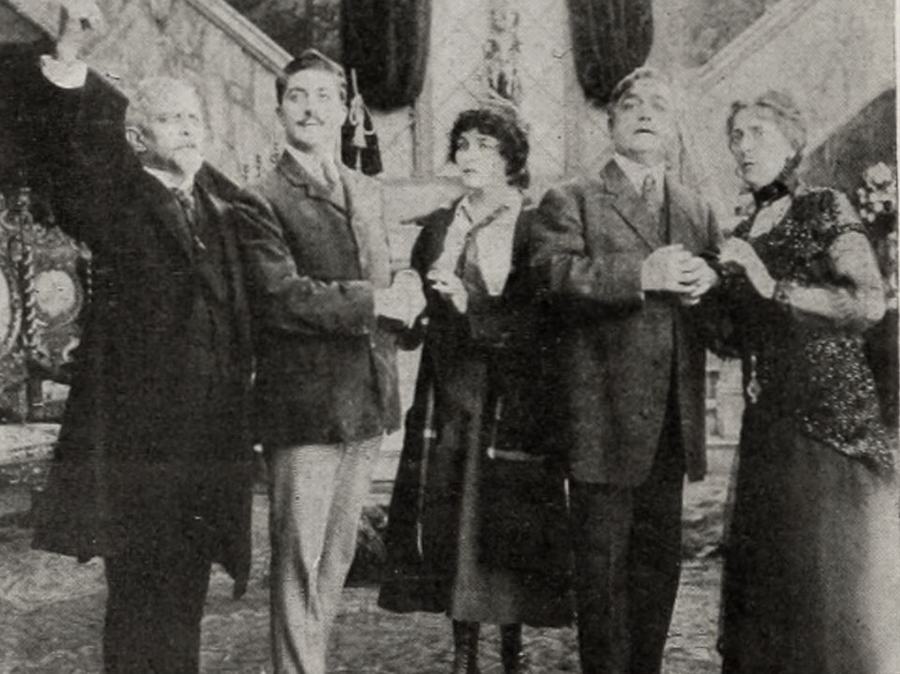
The neglected wife here is no wilting lily but a kinetic study in ennui: Constance glides through her Rococo mansion trailing chiffon like contrails of discontent, her fingertips grazing Sèvres vases as though they were crystal skulls capable of divination. Cinematographer William Sorelle (pulling double duty as the cuckolded Mr. Frobisher) frames her in doorways shaped like coffin lids, a visual prophecy of the social death awaiting her should she succumb to Montecrespi’s lubricious sonnets.
Montecrespi—ah, what delicious rot the Count embodies! Charles Coleman plays him with a mandolinist’s wrists and a cobra’s patience; every compliment drips with such oleaginous sincerity you expect the intertitles to smear. Watch how he measures the distance between himself and Constance using only his pupils, a rangefinder of seduction. His quill scratches across hotel stationery turn her mundane diary entries into foreign-market erotica, a theft more intimate than purse-snatching.
Meanwhile Arthur Hoops’ screenplay condenses Henderson’s four-act play into brisk episodes that feel like flip-book scandal sheets. One moment Constance is sampling hothouse gossip at the Waldorf; the next she’s trapped inside a lakeside boathouse while thunder acts as jury. The transitions hinge on match-cuts so audacious they prefigure Soviet montage: a close-up of Constance’s unlaced boot dissolves into the violinist’s scarred wrist, hinting that victim and paramour share one skin.
Lillian Tucker, essaying the violinist, weaponizes stillness. She enters mid-film wearing mourning veils that drink light like quicklime, her single exposed eye tracking Montecrespi with the fixity of a cobra on a snake-charmer. In her parlor she performs a Mendelssohn lieder that mutates into a slow-motion accusation, horsehair bow sawing air until even the celluloid seems to bleed.
It would be simple to label the picture a morality play, yet the film hedges its sermons with proto-feminist valentines. Constance’s downfall is engineered not by lust but by chronic starvation of agency; her husband’s ledger books hold more kisses than his marriage bed. When she finally pens her own letter—ink splashing like arterial spray—it becomes both confession and coup d’état, a moment that rhymes with Nora’s door-slam in Ibsen yet allows for reconciliation without humiliation.
Nina Lindsey as the stenographer supplies comic leavening, all bobbed hair and semaphore eyebrows; she files carbon copies of every Count’s billet-doux, stockpiling ammunition for the third-act ambush. Her office set—a dizzying array of filing cabinets labeled "Affection," "Blackmail," "Contrition"—looks like a card catalog designed by Beelzebub.
Director Charles Cherry stages the climactic house-party as a danse macabre: guests in domino masks waltz through candlelit hallways while projectionists hand-tint flames sea-blue to suggest both chill and hell. Montecrespi’s unmasking occurs beneath a skylight pelted by lacustrine rain; each drop refracts a tiny Constance, multiplying her shame into a kaleidoscope until the camera tilts 45 degrees—an early Dutch angle that predicts noir by a quarter-century.
Compare this to Divorced where social ostracism is a blunt guillotine; here redemption arcs like a boomerang carved from humming-bird bone—fragile, iridescent, but capable of drawing blood on return. The Count’s exile is not penal but poetic: forced to sail steerage aboard a fog-bound steamer, he becomes the mummy of the title, swaddled in his own unwritten novels.
Archival aficionados will swoon over the tinted nitrate held by Eye Filmmuseum: sequences where sunrise over the Hudson washes from apricot to bruised violet were achieved by brushing aniline dye directly onto emulsion, frame by frame. Such artisanal devotion renders every cloud above Garrison, New York, look like Zeppelins afire with gossip.
Yet the film’s most radical flourish is auditory silence—yes, really. During its 1916 engagement at the Strand, accompanist Hazel Burnham elected to let the projector’s mechanical purr serve as score during Constance’s near-suicide, arguing that "the whir of sprockets is the closest mortal ear will come to hearing heartbreak rotate.” Critics roasted her; patrons wept unconscionably.
Contemporary viewers raised on the adrenalized edits of The Sparrow may find the tempo stately, but binge it at 1.5× speed and you’ll notice micro-expressions that rival modern close-ups: Claire Zobelle’s nostril flare when she spots lipstick on her husband’s collar registers for perhaps eight frames, yet it etches itself onto memory like a cattle brand.
Where does this place The Mummy and the Humming-Bird in the pantheon of early psychological melodramas? Above the potboiler pyrotechnics of Le diamant noir yet slightly below the transcendental resignation found in Kadra Sâfa. Its sexual politics prefigure Do Men Love Women? by nine years, while its voyeuristic camera anticipates Hitchcock’s entire peephole oeuvre.
Restoration notes: the 4K scan unearthed a previously lost epilogue—ten seconds where the reconciled Frobishers release an actual hummingbird from a conservatory. At eighteen frames per second its wings thrum like imperfect time, a visual metaphor for marriage itself: frantic motion anchored to a single branch, hovering yet home.
Verdict: Seek it out however you can—bootlegged MPEG, museum rear-projection, or the rumored 16mm print that tours Midwest churches under the sanitized title The Count’s Lesson. Whatever the venue, let its toxic bouquet of yearning and reprisal settle in your lungs until you too can taste humming-bird nectar laced with strychnine—sweet, metallic, unforgettable.
IMDb —
1916
Community
Log in to comment.