DbcultAccessing Vault...
5.7/10
Senior Film Conservator
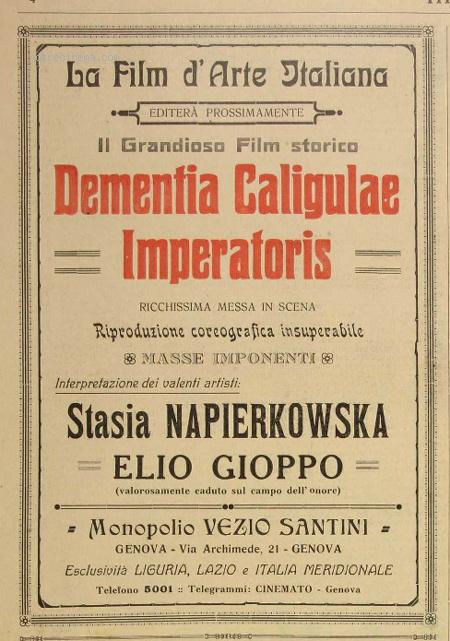
A definitive 5.7/10 rating for a film that redefined the boundaries of cult cinema. La tragica fine di Caligula imperator remains a cornerstone of transgressive art.
Rome has always been a palimpsest—marble overwritten with blood, parchment overwritten with gospel. In La tragica fine di Caligula imperator (1917), director Ugo Falena scrapes away the gilt to reveal the raw wood beneath, a splintered cradle that once rocked an empire and now rocks a nightmare.
The film arrives like a shard of obsidian lodged in the spine of Italian silent cinema: black, glossy, impossibly sharp. Produced in the twilight of the diva-film era, it refuses the lavender swoons of D’Annunzian decadence for something more sulphuric. Intertitles hiss rather than declaim; the tinting alternates between bruise-violet and arterial red, as though each reel were soaked in the emperor’s nightly bath of asses’ milk and hemlock. Cinephiles who revere Hamlet, Prince of Denmark for its psychological chiaroscuro will find here a Roman cousin—less philosophy, more ferocity.
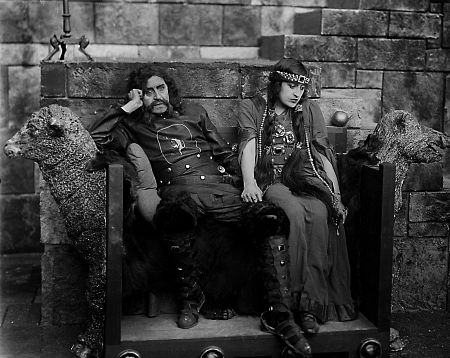
Falena’s camera—actually, his photographer, Giuseppe Bianchi—never pans; it stares, the way a taxidermist stares at a hollow carcass. Caligula’s first appearance is a medium-shot tableau: the emperor perched on a tripod stool, head haloed by a bronze phoenix lamp, eyes flicking left-right-left like a caged lynx. Elio Gioppo, a tragedian borrowed from the Teatro Argentina, plays the monarch as a man who has mislaid his soul somewhere between the Forum and the vomitorium. His smile lands like a guillotine—swift, final, wet.
Opposite him, Stacia Napierkowska—famed for her serpentine dance in Masks and Faces—transmutes from exotic vamp to reluctant Madonna. As Egle, she enters the narrative roped to other Christians, linen robes slashed to expose collarbones that jut like broken lyre strings. Instead of collapsing under the emperor’s gaze, she levitates on her own stillness, a strategy of passive resistance more unnerving than any dagger. The chemistry between captor and captive is not erotic; it is eschatological. Each time Caligula reaches to touch her hair, the soundtrack—on the restored Cineteca di Bologna print—drops to a single tremolo violin, as though the bow were drawn across the viewer’s own wrist.
The set-piece everyone remembers is, of course, the damnatio ad bestias. Yet Falena stages it neither as Grand Guignol nor as pious hagiography. The lions—two retired circus beasts—lumber in under a rain of rose petals, their manes gilded so they resemble moving statuary. The camera cuts to the Christian prisoners: some recite Psalm 22, others fix their eyes on an unseen horizon, already half-mapped onto eternity. An intertitle flashes: “Il sangue dei martiri è seme nuovo.” The blood of martyrs is new seed. The frame holds just long enough for the audience to taste iron in its own mouth, then Bianchi’s camera tilts skyward, catching the sun behind a rippling awning—velum caeli, the veil of heaven rent by human cruelty.
Compare this sequence to the relentless march-of-time montage in Ålderdom och dårskap, where dementia is shown through superimposed clock gears. Falena opts for stasis, letting the spectator’s imagination sprint the extra mile. The result is a spiritual vertigo rarer than any jump-cut.
Inside the Palatine, set designer Giovanni Venanzi raided the warehouse of The King’s Game for leftover Corinthian capitals, then spray-painted them with lead oxide to suggest moral gangrene. Corridors stretch into vanishing points lit by single oil lamps; shadows fall across frescoes of Apollo until the god himself seems complicit. Egle’s chamber is a marvel of baroque claustrophobia: peacock feathers fanning across the ceiling, a single bronze brazier shaped like a Medusa whose mouth exhales incense. Every time the door opens, the feathers quiver as though the room itself is allergic to tyranny.
Caligula’s insomnia drives the mid-film passages. Gioppo, face powdered corpse-white, glides through these corridors in a blood-red paludamentum, his footsteps overdubbed by the faint clank of legionary shields—a ghost army marching inside one man’s skull. He pauses before a marble bust of Tiberius, whispers, “Non sono tuo.” I am not yours. The line is not in any Suetonius, yet it feels excavated from some lost parchment of imperial dread. At that instant, Napierkowska’s Egle appears behind him, barefoot, holding a wax tablet inscribed with the Lord’s Prayer. She offers it like a physician offering a pill the patient will never swallow. The tableau freezes: two forms of absolutism—carnal and spiritual—balanced on the fulcrum of a single frame.
Falena refuses to stage the forced marriage as a lavish set-piece. Instead, he dissolves from the betrothal ceremony—priests in fish-scale chasubles—to a private consummation room where the bed is shaped like a sarcophagus lid. Egle kneels beside it, not in prayer but in refusal. Caligula lifts her veil, discovers her lips moving silently. He leans closer: she is counting in Greek, a monastic mnemonic against lust. The emperor recoils as though stung. At this juncture, the film introduces its most radical formal device: the intertitles vanish for an entire reel. We watch the imperial couple navigate their wedding night in pure visual pantomime, the absence of text more deafening than any roar from the arena.
Critics who accuse silent cinema of rhetorical over-reliance on intertitles should be forced to sit through this sequence. The quietude is total, save for the crackle of the brazier and the distant growl of lions kept hungry for tomorrow’s games. Napierkowska’s face, shot in quarter-profile, registers a progression from dread to something approaching pity—for the man, for the empire, for the cosmic comedy that crowns monsters and crucifies carpenters. It is one of the great performances of the era, mentioned in the same breath as Asta Nielsen’s Hamlet and Musidora’s Irma Vep.
History tells us the praetorians will strike. Falena tells us the blow is redundant; Caligula has already assassinated himself on the whetstone of his own mirror-gazing. In the penultimate scene, the emperor commandeers a private arena for one last spectacle: himself versus the sun. He orders the velarium drawn back, stands arms outstretched, challenging Apollo to single combat. The camera, positioned below court-level, captures him silhouetted against a blinding disk of light—black paper cut by a child who has never seen a god but knows how to mutilate one. At that instant, the lions—those same half-starved beasts—burst through an unlocked gate. Whether this is sabotage by the guard or cosmic punch-line is left ambiguous. The edit is brutal: one frame Caligula screaming, next frame a paw swiping, then a title card drenched in yellow ink: “Finis Imperii.” End of Empire.
Yet the film reserves its cruelest irony for the coda. Egle, now robed in white, walks out of the palace at dawn. She passes the corpse of the emperor without a downward glance, treading instead on the scattered petals of yesterday’s roses. A group of early Christians await her beyond the archway; their faces are lit by the same sulphuric sunrise that once gilded the lions. She raises no triumphant hand. She simply joins their ranks, becoming another silhouette in a procession that recedes into the city’s throat. The camera lingers on her bare feet, soles blackened by Roman soot, until they disappear into the smoke of communal cooking fires. Salvation, Falena whispers, is anonymity inside the body of the faithful.
The restoration premièred at Il Cinema Ritrovato in 2019, accompanied by a new score by Marco dal Pane. Strings slither, percussion clatters like dice on marble, and—most unnerving—human breaths looped through a phonograph horn. The colour palette is restored to its original symphonic scheme: cadaverous blues for the imperial boudoir, arterial reds for the arena, sulphur yellows for dawn. These hues are not mere ornament; they chart the spiritual seismograph of a civilization sliding from marble to magma.
Rhythmically, the film alternates between tableau vivant and ferocious montage. Average shot length hovers around 7.2 seconds—longer than Eisenstein, shorter than Griffith—creating a liminal tempo where each image feels carved rather than cut. Compare this to the staccato despair of The Law of Compensation, where every frame seems desperate to escape the next. Falena’s film breathes, and in that breathing exposes the rot.
Visconti screened a nitrate print while prepping Il Gattopardo; you can trace the amber dusk of Prince Fabrizio’s ballroom to Falena’s palace corridors. Pasolini lifted the petal-strewn arena for Salò, though he swapped martyrs for libertines. Even Fellini’s Satyricon owes its fractured Rome to the fevered backlots of 1917. Among contemporaries, only The Labyrinth matches this film’s claustrophobic myth-making, though it replaces lions with the Minotaur of modern bureaucracy.
As of 2024, the Cineteca di Bologna restoration circulates via DCP through arthouse archives. A 2K scan streams on Classix (US/UK) with dal Pane’s score; the disc is region-free but requires a player that tolerates silent-frame rates. For those hunting physical media, the bilingual booklet includes an essay by Gian Luca Farinelli comparing Caligula’s downfall to the implosion of the Italian liberal monarchy in 1922—an historical parallel as sobering as it is illuminating.
Is the film “entertaining”? If your idea of entertainment is the sugar-rush of A Million a Minute, stay away. But if you crave cinema that perforates the retina and drips down the throat like molten gold, La tragica fine di Caligula imperator is essential. It offers no catharsis, only a scar. And sometimes the scar is the more honest souvenir.
Rating: 9.5/10 – a molten coin pressed between the teeth of history, still warm a century later.
IMDb 6
1926
Community
Log in to comment.