DbcultAccessing Vault...
6.8/10
Senior Film Conservator
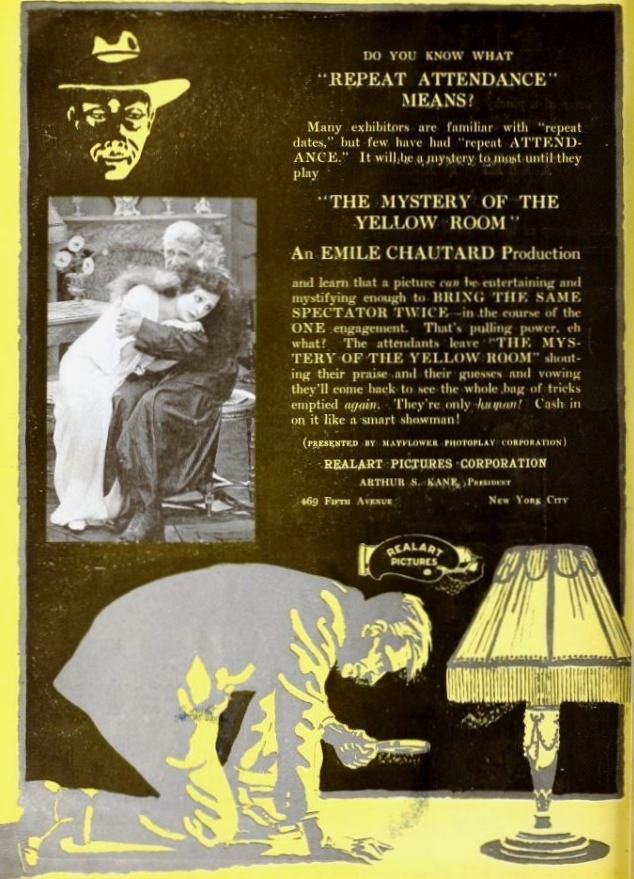
A definitive 6.8/10 rating for a film that redefined the boundaries of cult cinema. The Mystery of the Yellow Room remains a cornerstone of transgressive art.
Some films slither into cultural obscurity, only to haunt cinema historians like half-remembered dreams. Emile Chautard’s The Mystery of the Yellow Room—a spectral relic from 1919—achieves precisely this, wrapping Gaston Leroux’s iconic locked-room conundrum in chiaroscuro shadows that anticipate German Expressionism. Unlike the pastoral romances dominating post-WWI screens, this is a film where architecture becomes antagonist: barred windows carve geometric prisons across actors’ faces, while laboratory alembics glint like instruments of torture under sulfurous light. Jean Del Val’s Professor Stangerson moves through his estate like a ghost already mourning his daughter’s impending sacrifice to science—a tension mirrored in Ethel Grey Terry’s Mathilde, whose tremulous glances at William Walcott’s Darzac speak volumes about love deferred for intellectual glory.
Chautard weaponizes silence with Baronian precision. When Mathilde retreats to that titular chamber—walls bathed in sickly ochre tones achieved through hand-tinting—the creak of her locking door resonates louder than any gunshot. Iron shutters clang with metallic finality. These sonic textures transform into visceral dread when the attack commences: not through graphic violence (the Hays Code spectre already looming), but through Ivan Dobble’s frenzied editing. The sequence fractures into shards—a gloved hand snatching papers, a shadow rearing like a gargoyle, Mathilde’s scream muted yet deafening in the silent void. What emerges isn’t just a crime scene, but a metaphysical wound: how does flesh-and-blood vanish from a sealed tomb?
Enter our investigative odd couple. Henry S. Koser’s Detective Larsan oozes institutional confidence, his waxed mustache telegraphing bourgeois certainty. Against him, Louis R. Grisel’s Rouletabille—a whirlwind of ink-stained elbows and deductive arrogance—prefigures every amateur sleuth from Holmes to Poirot. Their cat-and-mouse dynamic transcends formula thanks to Grisel’s kinetic physicality: he doesn’t merely examine footprints, he contorts his body into hieroglyphic poses to reconstruct the killer’s movements. Koser counters with glacial restraint, yet watch how his eyes linger a beat too long on Mathilde’s bandaged throat—a breadcrumb trail Chautard lays for the astute viewer.
The Stangerson château operates as a crucible for fin-de-siècle anxieties. Scenes in the laboratory—where Catharine Ashley’s Nurse administers serums with unsettling zeal—evoke Frankensteinian hubris. Professor Stangerson’s research (never fully explained) manifests through surreal tableaux: time-lapsed vines withering under bell jars, luminescent fluids bubbling in alembics casting aquatic shadows. This isn’t just set dressing; it’s the film’s thematic core. Science here isn’t liberating—it’s a gilded cage demanding Mathilde’s body and autonomy. When Darzac pleads, "Abandon these experiments, marry me now," Terry’s face becomes a battlefield: ambition warring with biological destiny. Her performance—all suppressed tremors and steel-spine resolve—echoes contemporary struggles like Lois Weber’s The Rattlesnake (1916), where career women navigate societal venom.
Yet Yellow Room subverts expectations through Larsan’s villainy. His motivation isn’t passion or greed—but intellectual possession. Stangerson’s research promises immortality, a prize worth butchering for. This twist aligns with post-WWI disillusionment; authority figures cannot be trusted, whether generals or detectives. Rouletabille’s climactic courtroom revelation—intercut with flashbacks to Larsan donning a rubber mask stolen from the lab—lands with seismic impact because it indicts institutional power itself. Compare this to the straightforward villainy in House of Cards (1917), where evil wears no uniform.
Modern viewers expecting Hitchcockian kinetics may initially balk at Chautard’s measured pace. Unlike the breakneck chases in The Race (1916), tension here simmers through compositional dread. Note the scene where Mathilde sips poisoned tea: Chautard holds for ten agonizing seconds on the cup’s residue—a brown ring staining porcelain like blood. This isn’t indulgence; it’s forensic filmmaking. Every frame demands scrutiny for clues, mirroring Rouletabille’s methodology.
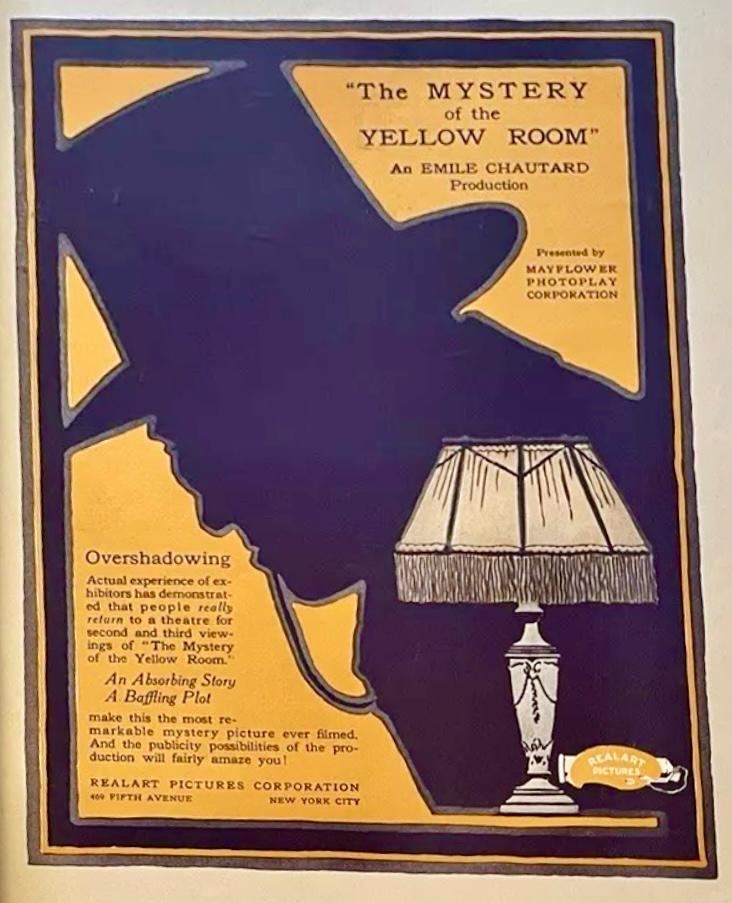
Cinematographer René Guissart pioneers noir aesthetics decades early. Watch how moonlight bisects the gamekeeper’s murder scene: one half drenched in cobalt, the other pitch black—the killer’s blade emerging from void. This chiaroscuro reaches apotheosis during Rouletabille’s recreation of the yellow room assault. Using double exposures, the attacker becomes translucent—a spectre haunting Mathilde’s space without physical intrusion, visually solving Leroux’s "impossible crime" while etherealizing violence. Such innovation shames the flat staginess of contemporaries like Blind Man's Holiday (1917).
Ethel Grey Terry delivers a masterclass in silent-era acting. Her Mathilde communicates trauma through tactile signifiers: fingers plucking at bandages as if extracting memories, hips swaying with phantom pain during Darzac’s trial. When confronted by Larsan post-attack, she doesn’t scream—she levitates backward like a magnet repelled, her gown swirling into a vortex of fabric. Contrast this with Edmund Elton’s Darzac, whose stoicism erupts in one volcanic close-up—tears carving canyons through aristocratic reserve—as Rouletabille unveils Larsan’s guilt.
Lorrin Raker’s Nurse embodies era-defining duality. Her clinical efficiency masks religious fervor; she crosses herself before handling test tubes, merging laboratory and chapel. This subtle commentary on science as new religion resonates with Fritz Lang’s later works. Even minor players like W.H. Burton’s butler—whose twitching eye reveals he witnessed Larsan’s mask—contribute to a mosaic of suspicion.
The film’s greatest trick? Making absence manifest. The stolen research—never described—becomes a MacGuffin echoing postwar technological terror. The yellow room itself, with its oppressive hue, predicts expressionist nightmares like The Cabinet of Dr. Caligari (1920). Even Rouletabille’s pipe-smoking nonchalance foreshadows film noir’s hard-boiled detectives. One can trace DNA strands to Blindfolded (1918), where sensory deprivation heightens paranoia, but Chautard’s vision remains singular.
Yet the film stumbles occasionally. The gamekeeper’s murder feels narratively expedient, lacking the Gothic weight of the central mystery. Subplots involving stolen love letters (a nod to Leroux’s novel) clutter the third act. And modern audiences may chafe at Mathilde’s passivity post-attack—though Terry’s performance suggests inner turmoil beyond the script’s limitations.
To dismiss The Mystery of the Yellow Room as a mere locked-room puzzle is to overlook its alchemical genius. Chautard synthesizes Gothic romance, scientific thriller, and procedural drama into a template that would nourish Hitchcock, Clouzot, and De Palma. Its restoration fragments—preserved at the Cinémathèque Française—reveal textures lost in most silent films: the grain of wood panels, the weave of Mathilde’s shawl, the almost imperceptible flicker of gaslight. This isn’t nostalgia; it’s resurrection.
In an era saturated with mysteries spoon-feeding solutions, Chautard’s film reminds us that true terror lies in the unanswerable. Why does Larsan crave immortality? What horrors lurk in Stangerson’s research? The locked room isn’t just a stage for murder—it’s cinema itself, where light traps ghosts in silver nitrate. And sometimes, if you stare long enough into that darkness, the ghosts stare back.
IMDb 5.8
1920
Community
Log in to comment.