Summary
Amid the gas-lit corridors of a crumbling Norman manor, Mathilda—daughter of the brooding Professor Stangerson—carries a clandestine scar: a decade-old, unregistered marriage to Jean Roussel, a counterfeiter she believes long buried by penal rot. When her father presses her toward the respectable arms of Robert Darzac, she consents, trusting the past entombed. Yet Roussel, alive and feral, drifts out of fog and prison ink, slipping an illicit billet into her gloved hand: “Come to America, or I speak.” Terror seals her throat; Roussel’s jealousy calcifies into trespass. He infiltrates the ochre-walled boudoir known only as the Yellow Room, a hue that seems to perspire paranoia. That twilight, father, fiancé and daughter return from a walk stitched with unease; Mathilda retires early, steps inside, and confronts the resurrected husband. A strangled scream, a thud, then blackout. Later, a pistol crack ricochets through the château; the professor bursts in to find his daughter bloodied, the chamber hermetically sealed, the assailant vanished into ether. Enter Rouletabille, carrot-tired prodigy of logic, and the corpulent Inspector Larsan—who, beneath whiskers and avuncular padding, is Roussel himself, nursing a shredded hand and a conscience equally lacerated. Clues bloom like mildew: a single flaxen hair, a monogrammed handkerchief sopped in crimson, a marriage certificate that could indict or emancipate. Over nights of candle-wax and corridor footfalls, Rouletabille deciphers that Mathilda’s wound was self-inflicted in somnambulant self-defense, the shot fired at phantoms, the gash born of falling furniture; Larsan’s laceration came from her desperate teeth. In a final supper laced with laudanum, the detective feigns stupor, retrieves the incriminating document, and—moral arithmetic done—allows the fugitive one narrow window to disappear into myth. The Yellow Room exhales, no longer a crime scene but a confessional; Mathilda, document burned, is free to step into dawn with Darzac, though the sulfuric taint of secrecy lingers like old wallpaper glue.
Synopsis
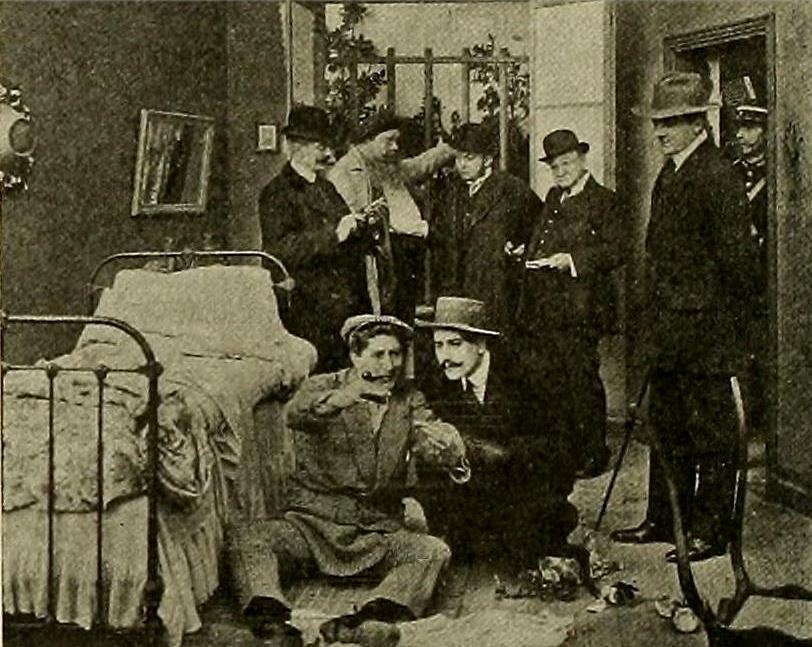
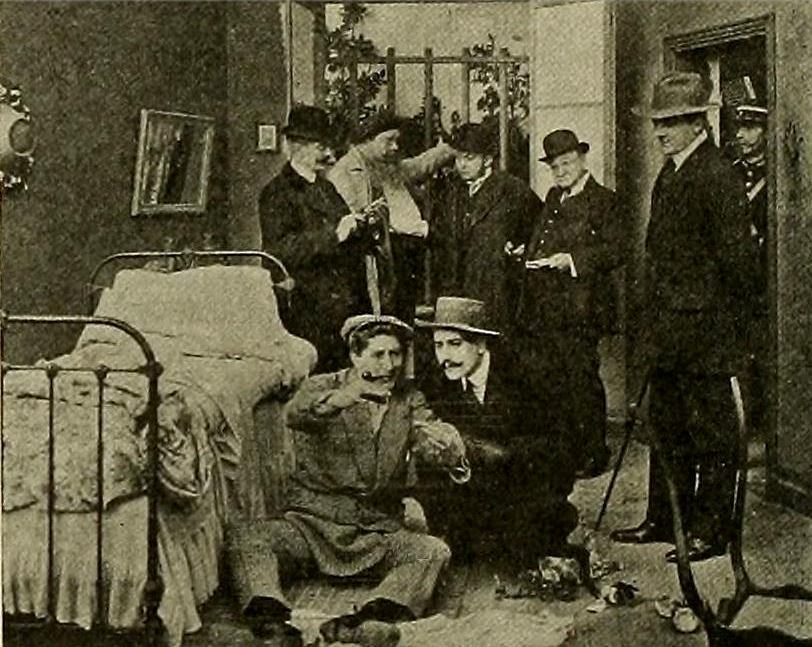
A reminiscence of her act ten years ago, recalling how she had secretly married Jean Roussel, flashes through the mind of Mathilda, daughter of Professor Stangerson, when her father asks her to become the wife of Robert Darzac, and how their wedding certificate could not be filed as her husband was imprisoned for passing counterfeit money. But she soon dismisses the horror upon the thought that Roussel must have been dead (she never having heard from or of him) and at last consents to the announcement of her betrothal to Darzac. Roussel, however, was still alive and soon learns of the engagement of Mathilda. By a subterfuge he manages to get a note to her telling her that he still loves her and begging her to flee with him to America. Mathilda was too frightened to answer, so Roussel in a jealous rage goes to the residence of Mathilda and hides in the yellow room occupied by her. Mathilda, who had been out walking with her father and fiancé, returned and feeling tired goes direct to her room, where she comes face to face with Roussel, who cautions her not to utter a word of alarm. But Mathilda was very much afraid and screams. In order to stop her, Roussel chokes her into unconsciousness and leaves her for dead. That evening as she joins her father he notices that she is unusually pale and advises her to retire early. She does and no sooner had the household retired when a shot comes from the room of Mathilda. Upon investigation the father finds that his daughter is lying unconscious upon the floor with a deep gash in her head, but no trace of her assailant could be found for the doors and windows were all locked from the inside. Professor Stangerson places the solving of the mystery in the hands of Rouletabille, a noted detective, and inspector Larson, They are given adjoining rooms in the Stangerson castle, and in his work of unraveling the enigma, Rouletabille finds under the bed of Mathilda a hair and a bloody handkerchief. Then Mathilda receives another letter from Roussel, which makes her change her room. At midnight the detective hears sounds coming from the yellow room, and stations Larson and the professor at both ends of the gallery, but no one is found. Previously the detective had caught a glimpse of a bearded man and has come to the conclusion that he must be in the house. He is also surprised to learn that Larson's hair is the color of that which he had found in Mathilda's boudoir. Larson, who was none other than Roussel, sends Mathilda another note and fearing the surveillance of Rouletabille, he invites the detective to supper in his room. He drugs the wine which is drunk by the detective, and as the latter is examining Larson's hair he notices a bad wound in the inspector's hand and then falls unconscious. Rouletabille's assistant brings him around, and after forcing from Larson the marriage certificate deliberately gives him a chance to escape. Then the detective gives Mathilda the unrecorded marriage document, the destruction of which means her freedom to marry Darzac. The mystery of the yellow room was cleared by the detective's remarkable deduction which shows that the deep gash in the head of Mathilda had been caused by a vision of her assailant and she, in a subconscious state, had discharged the revolver in self-defense and in falling had landed against a table, and the ugly wound in Larson's hand had been done when she had her encounter with him in the yellow room.
Review Excerpt
"
The saffron-walled enigma glows again.
In the chiaroscuro of early French silent cinema, where shadows still learn how to crawl across the screen, The Mystery of the Yellow Room arrives like a sulphuric match struck in a mausoleum—its flare brief, acrid, yet illuminating every crack in the masonry of human deceit. Director Maurice Tourneur, refusing to genuflect to theatrical tableaux, turns Gaston Leroux’s pulp labyrinth into a kinetic fever dream: doors inhale rather than open, corridors el..."