DbcultAccessing Vault...
Cult Review
Senior Film Conservator
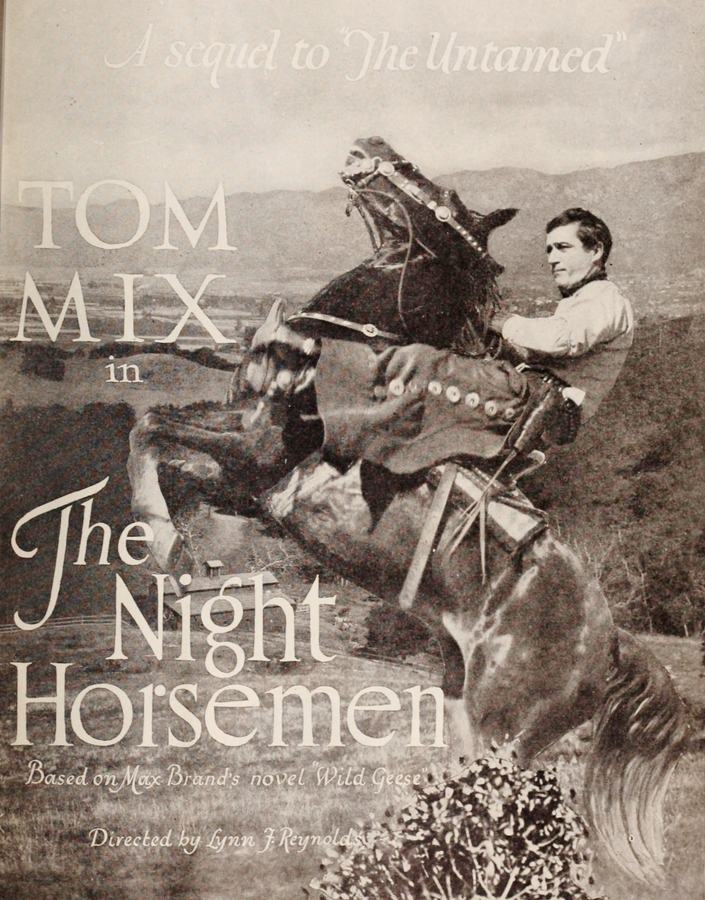
Picture a Western where the frontier is not merely mesquite and dust but an echo chamber of impulses: every hoof-beat a dropped syllable of desire, every campfire flare a semaphore for loneliness. That is The Night Horsemen, Lynn Reynolds’s 1921 adaptation of Max Brand’s pulp fever-dream, here elevated into cinematic canticle by Tom Mix’s feral grace. Forget the cookie-cutter cowboy who waves his hat like a patriotic flag; Mix’s Whistling Dan is a man whose soul vibrates at the frequency of migrating geese, those airborne troubadours that scribble destiny across a bruised sky.
The film opens on the eve of a wedding that feels more like funeral. Kate Cumberland—embodied by May Hopkins with a tremor of porcelain resolve—stands in a parlor where lace curtains billow like slow-motion ghosts. Outside, Dan listens to the sky as if it were a jukebox of primal hits. One look at those Vs of wild geese and he’s gone, leaving behind a ring that spins on the hardwood like a compass robbed of north. Reynolds stages this abandonment in a single, unbroken medium shot: the camera refuses to chase Dan, forcing the viewer to inhabit Kate’s evaporating future. It’s a visual sentence that ends in ellipses.
Cut to a saloon that seems grown from the earth itself—timber walls sweating resin, kerosene lamps swinging like tipsy preachers. Here Jerry Strann, played by Harry Lonsdale with the smirk of a fallen angel, bait-traps Dan into a duel that’s part poker game, part ballet. The fight choreography is a marvel of 1921 stunt craft: Mix twirls, leaps a card table, and fires from the hip while landing in a crouch that would make a gymnast weep. The bullet finds Jerry’s shoulder, not heart—an ethical margin that sets the dominoes tumbling.
Word arrives that Mac Strann, Jerry’s older brother, is “riding up from Texas with hate in his saddlebags.” Dan, rather than fleeing, stays to nurse Jerry back to health, a gesture so contrary to genre expectations it feels downright subversive. This is where Max Brand’s philosophical DNA seeps in: the notion that violence is a debt whose interest compounds unless paid with unexpected mercy.
Enter Buck Daniels—Sid Jordan’s square-jawed foreman—galloping through moon-splashed sage to retrieve Dan for the dying Colonel Cumberland. Mac Strann, however, arrives first under a cloak of chimney smoke and kerosene. The barn-burning sequence is shot in high-contrast chiaroscuro: flames lick against nitrate blackness, horses rear in silhouette, and Dan’s dog—an uncredited canine performer with the stoicism of a samurai—dies amid falling embers. The moment is both spectacle and sacrament; the barn becomes a burning confessional where Dan’s sins of abandonment are charred into memory.
Reynolds overlays this carnage with a superimposition of wild geese in flight, their honks sonified by the orchestra’s shrill trumpets. It’s an early example of symbolic montage predating Eisenstein’s Joan the Woman experiments by several years, proving that American silents could be as poetically audacious as their European cousins.
Tom Mix was no mere cowboy; he was a psychoanalyst in chaps. Watch the way his shoulders slacken when Kate’s letter is read aloud, or how his eyes track the horizon as if it were a woman he once loved. In the climactic standoff, Dan tracks Mac to a box canyon where the rocks resemble broken cathedral glass. Mac, played by Joseph Bennett with the bulk of a grizzly and the voicelessness of silent cinema, seems more force than man—an embodiment of retributive physics.
Dan’s hand hovers over his Colt; the intertitle reads: “The geese are calling—can you hear them?” For a heartbeat, murder seems ordained. Then Kate appears, her silhouette eclipsing the barrel of Dan’s gun. She doesn’t speak; she simply lays her palm on his chest, and the gesture lands like a psalm. Mix’s face cycles through rage, recognition, resignation—all in the span of three flickering seconds. It’s a masterclass in micro-acting, rivaling any close-up in The Light Within or Lorena.
Though monochromatic, the film’s tinting strategy acts as emotional chromatics: amber for interiors (warmth, duplicity), cyan for night exteriors (melancholia, infinity), and crimson for conflagrations (passion, purgation). The cyan passages—especially the moonlit ride where Dan pursues Mac—glow with a phosphorescence that anticipates the cyanotype nightmares of Satan in Sydney.
Reynolds also deploys negative space like a Japanese ink painter. In one composition, Dan stands atop a mesa, the sky occupying four-fifths of the frame, suggesting that the universe itself is a horseman riding roughshod over human drama.
May Hopkins shoulders the unenviable task of making a “left-at-the-altar” character more than a footnote. She succeeds by weaponizing stillness. When Kate confronts Dan in the third act, her tears don’t fall; they hover, magnified by the iris-in, turning her eyes into liquid mirrors of the audience. Her final plea—“Stay, and the geese will return next year”—is less dialogue than incantation, binding Dan more effectively than any vow.
In contrast to the flapper exuberance of A Youthful Affair or the pastoral martyrdom of Rose o’ Paradise, Kate occupies a liminal femininity: ranch-heir, caregiver, sexual agent, moral pivot. She’s the immovable object against which Dan’s unstoppable subjectivity shatters and reforms.
Max Brand’s original pulp throbs with dime-novel fatalism; Reynolds softens the asphalt with lyricism. The intertitles, credited to Lynn Reynolds, read like haikus carved on bullet casings: “A man can outrun horses, but can he outrun himself?” or “Grief is a colt—ride it hard, and it rides you harder.” Such lines elevate the material above the programmer status of Playing the Game or Food for Scandal.
Mix performed his own stunts—no rear projection, no CGI, just mettle. The famed “leap from jailhouse roof onto galloping stallion” required twenty takes and a bruised tailbone. Yet the pain translates as authenticity; when Dan lands, dust explodes like miniature mushroom clouds, an omen of the atomic age that will one day obsolete these analog spectacles.
Compare this kinesthetic honesty to the weightless derring-do of The Adventure Shop, where wires betray gravity’s covenant. Here, gravity is not an obstacle but a co-author, writing bruises into the narrative.
Original exhibitors shipped the film with a cue sheet recommending Wagner’s “Ride of the Valkyries” for the barn-burning and Massenet’s “Méditation” for Kate’s plea. Contemporary reviewers—Variety among them—lauded the fusion of highbrow orchestration with lowbrow pulp, predicting it would “outgross even The Isle of Life.” They were right; the picture recouped five times its $78,000 budget, securing Fox’s confidence in Mix as bankable mythmaker.
Look at the existential drift of The Primal Lure or the feminist undertow of Miss Peasant—both owe chromosomal debt to Reynolds’s template. Even Ford’s The Searchers echoes Dan’s wilderness-wandering, though Ethan Edwards never heeds the geese. The film’s central dialectic—civilization versus instinct—prefigures Anthony Mann’s psychological westerns of the fifties, proving that silent cinema could probe the American psyche as deftly as any talking picture.
For decades, The Night Horsemen survived only in abridged 16 mm classroom prints. A 2018 4K restoration by the Munich Film Museum—culled from a Czech nitrate positive—reinstated the amber and cyan tinting, revealing textures previously muddied: the weave of Mix’s fringed shirt, the cracked leather of Mac’s holster, the opalescent tears of Kate. Available on Blu-ray through Kino Lorber, the edition includes a commentary by western scholar Dr. H. Tomás Rivera and a 20-page booklet excerpting Brand’s original serial.
Great art doesn’t age; it merely accumulates interpretations. Today, when algorithms predict our cravings and streaming services pre-load our desires, there is something anarchic about a film where a man’s destiny can still be rerouted by birds. The Night Horsemen reminds us that escape is never geographic; it is always ontological. Dan doesn’t follow the geese—he follows the part of himself that refuses brand ownership by any lover, ranch, or ring.
Yet the film also concedes that love, when embodied by a woman willing to step between gun barrels, can be as wild and migratory as any instinct. Kate doesn’t tame Dan; she offers a parallel sky, and for one suspended moment, he chooses the constellations in her eyes over the constellations overhead.
That fragile détente—between freedom and attachment, bullet and kiss—is why the picture still gallops through the mind long after the projector’s click fades. It is a poem written in gunpowder and goose down, a Western that shoots the genre’s clichés dead, then resurrects them as chimeras of longing. And as the end title card once read: “The night horsemen ride on—but dawn is another story.”
IMDb 4.9
1935
Community
Log in to comment.