DbcultAccessing Vault...
5.2/10
Senior Film Conservator
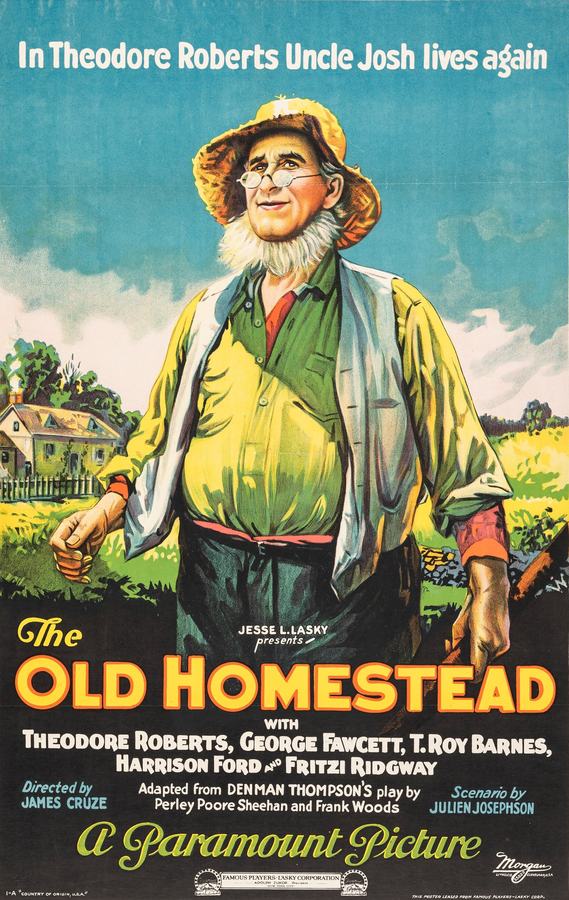
A definitive 5.2/10 rating for a film that redefined the boundaries of cult cinema. The Old Homestead remains a cornerstone of transgressive art.
Imagine a film that smells of damp sawdust and kerosene, its intertitles flickering like the last lantern in a bankrupt barn. The Old Homestead—released in the same year Howard Carter cracked open Tutankhamun’s tomb—digs not into Egyptian gold but into the loam of American guilt, unearthing a morality play as cracked and fecund as drought-parched earth suddenly split by lightning.
Director William C. deMille (Cecil’s lesser-known, more humanistic brother) stages the crime in chiaroscuro: a lantern sputters, a tin box yawns open, coins clink like cold bells. Lem’s theft is less a robbery than a genetic defect—the son’s hand simply doing what the father’s rhetoric of thrift has primed it to do. Eph Holbrook, essayed by Theodore Roberts with a patriarchal rigor that could split rail ties, embodies New England’s icy covenant: property equals virtue. When the cash vanishes, Eph’s face registers not loss but ontological betrayal, as though God himself short-changed the ledger.
Reuben’s incarceration unfolds in a cell whose bars stripe moonlight into prison-barcode. Charles Williams, saddled with the thankless role of moral counterweight, lets his eyes do the talking—huge, dark, calf-like pools that seem to petition the cosmos for a habeas corpus. Enter Happy Jack (Jim Mason), a tramp whose grin arrives half a second before the rest of him. Mason plays him like a jazz solo in a hymnbook: loose-limbed, cigarette behind the ear, pockets rattling with harmonicas and improbable anecdotes. Their jailbreak, accomplished via a conveniently left-forged key and a guard who sneezes at the crucial moment, feels less like narrative contrivance than like the universe briefly admitting it was wrong.
Meanwhile Uncle Josh—Frank Hayes beneath a thatch of hair like wind-tangled hay—signs the farm away with the solemnity of a man signing his own death certificate. DeMille holds the close-up: ink trembles, a drop threatens to fall, the quill scratches like a mouse inside the wall of a debtor’s conscience. The mortgage here is not mere paperwork; it is original sin translated into accountancy, the American Eden repossessed by a banker’s ink-stained thumb.
Gossip migrates faster than the Western Union wires. Ann (Fritzi Ridgeway), all gingham and gnawed knuckles, hears via the town’s whisper-mill that Reuben has eloped with the perfidious Rose. Ridgeway’s performance is a masterclass in silent-era interiority: her shoulders fold inward like a book slammed shut, yet her chin juts defiantly. The moment she scrapes Reuben’s name off her dance card, the ink smears into a bruise-colored teardrop—a visual haiku of betrayed devotion.
But the film’s volta arrives via postcard: Shanghai’s bund teems with rickshaws and red-sailed junks, Reuben’s silhouette swallowed by imperial dusk. The intertitle reads, “Across the yawning ocean, a wage is earned in exile.” Suddenly the picture widens from parochial melodrama to geopolitical panorama; the same Pacific that will later carry Hemingway’s expatriates now ferries a Yankee farm boy whose only crime was proximity to another man’s dishonor.
Back home, the seasons cycle with punitive indifference. DeMille time-lapses the farm through a gauntlet of mortgage notices: winter’s first frost etches due dates across windowpanes; spring planting becomes a race against compound interest; summer’s locusts devour both cornstalks and hope. Cinematographer L. Guy Wilky shoots the fields in low-twilight ochre, so every furrow resembles a fresh-dug grave. You can practically smell the soil turning sour.
Then—the storm. Not some polite Midwestern zephyr, but a full-throated, Old-Testament tantrum. The cyclone sequence, achieved with cotton-bale clouds, wind machines, and miniature barns splintered by off-screen carpenters, rivals Victor Sjöström’s wind-whipped psychodramas. Lightning forks like divine redaction, erasing saloons, steeples, and the very ledger where Eph recorded his usurious triumphs. When dawn breaks, the landscape resembles a child’s toy box upended by an irate deity—yet there stands Josh’s farmhouse, solitary and inexplicably untouched, a moral Gibraltar amid the rubble. In that moment the film achieves the same mythic resonance as The Daughter of Dawn’s virgin prairies—nature itself conspiring to expose human covetousness.
Lem’s confession, delivered in a single sustained close-up, is a tour de force of silent-era acting. Roberts lets his jowls quiver, eyes darting like trapped sparrows, before the words—“I took it. The storm showed me my face.”—materialize in stark white letters. The dialogue card lingers longer than necessary, as though the film itself needs to exhale after holding its breath for sixty minutes.
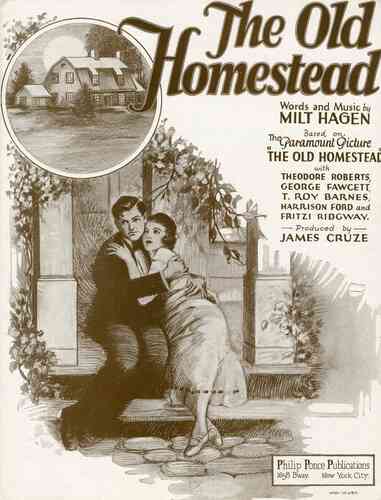
Reuben’s return borders on the Eucharistic. A steamer deposits him back onto American wharves; he strides through the ruined town, suitcase in hand, clothes sun-bleached to the color of penitence. The reunion with Ann occurs amid the skeletal remains of what was once a bandstand—now merely splinters and a single, miraculously intact violin. Their embrace is filmed in profile against a sky the bruised purple of sacramental wine. No kiss; just foreheads touching, breath mingling, the entire American experiment distilled into two silhouettes learning to trust gravity again.
Compare this dénouement to In Old Kentucky, where feuding clans reconcile over a horserace and a jug of moonshine. The Old Homestead offers no such festive catharsis; its resolution tastes of rain-soaked wood and iodine, a scar rather than a trophy. The final intertitle, superimposed over a sunrise that cautiously refuses to blush too rosily, reads: “The land endures; so must we.” Credits fade, but the after-image glows like ember under ash.
Technically, the print survives in 35mm at the Library of Congress, though two reels remain vinegar-syndrome amber. The Mont Alto Motion Picture Orchestra’s 2019 score—commissioned for the Pordenone Silent Film Festival—threads Appalachian fiddle motifs against dissonant chords that evoke the cyclone’s atonality. Viewers should seek the MoMA restoration; the grayscale breathes properly there, blacks pooling like spilled ink, whites stinging like January sun on retinas.
In the taxonomy of rural melodrama, this film nests between Graziella’s pastoral romanticism and Napoleon’s revolutionary swagger—yet it skews closer to D. W. Griffith’s A Corner in Wheat in its class-conscious ire. The mortgage crisis of the 1890s haunts every frame, foreshadowing both the Great Depression and 2008’s subprime collapse. When Josh’s payment book trembles in his arthritic grip, you feel the same tremor that would one day rattle Lehman Brothers’ glass towers.
Performances? Hayes’s Uncle Josh deserves a pedestal in the pantheon of agrarian martyrs; watch the way he removes his hat before signing—an abdication crown. Roberts, fresh from chewing Pharaoh-scenery in The Ten Commandments, dials down to flinty zealotry, his Eph a man who would foreclose on the prodigal son if the interest accrued. Williams has the thankless straight-man role, yet his stoic mien provides the film’s moral ballast; when he finally smiles—one corner of the mouth, barely a twitch—it feels like sunrise after a month of rain.
The screenplay, triangulated among Sheehan, Woods, and Josephson, adapts Denman Thompson’s barnstorming play with surgical concision. Gone are the vaudeville jigs, retained is the marrow: money as original sin, exile as purgatory, storm as apocalypse. The intertitles avoid the floral excess of The Marriage of William Ashe; instead they land with haiku brevity—“Debt is a shadow that grows at dusk.”
Is the film flawless? Hardly. A comic subplot involving a traveling hypnotist feels grafted from a Sherlock Ambrose two-reeler, and the Chinese sequences rely on paper-lantern exoticism. Yet these are peccadillos in a tapestry otherwise woven with moral seriousness. The cyclone, for instance, is not mere spectacle; it is the Old Testament crashing a secular parable, a deus ex machina that paradoxically restores human agency by annihilating the evidence of avarice.
Criterion aficionados will note anticipatory DNA for The Wind (1928) and even Malick’s Days of Heaven. The idea that landscape can be both accomplice and judge—that corn can whisper accusations and skies can hand down verdicts—begins here. DeMille’s camera, usually content to record drawing-room histrionics, suddenly cranes upward during the tempest, assuming a God’s-eye POV that predates Rhythmus 21’s geometric omnipotence.
So, pilgrim of forgotten cinema, seek The Old Homestead. Let its sepia tempest rinse your modern cynicism; let its final stillness—three figures on a porch watching the sun cautiously re-bless the soil—remind you that American storytelling once believed in the possibility of restitution. The film does not merely depict redemption; it enacts it, frame by weather-warped frame, until the screen itself seems to exhale the dust of a hundred years, straight into your grateful lungs.

IMDb —
1930
Community
Log in to comment.