DbcultAccessing Vault...
5.3/10
Senior Film Conservator
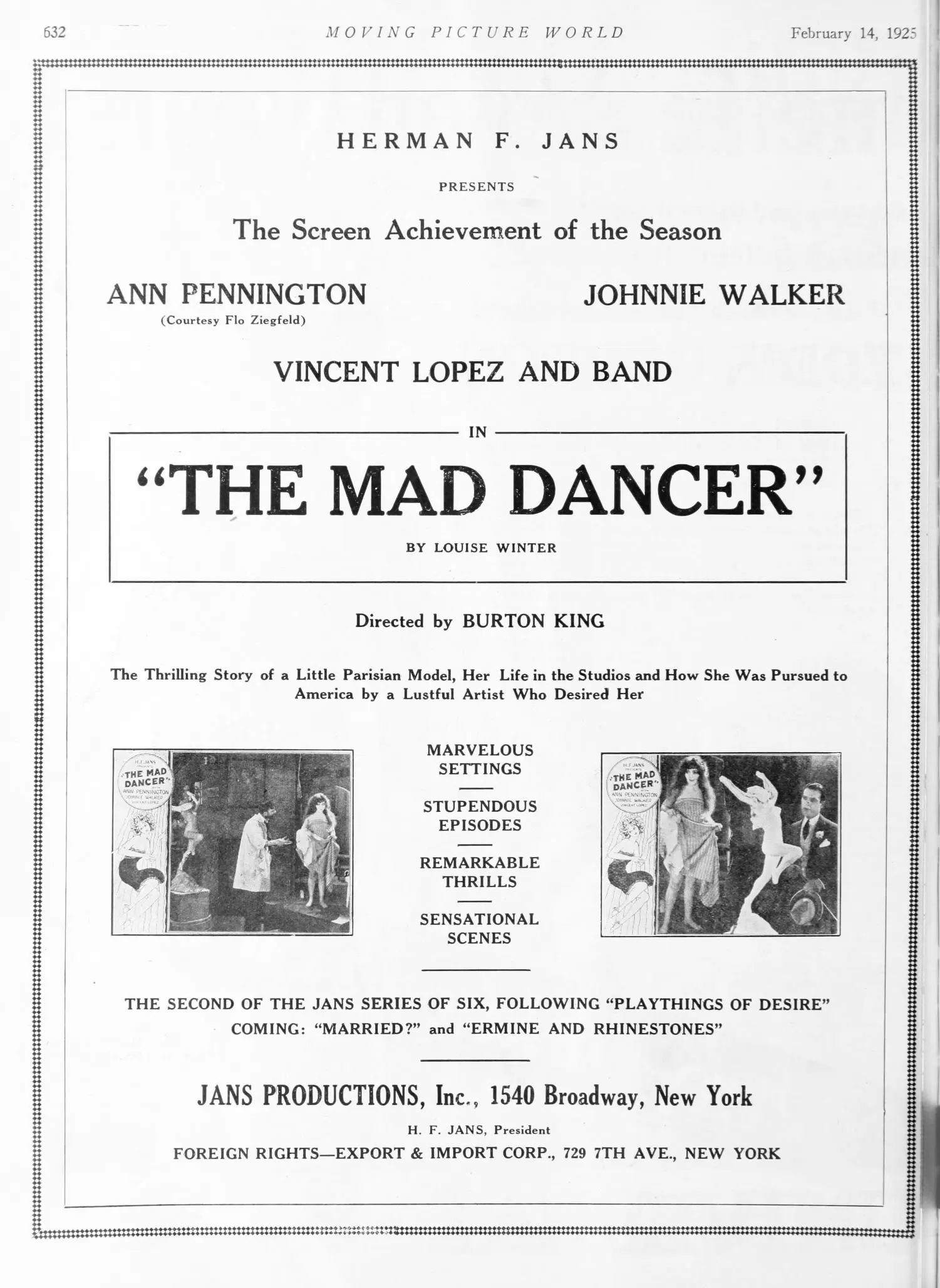
A definitive 5.3/10 rating for a film that redefined the boundaries of cult cinema. The Mad Dancer remains a cornerstone of transgressive art.
The Mad Dancer (1920s), a silent film steeped in the chiaroscuro of early cinema, unfolds as a taut psychological drama where the body becomes a contested site of power. Mimi, the titular figure, is not merely a dancer but a symbol of modernity’s dissonance with tradition—an archetype of the 'New Woman' whose sensuality threatens to destabilize the moral order. The film’s opening scenes, shot in the Latin Quarter’s shadowy alleys, use chiaroscuro to frame her as both muse and outcast, her nudes for Verlaine’s statue serving as a metaphor for the commodification of female autonomy. An Alaskan Honeymoon and A Woman of Pleasure similarly grapple with gendered power dynamics, yet The Mad Dancer distinguishes itself through its visceral use of sculptural imagery.
Verlaine, portrayed with a smug detachment by the era’s archetypal leading men, is less a tragic figure than a conduit for societal judgment. His statue, a grotesque parody of classical idealism, becomes a recurring motif—the frozen head of Mimi, shattered in a climactic act of defiance, mirrors the film’s broader critique of art as a tool of control. The cinematography here is masterful: when Mimi defaces the statue, the camera lingers on her hands, their movements both violent and methodical, contrasting sharply with the stillness of the bronze. This juxtaposition echoes the silent film tradition of using gesture to convey inner turmoil, a technique later refined in The Crime of the Camora.
The film’s second act, set in the sterile opulence of Washington, D.C., is a masterclass in visual irony. Mimi’s engagement to Senator Arundel’s son, Keith, is framed against backdrops of marble and gilded frames—spaces that echo the very art world Verlaine inhabits. Yet her rejection of these surroundings, symbolized by her abrupt departure to live in a cramped apartment, underscores the tension between societal expectation and personal truth. The use of color here is restrained; the palette shifts from the rich earth tones of Paris to the monochromatic bleakness of Washington, a visual shorthand for the loss of cultural vitality. This thematic consistency is rare in silent films of the period, where narrative often overshadowed aesthetic cohesion.
The subplot involving Verlaine’s public humiliation is both its most audacious and its most divisive element. His drunken outburst at the statue’s unveiling—a moment rendered in a single, unbroken take—captures the film’s willingness to embrace awkwardness as a form of truth. Senator Arundel’s subsequent bribe to retract his confession is a pragmatic resolution, but it feels less like a narrative conclusion than a societal surrender. This ambiguity invites comparison to A Broadway Scandal, where similar moral conflicts are resolved through institutional compromise rather than personal catharsis. Yet The Mad Dancer avoids the didacticism of its peers; its final shots of Mimi and Keith’s marriage are tinged with melancholy, suggesting that happiness is not a triumph over adversity but a fragile truce.
The casting is a curious blend of charisma and anonymity. Nellie Savage’s portrayal of Mimi is understated yet piercing—her eyes, framed by the film’s frequent close-ups, convey a range of emotions from defiance to vulnerability. The supporting cast, including the gruff but sympathetic Keith and the smugly villainous Verlaine, leans into archetypes, yet the film’s strength lies in its restraint. Dialogue is minimal, replaced by a score by Vincent Lopez Orchestra that swells in moments of tension, its crescendos mirroring the visual crescendos of the statue’s destruction. This aural-visual harmony is a hallmark of the silent era’s best work, and The Mad Dancer executes it with precision.
Technically, the film is a product of its time but also a precursor to later cinematic innovations. The use of negative space in Mimi’s early scenes—her body often isolated against vast, empty canvases—anticipates the stark compositions of German Expressionism. Similarly, the fragmented structure, which jumps between Paris, New York, and Washington without clear transitions, reflects an early experimentation with non-linear storytelling. These choices, while occasionally jarring, contribute to the film’s thematic coherence: a narrative about dislocation and reinvention.
In the context of 1920s cinema, The Mad Dancer occupies a unique space. It avoids the overt melodrama of Surprise and the romantic idealism of The Romantic Journey, instead offering a nuanced exploration of agency. Its themes of art as both liberation and oppression resonate with modern audiences, particularly in an era where the boundaries between public and private identity are increasingly contested. While the film’s pacing may feel uneven to contemporary viewers, its bold visual language and unflinching examination of societal hypocrisy ensure its relevance.
In conclusion, The Mad Dancer is a film that rewards careful viewing. Its interplay of form and theme, its refusal to sanitize its characters, and its innovative use of visual motifs make it a standout in the silent film canon. For scholars and casual viewers alike, it is a reminder of cinema’s power to interrogate the very structures it mirrors. As Mimi walks away from Verlaine’s shattered statue, the final shot lingering on her silhouette against a Washington skyline, the film leaves us with an unresolved question: can art ever truly liberate, or does it merely reframe the chains?
IMDb —
1918
Community
Log in to comment.