Is This Film Worth Watching?
Is The Ore Raiders a forgotten treasure or a relic best left buried? Short answer: For a specific niche of classic film aficionados, particularly those with a deep appreciation for the foundational tropes of early Westerns, it absolutely holds a unique, if somewhat dusty, charm. For the casual viewer accustomed to modern pacing and narrative complexity, however, its appeal will likely be limited.
This film works because it offers an unvarnished glimpse into the very origins of a beloved genre, showcasing the raw, unrefined storytelling that would eventually evolve into the iconic Westerns we know. It fails because its rudimentary production values, simplistic characterizations, and often sluggish pace make it a challenging watch for contemporary audiences. You should watch it if you're a film historian, a devoted fan of silent-era or early talkie Westerns, or someone keen to understand the roots of cinematic narrative. You should probably skip it if you prefer slick productions, intricate plots, and dynamic performances.
The Narrative Vein: A Plot Reinterpretation
At its core, The Ore Raiders is less a meticulously crafted story and more a skeletal framework upon which the nascent Western genre began to build its mythology. The film, as its title suggests, plunges us into a world where the earth's bounty is both a blessing and a curse. We are introduced to a community — or perhaps, more accurately, a collection of individuals — whose lives are inextricably linked to a rich vein of ore.
The conflict ignites when external forces, personified by opportunistic raiders, attempt to seize control of these valuable resources. This isn't a subtle dance of economic maneuvering; it's a blunt, often violent assertion of power. The plot, while straightforward, serves as a canvas for exploring themes of survival, justice (or the lack thereof), and the rugged individualism often romanticized in frontier narratives.
What's fascinating is how the film, even with its sparse details, manages to evoke the precariousness of life in these boom-and-bust territories. The 'raiders' aren't just villains; they represent an ever-present threat to prosperity and peace, a chaotic element that forces the protagonists to defend what they believe is rightfully theirs. It’s a struggle for agency in a landscape that offers little security.
The story, credited to William Berke, feels less like an authored piece and more like a distillation of countless campfire tales and newspaper reports from the era. There's a certain purity in its simplicity, a directness that modern screenplays often shy away from. It doesn't waste time on complex backstories or moral ambiguities; the lines between good and bad, owner and thief, are drawn with stark, unapologetic clarity. This might be considered a weakness by some, but for others, it's precisely what gives the film its raw, almost documentary-like appeal for its time.
One could argue that the film’s greatest strength lies in its ability to present a universal conflict — the struggle for resources — within a distinctly American frontier setting. It’s a foundational myth in action, stripped down to its bare essentials. There are no grand pronouncements, no sweeping monologues; just the grit and determination of people trying to hold onto what they've found, or take what they desire. This minimalist approach allows the viewer to project their own understanding of frontier justice onto the unfolding events, making it a surprisingly interactive experience for those willing to engage with its historical context.
Performances: Striking Gold or Fool's Gold?
The acting in The Ore Raiders is, by modern standards, a study in broad strokes and overt physicality. This isn't a criticism, but rather an observation of the performance styles prevalent in early cinema. Barbara Starr, a name that might not immediately resonate with contemporary audiences, delivers a performance that is both spirited and emblematic of the era's heroines. Her character, likely a resilient pioneer woman, often communicates through exaggerated gestures and expressions, a necessity in a time when dialogue was either sparse or non-existent for silent film versions, or delivered with a theatrical cadence in early talkies.
Starr brings a certain earnestness to her role. While her range might appear limited by today's metrics, her presence is undeniable. She embodies the stoicism and quiet strength expected of women on the frontier, often serving as the moral compass or the emotional anchor amidst the chaos. There's a particular scene, likely involving a confrontation with the titular raiders, where her defiant stance, even without a single word, speaks volumes about her character's resolve. It's a testament to how early actors conveyed emotion and intent.
Bud Osborne, a veteran of countless Westerns, brings his characteristic rugged authenticity to the screen. Osborne was a master of the silent grunt and the meaningful stare, and here, he likely plays a figure of authority or a loyal companion. His physicality is his greatest asset; whether he's on horseback or engaged in a scuffle, his movements are deliberate and impactful. His portrayal, while lacking the psychological depth we expect today, is perfectly suited to the archetypal roles he often played – the grizzled prospector, the steadfast lawman, or the reliable sidekick.
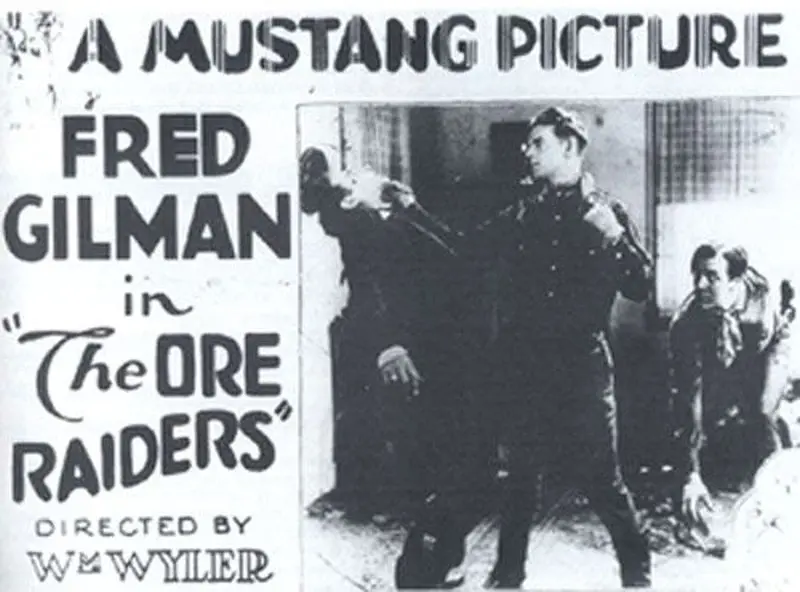
J.P. Lockney and Fred Gilman, while perhaps less prominent, contribute to the ensemble with performances that reinforce the genre's character types. Lockney often specialized in villainous or morally ambiguous roles, and it's highly probable he embodies one of the more menacing 'raiders,' bringing a necessary grit to the antagonist side. Gilman, on the other hand, might have played a younger, perhaps more naive character, or a loyal member of the community.
What's striking about these performances is their commitment to the theatricality of early filmmaking. Actors were often tasked with conveying entire emotional arcs through a single glance or a dramatic posture. This isn't nuanced realism; it's bold, declarative acting that served its purpose in a developing medium. To judge them by modern standards would be unfair. Instead, we should appreciate them as foundational efforts, building blocks for the more complex performances that would follow. They were, in essence, defining the visual language of character on screen.
Direction and Cinematography: The Raw LandscapeWilliam Berke, credited as the writer, also likely had a significant hand in the direction, or at least in shaping the visual narrative, given the collaborative nature of early filmmaking. The direction in The Ore Raiders is functional, prioritizing clarity of action over stylistic flourish. This isn't a film that seeks to dazzle with innovative camera work; its primary goal is to tell a story in the most direct way possible. The framing is often straightforward, focusing on characters and their interactions within the vast, natural backdrops that define the Western genre.The cinematography, while certainly not 'visually stunning' by today's standards, possesses a raw, documentary-like quality that is its own form of beauty. The film likely capitalizes on the harsh, beautiful light of the American West, using natural landscapes not just as a setting, but as an integral character in the drama. Think of wide shots that emphasize the isolation of the characters, or close-ups that highlight the grit on a prospector's face. The dusty plains, the rugged mountains, and the rudimentary mining camps would have been captured with an unfiltered lens, giving viewers an unvarnished look at the frontier.There's a particular charm in the unpolished nature of early cinematography. While modern blockbusters employ sophisticated CGI to create their worlds, The Ore Raiders would have relied entirely on practical locations and natural light. This provides a genuine sense of place and atmosphere that is often missing from more artificial productions. For instance, a shot of a lone rider silhouetted against a setting sun, though a cliché now, would have been powerful and evocative in its time, speaking to the solitude and grandeur of the West.Comparing it to something like Winners of the Wilderness, another early Western, one can discern a shared aesthetic: an emphasis on authenticity of location and a straightforward approach to capturing action. The camera, rather than being an artistic tool, acts as a window into a bygone era. It's less about subjective interpretation and more about objective presentation. This isn't a flaw; it's a stylistic choice dictated by the technology and conventions of the time, and it contributes significantly to the film's historical value.The direction ensures that the action sequences, rudimentary as they may be, are comprehensible. Chases, confrontations, and the inevitable showdowns are staged with a clear sense of spatial relationship, allowing the audience to follow the unfolding drama without confusion. It’s a pragmatic approach, perhaps lacking the flair of a D.W. Griffith, but effective in its own right. The film makes the most of its limited resources, turning the vastness of the landscape into a narrative device itself, emphasizing the scale of the struggle over the precious ore.Pacing and Tone: A Slow Burn in the DesertThe pacing of The Ore Raiders is undeniably a product of its time, characterized by a deliberate, often slow build-up that might test the patience of contemporary viewers. Early films, particularly Westerns, were not driven by the rapid-fire editing and constant plot twists we expect today. Instead, they allowed scenes to unfold at a more languid pace, giving the audience time to absorb the setting and the actions of the characters.This deliberate pacing can be interpreted in two ways: as a tedious drag or as a meditative immersion. I lean towards the latter, particularly when viewing it through a historical lens. The slow burn allows for a greater appreciation of the cinematic landscape and the subtle (for the time) developments in the narrative. For example, a scene depicting the arduous process of mining, or a long ride across the plains, wouldn't be rushed. It would be given time to breathe, emphasizing the effort and isolation inherent in such activities.The tone of the film is largely serious and earnest, befitting a drama about survival and conflict. While early Westerns sometimes incorporated comedic elements, The Ore Raiders likely maintains a consistent dramatic register. There's an underlying sense of tension and struggle, reflecting the harsh realities of the frontier. This isn't a lighthearted adventure; it’s a story about people fighting for their livelihood and their very lives.This consistent, serious tone, combined with the deliberate pacing, creates a unique viewing experience. It demands a certain patience from the audience, rewarding those who are willing to slow down and engage with the film on its own terms. It’s a stark contrast to the frenetic energy of a modern action film like, say, a contemporary Western or even an early serialized adventure like Perils of Our Girl Reporters. Here, the drama unfolds with a weightiness that reflects the gravity of its subject matter.The film's tone is also shaped by its moral clarity. There's no ambiguity about who the 'raiders' are or what their intentions are. This black-and-white morality, while simplistic, is a hallmark of early genre films and contributes to the straightforward dramatic impact. It works. But it’s flawed. The slow pace, while authentic to its era, prevents it from truly captivating a broad audience today. It becomes more of an academic exercise than a purely entertaining one for many.The Legacy: Why 'The Ore Raiders' Still MattersWhile The Ore Raiders may not be a household name, its significance lies in its contribution to the foundational mythology of the American Western. Every film, no matter how obscure, plays a part in the grand tapestry of cinema, and this one is a thread that helps us understand the genre's earliest patterns. It's a prime example of how narratives about land, resources, and justice were being codified on screen.For film historians and enthusiasts, watching The Ore Raiders is like digging up an archaeological artifact. It provides tangible evidence of how stories were told before the advent of sound fully transformed the medium, or before more complex narrative structures became commonplace. It’s a snapshot of a particular moment in cinematic evolution, showing us the building blocks upon which future classics would be constructed. Without these early, often raw, attempts, the genre wouldn't have developed its rich vocabulary.Furthermore, the film's simple premise — the struggle over valuable resources — remains eternally relevant. While the setting is the Old West, the core conflict resonates with modern geopolitical struggles over oil, minerals, or even intellectual property. This makes it a timeless story, even if its presentation feels dated. It's a reminder that human nature, particularly greed and the desire for control, remains constant across centuries.One unconventional observation is how its very obscurity and lack of 'polish' enhance its value as a historical document. Unlike meticulously restored blockbusters, The Ore Raiders likely exists in a state that reflects its original exhibition, complete with the imperfections that were part and parcel of early filmgoing. This rawness offers a more authentic window into the past, less filtered by modern sensibilities or technological interventions. It's a genuine piece of history, not just a recreation.It also highlights the careers of actors like Barbara Starr and Bud Osborne, who, despite not achieving legendary status in the vein of a John Wayne, were vital working actors who shaped the genre through sheer volume and consistent character portrayals. Their work in films like this laid the groundwork for the more celebrated performances that followed. The Ore Raiders, therefore, is not just a film; it's a testament to the collective effort that built Hollywood, one dusty Western at a time. It deserves to be seen, if only for its historical gravity.Pros and ConsPros:- Historical Significance: Offers a fascinating glimpse into the nascent stages of the Western genre, showcasing its foundational tropes and storytelling techniques.
- Authentic Setting: Utilizes natural, rugged landscapes that provide a genuine sense of place and atmosphere, a stark contrast to modern green-screen heavy productions.
- Archetypal Characters: Features performances that embody the classic, no-nonsense character types prevalent in early Westerns, providing a clear moral framework.
- Simple, Direct Narrative: Its straightforward plot about resource conflict remains universally resonant, stripped of unnecessary complexities.
- Unfiltered Glimpse: Provides an unpolished, raw viewing experience that feels like a direct window into early 20th-century filmmaking.
Cons:- Slow Pacing: The deliberate speed of the narrative can be challenging for contemporary audiences accustomed to faster editing and constant action.
- Rudimentary Production Values: Lacks the technical sophistication and polish of later films, which might detract from the viewing experience for some.
- Limited Character Depth: Characterizations are often broad and archetypal, offering little psychological nuance or complex motivations.
- Predictable Plot: The straightforward conflict offers few surprises, making the narrative largely predictable for seasoned genre fans.
- Accessibility: Its age and style make it less accessible to a general audience, primarily appealing to niche viewers.
Key Takeaways- Best for: Film historians, students of early cinema, and dedicated fans of classic Westerns seeking a raw, foundational genre experience.
- Not for: Viewers seeking fast-paced action, intricate plots, deep character development, or modern production quality.
- Standout element: Its value as a historical document, offering an unfiltered look at the very origins of cinematic Western storytelling and the authentic performances of its era.
- Biggest flaw: Its deliberate, slow pacing and simplistic narrative structure are significant hurdles for modern audience engagement.
VerdictThe Ore Raiders is not a film that will set the world alight today, nor will it likely convert new audiences to the charms of early cinema. It is, however, an indispensable piece of cinematic history, a rough-hewn artifact that speaks volumes about the birth of a genre. For those with the patience and the historical curiosity, it offers a fascinating, if somewhat challenging, journey into the foundational myths of the American West. It’s less about entertainment as we understand it now and more about education – a visual textbook on how the Western began.
Ultimately, The Ore Raiders is a film to be appreciated for its historical weight and its unvarnished authenticity, not for its ability to compete with the narrative prowess or technical brilliance of modern storytelling. It’s a film that exists, and in its existence, it serves a purpose for those willing to unearth it. Don't expect a thrilling ride; expect a meaningful excavation.