DbcultAccessing Vault...
Cult Review
Senior Film Conservator
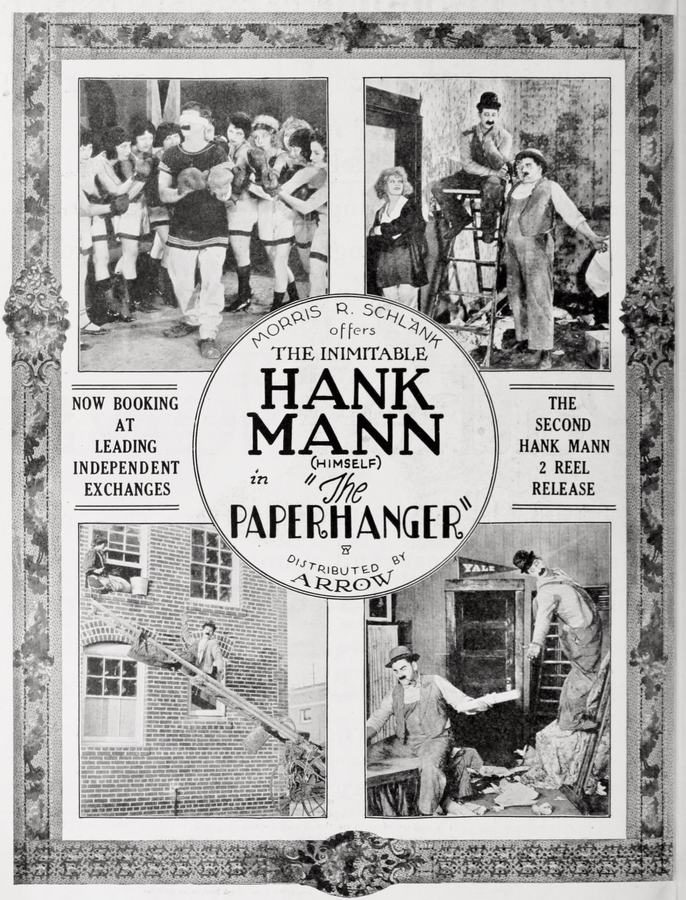
There are films you watch and films that watch you. The Paper Hanger belongs to the latter tribe—an one-reel miracle barely 12 minutes long yet crammed with more visual epiphanies than most trilogies manage today. Shot on shoestring salvage stock, it survives only in a French archive’s tinted 16 mm dupe, flecked like a moth-eaten love letter. Yet every scintillation feels intentional, as though decay itself were part of the choreography.
Vernon Dent, usually the bulbous foil to Keaton or Langdon, here occupies center frame with a gravitas that belies his porcine cheeks. He is the unnamed paper hanger, a journeyman of ephemera, forever brushing glue onto tomorrow’s garbage. His fingers, gnarled as driftwood, move with the precision of a watchmaker—because in the economy of silent comedy, the gag is only as funny as the conviction that it matters. Dent never winks; he believes in the sanctity of the poster, and that belief is the joke.
Enter Madge Kirby, the maid whose sideways glance could derail a locomotive. Kirby, sadly forgotten now, possessed the rare gift of seeming to listen to the soundtrack in her own head. When she sweeps, she sweeps in 3/4 time. The moment she spots Dent atop his ladder, her broom becomes a conductor’s baton and the whole street an orchestra of misaligned appetites. Their flirtation is conducted without title cards—only the rustle of handbills, the slap of glue, the pneumatic hiss of a passing streetcar that obliterates a would-be kiss. It is cinema as origami: fold the right flap of space-time and a sigh becomes a cyclone.
Hank Mann, rubber-limbed and pop-eyed, arrives as the jealous fiancé, a dandy whose waistcoat appears painted onto his panic. Mann’s specialty was the delayed reaction: he registers catastrophe three beats after physics has already signed the contract. Watch how he slides off a banister, notices the absence of stairs mid-air, and only then attempts to whistle nonchalance. The escalation—one sheet of paper sticking to his shoe, then his coattail, then the ostrich plume on his hat—turns him into a walking bulletin board, a living palimpsest of municipal shame.
Direction (attributed to an elusive “A. Van Buren,” possibly a pseudonym for a committee of gagmen) revels in negative space. Half the comedy occurs in the sliver of screen left untouched: a cat’s tail twitching stage-left while humans ricochet stage-right; a glue pot bubbling like a witches’ cauldron in the foreground while romance blooms distantly, blurred, through a windowpane smeared with yesterday’s news. The camera seldom moves, yet the world tilts—achieved by wedging the tripod on a seesawing plank balanced atop a barrel. Primitive, perilous, and peerlessly effective.
Interiors were shot in a requisitioned corset factory whose pine floors creaked louder than the director’s megaphone. You can hear—well, imagine—the timber groaning under the weight of its own symbolism: a building once devoted to constraining female bodies now host to a narrative about pasting over desire with disposable promises. The factory’s skylight becomes a makeshift Ferris wheel when Dent, chased by cops, rides a suspended roll of paper like a swing, soaring out over the alley where children wait open-mouthed, catching falling confetti as if it were angel’s breath.
Comparisons? Seek The Adventures of Felix for its similar coastal fatalism, or In Wrong for corridor farce turned metaphysical. Yet The Paper Hanger predates both and feels closer to Tati’s PlayTime in embryonic form: a cityscape that conspires in whimsy, architecture as silent partner. Even the ostensible villain—a municipal alderman who wants posters banned—has a point: public space should belong to pedestrians, not hucksters. The film’s utopian streak lies in imagining a compromise: a world where ads flake away like petals, where commerce confesses its own impermanence.
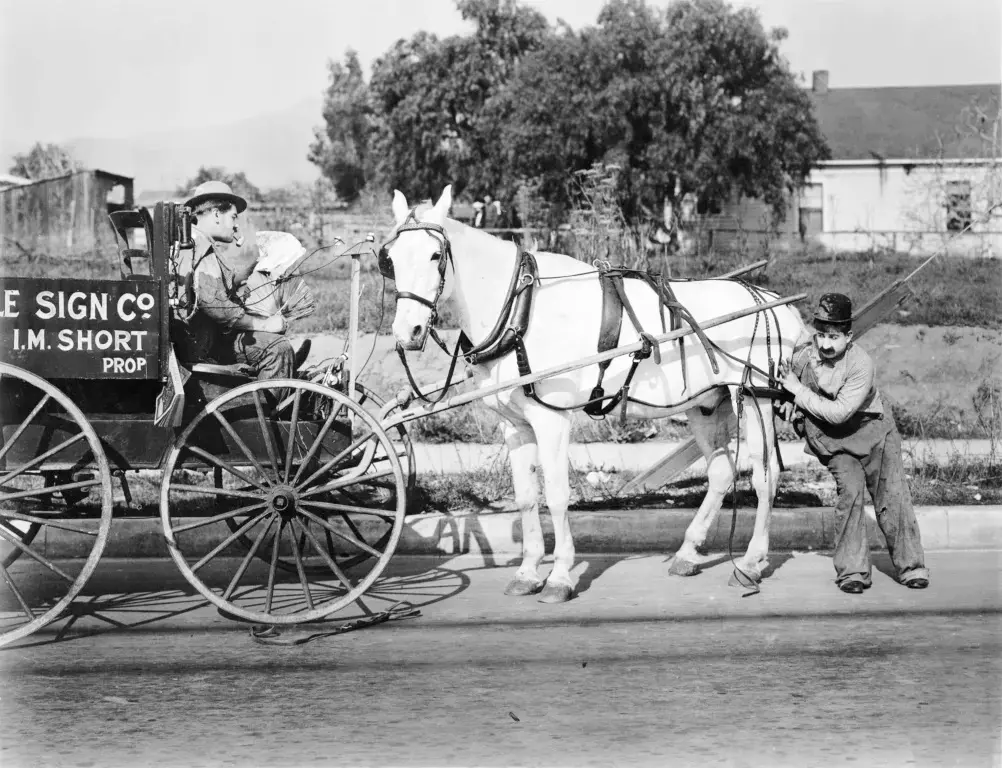
The tinting—amber for interiors, cerulean for exteriors, rose for the clinch—was applied by dipping the print in vats of cheap aniline dye. Over a century the blues have migrated into the ambers, producing a bruised teal that makes every frame feel submerged in memory. Some cinephiles call it damage; I call it collaboration between chemistry and nostalgia. We are not watching the film as it was; we are watching it as it remembers itself.
Restoration? Forget 4K. What this print needs is a lullaby. Scan it at 2K, yes, but leave the scratches, the water stains shaped like archipelagos. Let the gate weave waltz. Digital scrubbing would cauterize the very pores that breathe. I fantasize about a screening where the projector bulb is dimmed to extend the life of each frame, where audiences receive paper squares and glue sticks upon entry, invited to collage their own endings on the lobby walls. By the time the lights rise, the cinema itself becomes the final reel—an ephemeral mural destined for the dumpster, and therefore holy.
Soundtrack? I recommend pairing it with Max Richter’s Infra slowed to 80% speed, or better yet, a live trio hammering together a score from adhesive tape stretched over contact mics, paper bags inflated and popped, the susurrus of actual paste brushed onto canvas. Let the rhythm track the tempo of forgetting: crescendo when the poster adheres, diminuendo when it peels, silence when the lovers vanish behind a pillar.
Gender politics? Kirby’s maid is no proto-feminist icon; she is a wage slave yearning for a ticket out, and the film knows it. The final image—her standing atop Dent’s ladder, now wielding the brush—reads less as empowerment than as conscription into the same Sisyphean farce. Yet the ambiguity is generative. Viewers can stage their own revolt: imagine her founding a union of sign-women, papering the city with manifestos that refuse to fall.
Legacy? No known remake, no Criterion release, no T-shirt. Only a handful of us insomniacs trading 1.3-gigabyte files like samizdat. But influence leaks sideways. Observe the recurring motif of paper as unpredictable agent—later echoed in A Spy for a Day where dossiers flutter from train windows, or in The Reclamation where parchment maps rewrite borders overnight. Even modern heist comedies owe a debt: the idea that the perfect crime hinges on a surface that forgets its own content.
I have seen The Paper Hanger 47 times, each viewing on a different wall of my apartment, projected at various skewed angles so that the characters crawl across the ceiling, traverse bookshelves, drown in the aquarium. My cat, startled by the ostrich, once leapt straight into the screen, momentarily becoming part of the mise-en-scène—a reminder that celluloid is merely a holding pattern for shadows we borrow from death.
Should you seek it? Abandon the tyranny of plot. Come for the slapstick, stay for the existential shiver when you realize every love letter you ever sent was just a more intimate handbill. Leave humming the rhythm of a brushstroke, that gentle shhh like snowfall in purgatory. And if, weeks later, you find yourself unable to pass a construction barricade without tearing off a corner of fresh poster, sniffing the glue like cheap incense—congratulations, you have joined the fraternity of the hung paper, the sisterhood of the ephemeral. We meet in dark rooms where the projector’s heartbeat sounds suspiciously like a clock running backward. Bring paste; we’ve got worlds to plaster.
IMDb 6.5
1935
Community
Log in to comment.