DbcultAccessing Vault...
Cult Review
Senior Film Conservator
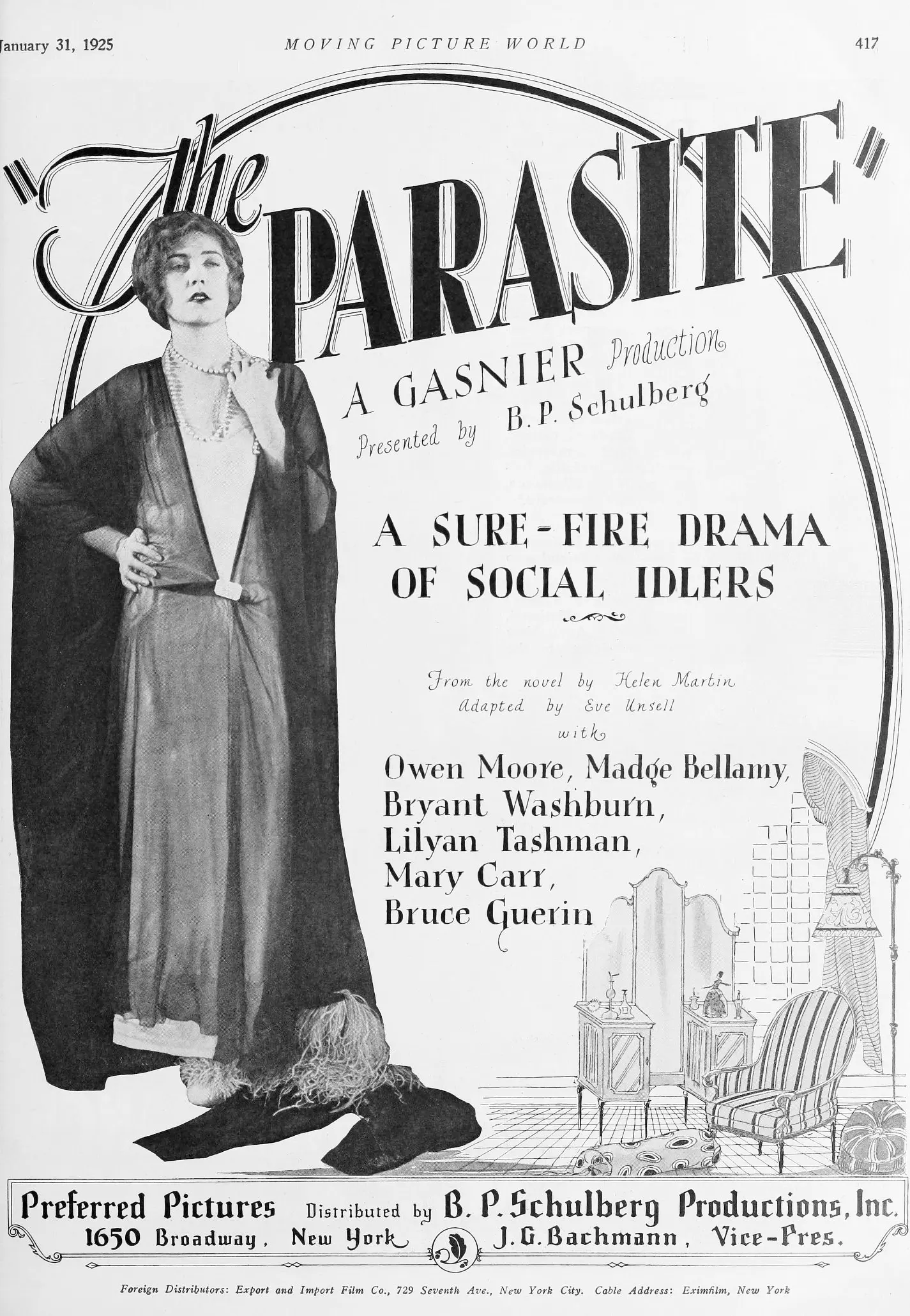
Short answer: yes, but only if you have an appetite for the heightened emotional stakes of the silent era and can look past the occasionally rigid social mores of 1925. This film is for viewers who enjoy vintage domestic dramas with a survivalist twist, but it is definitely not for those who demand modern pacing or subtle character motivations.
In the landscape of 1920s cinema, The Parasite stands out as a fascinating artifact that bridges the gap between social commentary and pure, unadulterated pulp. It is worth watching for the performance of Madge Bellamy alone, who manages to convey a quiet dignity that contrasts sharply with the frantic energy of the surrounding cast. However, if you are looking for a nuanced exploration of divorce, you might find the film’s moral binary—casting the ex-wife as a mustache-twirling villain—a bit archaic.
This film works because it successfully pivots from a stuffy social drama into a visceral survivalist thriller without losing its thematic core. It manages to make the viewer care about the central child-in-peril trope by grounding it in a larger conversation about who is 'worthy' of belonging to a family. You should watch it if you want to see how silent cinema handled complex social labels like 'gold-digger' with more nuance than modern audiences might expect.
The title of the film is its most potent weapon. By labeling Joan Laird a 'parasite,' the film invites the audience to scrutinize the labor of caregiving versus the labor of social climbing. Arthur Randall (Owen Moore) is a man of success, but he is fundamentally a hollow center around which more interesting women orbit. When he hires Joan to care for his sick son, Bertie, the film enters its most interesting phase. We see the 'high society' vultures—who do nothing but consume—pointing fingers at a woman who is literally saving a life.
Consider the scene where Joan first enters the Randall household. The camera lingers on the cold, cavernous architecture of the mansion, suggesting that without Joan’s warmth, the house is just a tomb for Randall’s wealth. This is a recurring theme in films of this era, much like the domestic tensions seen in The Better Wife. The 'parasite' isn't the one who needs the money; it's the society that needs the drama to sustain its own boredom.
While the first half of the film is a slow-burn melodrama, the second half is an absolute adrenaline shot. The kidnapping of Bertie by his mother, Laura (Lilyan Tashman), is filmed with a surprising amount of grit. Tashman plays Laura not as a grieving mother, but as a woman possessed by a toxic sense of ownership. This isn't the maternal longing seen in Pettigrew's Girl; it is a violent reclamation of property.
The car chase is the film’s technical highlight. For 1925, the editing here is remarkably fluid. When Laura’s car finally goes over the cliff, the film doesn't shy away from the brutality of the moment. The wreckage isn't just a plot point; it's the physical manifestation of Laura’s broken life. The subsequent survival sequence in the hills allows the cinematography to breathe. The use of natural light and the rugged, unforgiving terrain creates a sense of isolation that makes the eventual rescue feel like a true miracle rather than a scripted inevitability.
Madge Bellamy is the soul of the film. In an era where 'big' acting was the norm, Bellamy’s Joan is remarkably restrained. When she is branded a parasite by the local gossips, she doesn't weep or wring her hands; she simply turns back to her work. It is a performance of labor. She reminds me of the stoic heroines in Freckles, women who define themselves by their actions rather than their reputations.
Lilyan Tashman, on the other hand, is a revelation as the antagonist. She brings a jagged, nervous energy to Laura. In the scene where she attempts to win Randall back, her eyes betray a mixture of genuine panic and calculated manipulation. It’s a performance that makes you wonder if the film might have been even better if it had explored her descent into madness with a bit more empathy. As it stands, she is a spectacular foil to Bellamy’s grounded Joan.
Bruce Guerin as Bertie is also worth noting. Child actors in the 1920s were often directed to be unnaturally precious, but Guerin manages to feel like a real boy in real danger. His chemistry with Bellamy during the hillside survival scenes is the glue that holds the final act together. Without that believable bond, the ending would feel like a cheap emotional ploy.
The directing by Louis J. Gasnier is efficient, if not revolutionary. He knows when to use a close-up to punctuate a moment of social cruelty and when to pull back to show the vastness of the California hills. The film’s pacing is its biggest hurdle for modern viewers. The setup takes a long time—perhaps too long—to establish Randall’s prosperity and the various social dynamics. However, once the kidnapping occurs, the film never looks back.
The cinematography in the sickroom scenes uses shadow effectively to mirror the uncertainty of Bertie’s health. It creates a claustrophobic atmosphere that makes the later transition to the wide-open hills even more jarring. This film fails because Arthur Randall remains too passive a character for a man whose actions drive the entire conflict; he is more of a prize to be won than a human being with agency.
The resolution—Randall marrying Joan—is predictable for 1925, but the path to get there is paved with more trauma than usual. The film doesn't just give Joan the man and the money; it makes her earn them through a harrowing ordeal. This is a common trope in films like The Price of Pleasure, where the heroine must pass a 'test' of character.
However, I would argue that the ending is actually quite cynical. Joan only gains social acceptance once she has nearly died for the Randall name. It suggests that for a woman of her class, 'parasite' is the default label until she proves she is willing to self-sacrifice to the point of extinction. It’s a dark undercurrent that gives the film a weight that many of its contemporaries, such as Pampered Youth, lack.
The Parasite is a film of two halves: a sharp, albeit dated, social drama and a gripping survivalist nightmare. While it suffers from some of the narrative shortcuts common in the mid-20s, its central performances and the sheer audacity of its third-act shift make it a compelling watch. It is a film that asks us to look at who is really feeding off whom. If you can stomach the melodrama, you'll find a movie that is surprisingly modern in its cynicism toward the upper class.
"A haunting reminder that in the eyes of the elite, service is often mistaken for opportunism."
Ultimately, this is a essential viewing for those tracking the evolution of the 'woman in peril' subgenre. It has more teeth than Hitchin' Posts and more heart than Fate's Frame-Up. It’s a messy, beautiful, and occasionally cruel piece of cinema that deserves a spot in the conversation about 1920s social realism.
IMDb —
1918
Community
Log in to comment.