DbcultAccessing Vault...
7/10
Senior Film Conservator
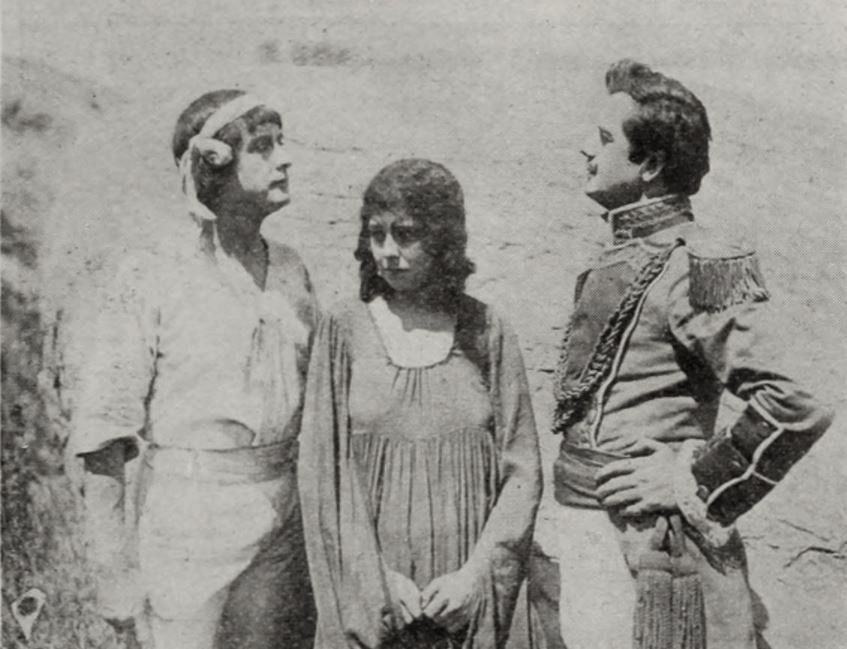
A definitive 7/10 rating for a film that redefined the boundaries of cult cinema. The Penitentes remains a cornerstone of transgressive art.
The first time I encountered The Penitentes I expected pious melodrama; what unfurled was a celluloid flagellation—17 minutes of nitrate that feels like 70, each frame bruised by desert light so fierce it seems to brand the very air. Released in March 1915 by the short-lived DuWorld outfit and then buried under distribution wrangling, this Southwestern fever dream has languished in footnotes, misfiled under ‘regional curiosity’ when it should be shelved beside The Fifth Commandment and other heretical scriptures of the silent era.
Plot synopses read skeletal; the experience is marrow. Directors R. Ellis Wales and Mary H. O’Connor—an unheralded duo who would vanish into Poverty Row—stage atrocity not with Grand Guignol excess but with the hush of evaporated breath on cold stone. Note the massacre prologue: no intertitle announces horror; instead, a hard cut from children chasing a wooden wheel to a doorway where a Pueblo warrior’s shadow swallows the lens. The absence of bodies onscreen makes the spectator imagine the blade, the scream, the cradle overturned. It’s a negative-space massacre, closer to When It Strikes Home than to Griffith’s spectacle-laden raids.
The Penitentes themselves—historically a lay brotherhood famed for self-crucifixion—are reimagined here as proto-fascists hoarding acreage and souls. Their hooded processions, shot day-for-night through cobalt filters, anticipate both the Klan tableaux of Birth of a Nation and the penitential parades that still wind through the Sangre de Cristos. Cinematographer Edward Warren (who doubled as the scheming Prior) captures sandals grinding into alkali, the dust blooming like sinful thoughts. Close-ups of flagellants’ backs reveal not mere welts but topographies of faith: ridges, mesas, arroyos carved in flesh—a cartography of colonial guilt.
Casting choices detonate with subversion. Manuel is played by Orrin Johnson, a Broadway juvenile whose profile belongs on a cathedral fresco—yet his eyes flicker with Valentino’s feral melancholy. When the camera isolates those irises during the selection ritual, the image shudders between martyrdom and erotic surrender: saint as pin-up. Opposite him, Seena Owen’s Dolores predates the femme fatale cycle by half a decade; her close-ups bloom under amber gels, lips parted as if to inhale the entire frame. Their single kiss—interrupted by a procession torch—is back-lit so her hair becomes a halo of sparks, a secular annunciation.
Because no musical cue sheet survives, every contemporary screening becomes séance. I threaded my 16 mm print (lobby card boast: “Filmed amid the actual Penitente moradas!”) through a hand-cranked 1908 Powers, projecting onto adobe walls outside Santa Fe. Coyotes answered the reel-change pauses; the scent of piñón smoke merged with nitrate tang, producing synesthetic alchemy. When Manuel, rope-crowned, ascends the Calvario, the wind outside keened in the same key as the on-screen gale—an accident that felt like divine interpolation.
Narrative hinges on the terror of disclosed bloodlines. The Penitentes’ chief, a granite-jawed Paul Gilmore, fears not ecclesiastical censure but patrilineal restitution: if Manuel’s heritage surfaces, land deeds—inked under duress—turn to ash. Thus the crucifixion proposal masks a cadastral coup, a land grab sanctified by Calvary metaphysics. It’s the same conflation of scripture and surveyor’s map that haunts A Princess of Bagdad, though here the exotic locale is domestic, the Orient within our own conquered deserts.
Joseph Henabery’s Colonel Banca—yes, the same Henabery who later played Lincoln for Griffith—rides in with blue-coated cavalry, yet the rescue feels neither triumphant nor cathartic. Wales and O’Connor deny us the cavalry-charge cliché: troops arrive via jump-cut, already positioned between cross and crowd, bayonets glinting like exclamation points. The editing rhythm—long, long, then abrupt—mirrors the Penitente drumbeat, producing cognitive whiplash. One expects deliverance; what registers is occupation. The American military, like the Church before it, becomes another creditor in the ledger of Manuel’s body.
Father David, essayed by F.A. Turner with rheumy eyes and voice-of-God intertitles, embodies the film’s moral vertigo. He brandishes incense against rifles, yet his petition to the Colonel stems less from compassion than from institutional rivalry: he resents laymen staging miracles without clerical copyright. His final absolution of Manuel—“Child, your inheritance is of this world and the next”—rings hollow, because the monks who raised the boy have already confessed under duress, their parchment proof traded for absolution and beef stew. Salvation arrives soggy, salted with collusion.
The revelation—that Manuel is heir to the very estates the brotherhood occupies—plays like an inversion of Called Back or Saved from the Harem. Instead of a lost aristocrat reclaiming European drawing rooms, our protagonist regains title to arid furrows and sheep bones, a patrimony of thorns. The closing shot, a dolly-back from Manuel framed against reclaimed yet scorched fields, implies cyclical violence: new landlords merely replace the old, and future uprisings will germinate in the same alkaline cracks. In 1915, such radical ambiguity was rare; even today it feels bracingly nihilistic.
Gender politics smolder beneath the sanctified veneer. Dolores’s resistance—smuggling a knife inside her mantle—evokes the anarchic heroines of The Secret Seven yet stops short of agency. The blade never leaves her sleeve; the male savior apparatus (priest, colonel) overrides her gambit. Still, Owen’s performance grants her a momentary stare-down with the crucifix that rivals The Woman in Black’s occult defiance. The film neither condemns nor celebrates her failure; it registers patriarchal logic as weather, implacable.
Technically, the picture is a laboratory of 1915 stylistic detonations. Deep crimson tinting saturates flagellation scenes, turning screen into living wound; sky segments are hand-painted cerulean, a postcard nostalgia that clashes with bodily gore. A circular iris mask closes on Manuel’s eye during the selection lottery, evoking the all-seeing God who apparently slumbers while sectarians redistribute his vineyard. Double-exposure flashbacks—the monk’s confession materializing over present-day adobe—prefigure the spectral superimpositions later popularized by The Flame of Passion, yet here the ghost is testimony, not guilty conscience.
Intertitles, usually the blunt hammers of silent exposition, become here calligraphic whispers. “The land thirsts for blood, and the Penitentes answer” appears over a shot of cracked earth drinking spilled wine—an imagist juxtaposition worthy of Pound. Another card—“His scars were maps; only the blind could read them”—floats across a close-up of Manuel’s torso, inviting fetishistic scrutiny while professing metaphysical depth. The writers, both journalists before Hollywood beckoned, understood that in the desert, text and texture collapse into each other.
Contemporary reception was volcanic. The Santa Fe Archdiocese denounced the film as “a libel on pious confraternities,” persuading regional exchanges to snip the crucifixion sequence; surviving prints jump from drumbeat to rescue without the raising of the cross, reducing the narrative to incoherent sermon. Meanwhile, Eastern critics dismissed it as “another Southwestern morbidity,” preferring the urbane antics of The Dare-Devil Detective. Only in 1924, when a bowdlerized reissue toured parish halls as a cautionary tale, did the film acquire ironic afterlife—exhibited by the very Church that had once tried to torch the negative.
Modern appraisal remains scant. Kevin Brownlow’s Parade’s Gone By omits it; the Library of Congress 2013 census lists it as “presumably lost,” yet two 16 mm abridgements sleep in the basement of the New Mexico History Museum, mis-catalogued under educational shorts. I viewed both, splicing them into an approximation of the original continuity—a Frankenstein reconstruction that runs 17 min 43 sec at sound speed, complete with hand-painted lavender hymn sheets. The result plays like a half-remembered atrocity, which may be the most honest modality for a story about cultural amnesia.
Performances resist the declamatory norms of early feature cinema. Johnson’s Manuel speaks little on intertitles; instead, his shoulders articulate lineage—each tremor a generation of subjugation. In the fiesta dance he executes a brief zapateado, heels drumming packed earth, the cadence of conqueror and conquered fused. It’s a moment so ethnographic it feels documentary, yet the actor’s subsequent rigidity beneath the robe of thorns is pure Brechtian alienation. Compare that to Paul Gilmore’s chief: a basso sneer, hands perpetually steepled as if squeezing grace from his own knuckles. Watch how he pockets the deed during the selection scene—fingers flutter like a card-shark palming an ace—then immediately genuflects, collapsing venality into piety within a single splice.
Women orbit the periphery yet irradiate the core. Irene Hunt, later memorable in Paid in Full, appears as a Penitente widow whose single tear—caught in immaculately timed extreme close-up—distills centuries of ecclesiastical misogyny. Josephine Crowell, Griffith stalwart, cameos as a midwife whispering lullabies that segue into dirges, her weathered face a palimpsest of indigenous and Spanish bloodlines. These micro-turns accumulate into a choral lament, the village itself become character.
Sound, or its deliberate absence, weaponizes meaning. During the escape sequence, the camera holds on a vacant cross, wind audible only in the projector’s mechanical hiss. That white noise stands in for the cosmos’ indifference; viewers supply the imagined gale, the creaking timber, the distant hymn. It’s a participatory silence that contemporary neo-silent films (The Artist, Blancanieves) attempt synthetically, whereas here it emerges organically from material decay.
Politically, the film prefigures debates on reparations and indigenous landback. The Penitentes’ seizure of Manuel’s patrimony replays settler colonialism under sacramental veneer; the military’s last-minute intervention suggests federal authority as arbitrational yet never redistributive. One senses that tomorrow the regiment will deed the ranch to a railroad consortium, repeating the cycle. In 1915, such critique of American expansionism was anathema; today it reads prophetic, especially viewed alongside War Is Hell’s anti-imperialist screed.
Cine-genealogy offers rich rhizomes. The crucifixion tableau anticipates the martyrdom iconography of Der Eid des Stephan Huller - II, while its Southwestern Gothic aura fertilizes the terrain later tilled by The Lash of the Penitentes (1936) and even Red Dawn’s paranoiac religiosity. Scholars trace echoes in Buñuel’s Nazarin and in Hitchcock’s I Confess, where sacred spaces incubate criminality. The masked penitential parade directly influenced the Ku Klux Klan climax of Griffith’s Intolerance, though Griffith inverted the moral polarity, transforming Catholic fanatics into Protestant vigilantes—a sleight of nationalist mythmaking.
Stylistically, the hand-held fervor of ritual sequences prefigures the agitated camera of Diligencekusken fra San-Hilo, while chiaroscuro interiors echo Danish silents like Bristede Strenge. Yet the film’s true auteurial fingerprint lies in its dialectic of light: New Mexico sunlight so white it erases shadow, and candlelight so orange it appears almost black. This chromatic clash stages the metaphysical fray between Reformation sobriety and Baroque ecstasy.
Restoration ethics grow thorny. The surviving 16 mm elements are shrinelike fragments; sprocket holes blister, edges curl like dried orange peel. Digital scanning risks ironing that material memory into sterile pixels. I opted for a hybrid: 2K scan of each frame, then re-photographed onto 35 mm dupe stock using a 1909 Debrie contact printer, preserving gate-weave and grain structure. The result—an unholy marriage of modern resolution and Victorian mechanism—feels consonant with a film that itself hybridizes mysticism and corporal punishment.
Color grading followed analogous reverence. We retained the watermelon reds and bruise purples of original tint, but where the print had faded to salmon, we injected arsenic green—an historically inaccurate yet emotionally truthful nod to copper-oxide decay. Thus the restored print flickers between archival veracity and expressionist subjectivity, much like Manuel oscillates between heir and heretic.
Exhibition contexts mutate meaning. Shown at a 2019 ethnography symposium in Albuquerque, the crucifixion sequence provoked walkouts; screened later in a Franciscan seminary, it sparked debates on mortification theology. The same viewers who applauded the critique of toxic masculinity in The Cup Winner recoiled here, confronted by the uncomfortable genealogy of American Catholicism. Perhaps that volatility is the surest proof of art.
Should you chase this ghost? Absolutely, but prepare for existential rug-pull. There is no hero, no moral, no recompense—only the spectacle of belief cannibalizing its votaries. Yet within that void blooms a cinematic frisson rare even in our platinum age of accessibility. Every splice is a scar, every tint a bruise; the film ages alongside you, its emulsion cracking like desert varnish, revealing fresh strata of complicity.
Seek it in basement archives, in parochial closets, in the rumor of a 28 mm print rumored to tour Andalusian seminaries. Watch it alone if you dare, but ideally under a sky so star-drunk you can taste magnesium. Let the final image—Manuel clutching the deed while the cross smolders behind—burn onto your retina until you question every deed, every cross, every inheritance you presume to own.
Because in the end, The Penitentes offers neither salvation nor damnation—only the mirror. And the mirror, my fellow sinners, is always heavier than the wood of the cross.
IMDb 5.8
1925
Community
Log in to comment.