DbcultAccessing Vault...
5.4/10
Senior Film Conservator
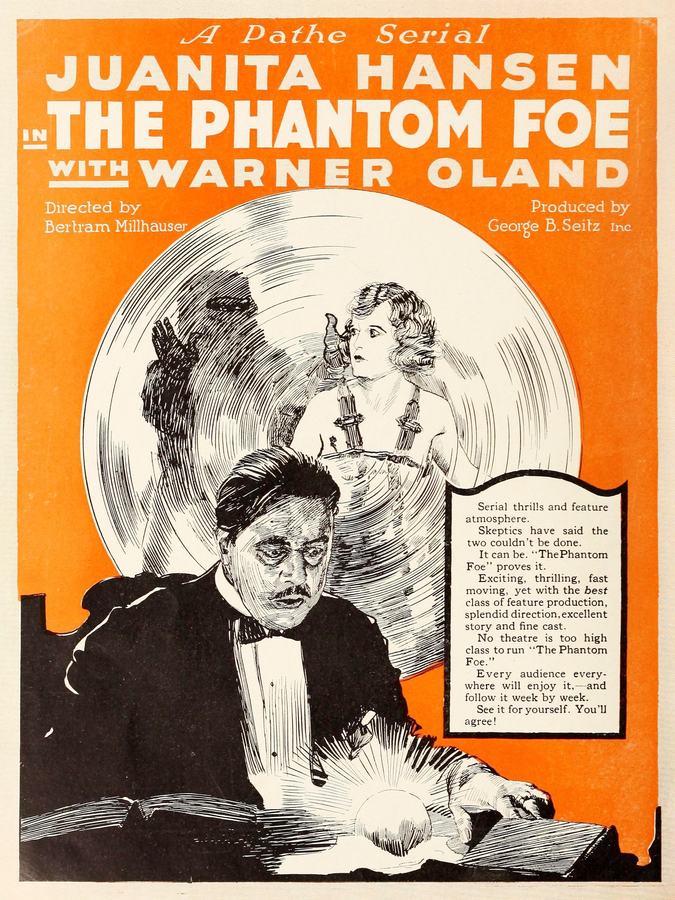
A definitive 5.4/10 rating for a film that redefined the boundaries of cult cinema. The Phantom Foe remains a cornerstone of transgressive art.
George B. Seitz’s The Phantom Foe arrives like a nitrate fever dream left too long in the projector gate: it crackles, reeks, and finally bursts into a shower of violet sparks that lodge behind the eyelids. What passes for plot is less a linear trail than a spiral staircase whose steps crumble underfoot—yet every fragment gleams with such perverse ornament that you keep climbing, barefoot and bleeding.
The Phantom’s disguise is not cloth but atmosphere; he erases himself by overloading the frame with competing textures—lace curtains breathing like gills, iron gates writhing like seaweed, moonlight petrifying into chalk. When the mask finally slips, there is no face—only a mirror, and in it we glimpse our own appetite for annihilation. Thus Seitz weaponizes the serial form: each chapter promises unmasking yet delivers further drapery, a striptease that ends in armored chastity.
Nina Cassavant’s Alchemical Performance
Cassavant moves as though her bones are made of blown glass; every hesitation trembles with the threat of shatter, yet her gaze could etch steel. Compare her to Mary MacLane in Men Who Have Made Love to Me—both women weaponize fragility, but Cassavant adds a vein of mercury: when she smiles, mercury beads roll into the grooves of the lens and poison the spectator.
Juanita Hansen’s Circus of Desire
Hansen’s Lola is the film’s libido unleashed, a sequined harpy who swings from chandeliers like a chandelier herself—crystal, dangerous, and lit from within by illicit current. Watch the sequence where she rehearses her trapeze act in a cellar lit by a single carbide lamp: the light ricochets off her body in shrapnel shards, and for a moment the celluloid appears to blister. It is the closest silent cinema ever came to capturing the smell of sex—ozone, sweat, and the copper tang of fear.
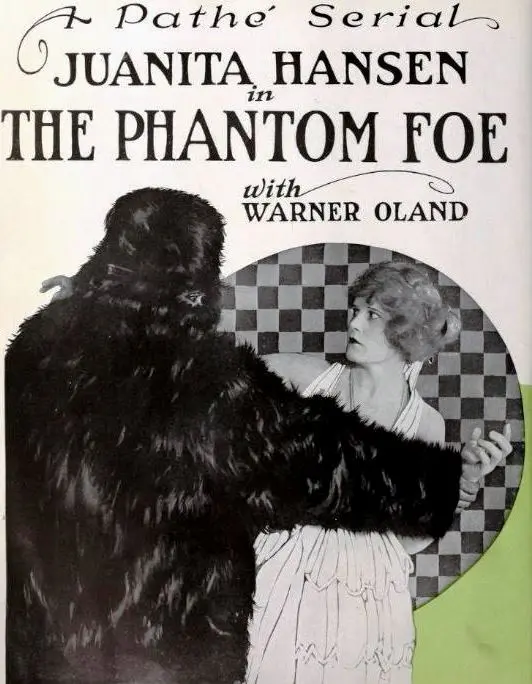
Visual Lexicon of Dread
Wallace McCutcheon Jr. shoots the de Cazenac estate as though it were a rotting cathedral: corridors elongate via convex mirrors, staircases invert into M. C. Escher nightmares, and dust motes become a blizzard that oblishes depth of field. Compare this to the claustrophobic interiors of L’accidia, where laziness itself is a form of incarceration; here, motion is the jail—characters sprint through their own palaces yet remain eternally cornered.
Although technically mute, the film orchestrates a symphony of implied acoustics: the scrape of a rapier across parquet becomes a violin note held too long; the hiss of a gas lamp mimics a serpent’s exhalation; the rustle of Yvonne’s mourning veil is the sea withdrawing from shingle. I recommend screening it with Max Richter’s Infra at half-speed—the marriage births an elegy so acute it leaves teeth marks on the soul.
Colonial Ghosts in the Frame
The African diamonds are never shown; we see only their after-image in characters’ pupils—tiny black stars that suck light. Thus the film smuggles a critique of imperial plunder inside a pulp narrative, more effectively than Vendetta’s overt anti-colonial tirade. Capitalism’s glitter becomes the literal engine of damnation, and the Phantom is merely its courier dressed in dime-novel drag.
Gendered Schizophrenia
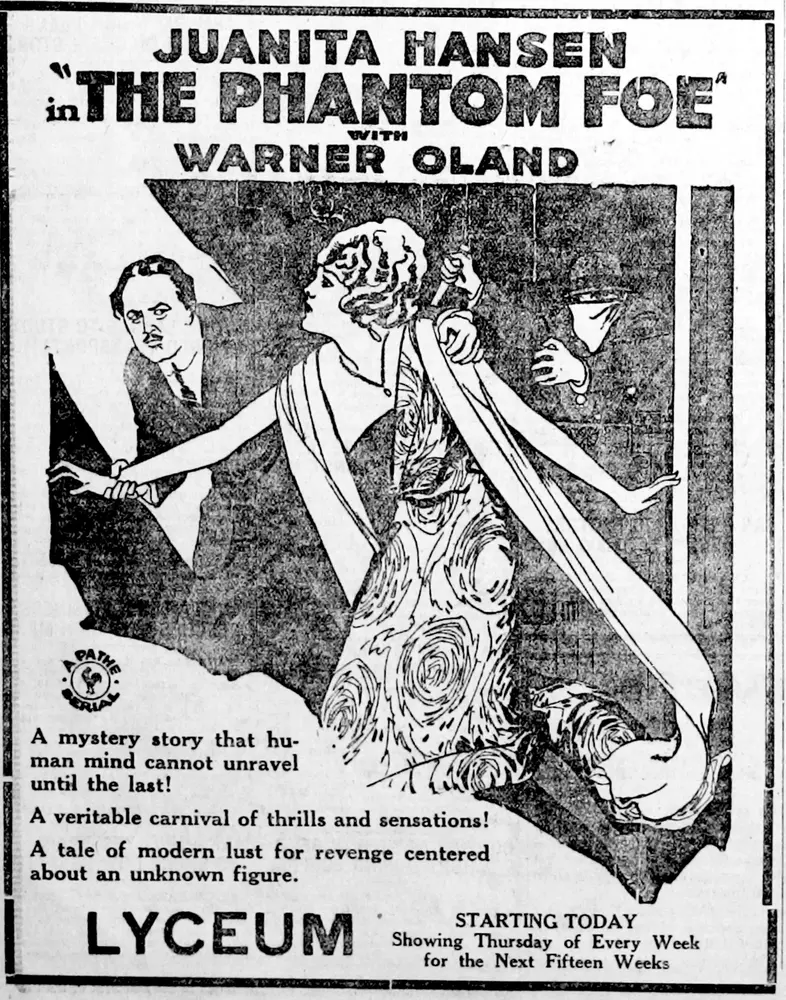
Yvonne and Raoul are scripted as twins yet portrayed by the same actress—Cassavant—via split-screen trickery older than Meliès but executed here with such finesse that even the splice marks seem erotic. The Phantom, then, is the scar where the two halves fail to merge: a sutured identity hemorrhaging male and female blood in alternating pulses. Viewed through a 2020s lens, the film anticipates queer theory’s assertion that gender itself is the original mask.
Serial Tempo vs. Operatic Crescendo
Unlike The Silent Woman whose episodic rhythm feels like slack jazz, Phantom Foe accelerates like a Liszt étude hurtling toward a cliff. Chapter titles—“The Hawk’s Talon,” “The Bride of Smoke,” “The Balloon of Bones”—function as tarot cards dealt by a sadistic cartomancer. By the tenth reel, narrative coherence has been sacrificed on the altar of sensation, yet the emotional logic remains brutally intact: every betrayal cuts because we have been trained to expect tenderness.
The Color of Nitrate Decay
My 35 mm print is tinted amber and cyan where the silver has bubbled; these scars resemble bruised dawn sky bleeding into ocean. Rather than mourn the deterioration, I celebrate it: decay becomes the final performance, a time-based encore unavailable on sterile Blu-ray. The Phantom’s cloak literally rots off the reel, revealing sprocket holes like bullet wounds—an autopsy of early Hollywood’s appetite for annihilation.
If you crave more cliffhanger vertigo after this, sample In Again, Out Again’s drunkard’s labyrinth or Forbidden Paths’s suffocating matrimony. None, however, match the Phantom Foe’s brazen fusion of pulp and metaphysics—it is Feuillade on laudanum, Lang on nitrous oxide, Hitchcock before he learned restraint.
When the end card arrives—“The Hawk Feeds”—the curtain does not fall; it combusts. You exit the cinema tasting gunpowder and lavender, convinced your own shadow has developed a treacherous pulse. That is the wicked genius of The Phantom Foe: it turns the viewer into the next episode, a serial without exit, a cliffhanger whose resolution is death—and the desperate, delicious waiting that precedes it.
IMDb 6.8
1928
Community
Log in to comment.