DbcultAccessing Vault...
7.8/10
Senior Film Conservator
A definitive 7.8/10 rating for a film that redefined the boundaries of cult cinema. The Pretenders remains a cornerstone of transgressive art.
Imagine, if you will, a world where every glance is a masquerade and every whispered name a forgery. Doty Hobart’s The Pretenders (1923) arrives like a brittle love letter fished from a time-capsule, its edges browned but ink still flammable. The film doesn’t merely traffic in mistaken identity—it stages an entire carnival of misrecognition, a puppet-theater where the strings are made of class anxiety and the puppets keep forgetting they are puppets.
From the first iris-in on rolling farmland baked in over-exposed amber, cinematographer Harry Fischbeck treats the landscape as both Eden and trap. The stalks of wheat glow like backlit cathedral glass, foreshadowing the sacramental innocence our lovers will soon profane through sheer cluelessness. Enter Crauford Kent’s Dick—three-piece suit tucked beneath denim like a secret shame—striding across loam that has never known a spade. He is the urban interloper, but the film refuses to lampoon him; instead, the camera lingers on the tremor in his gloveless fingers as he cups a cow’s udder he’s pretending to milk. The joke is not that he’s bad at farming; the joke is that farming, in this universe, is a metaphor for emotional honesty, and he is bankrupt.
Opposite him, Marguerite Courtot’s Elsie oscillates between porcelain doll and prairie firebrand. She wears gingham like haute couture, every pleat ironed into an assertion that identity is tailoring. Watch the micro-moment when she lifts her skirt hem to hop a split-rail fence: the fabric flicks with the precision of a ballerina’s jeté, and in that gesture the film announces its thesis—performance is pedigree. Because both lovers are performing, their romance is a hall of mirrors reflecting nothing solid. The screenplay understands that desire, at its most combustible, is not blind; it is cross-eyed.
Narrative combustion arrives aboard a night train painted the color of dried blood. The locomotive hiss syncs with the flicker of the projector’s shutter, marrying medium and motif: both are machines that dislocate people from context. Enter Spike—Richard Bartlett imbues the burglar with feline languor, all hipbones and cigarette smoke. The traveling-bag swap is staged in a cramped compartment bathed in chiaroscuro so severe it borders on German Expressionism. One can’t help but recall the claustrophobic carriages of Der Andere, though Hobart’s agenda is less existential dread, more champagne-cork farce. Still, the shadow of Caligari’s cabinet looms; everyone here is prisoner to an external script they haven’t read.
Back in the village, the jailhouse set becomes a proscenium of civic paranoia. Pinkarter—Henry Hallam channeling a proto-noir gumshoe—slams the iron door with the ceremonious disgust of a maître d’ refusing a tip. Note how the camera’s elevation drops three inches as the lovers cross the threshold: suddenly we’re at waist-level, children in an adult world of accusation. The film quietly asks, who among us isn’t impersonating someone? Even the detective, emblem of truth, misapprehends the bag’s contents, misreads the fingerprints of fate.
Hobart’s intertitles, often dismissed as utilitarian, deserve a curatorial second look. When Dick protests, “I’m no more a thief than the moon is green cheese,” the font swells, the no ballooning into typographical hysteria. It’s a moment of meta-acknowledgment: the film knows language itself is a confidence trick, a forged passport. Compare this to the laconic austerity of Eisenstein’s Strike, where intertitles behave like sledgehammers; Hobart opts for paper cuts laced with laughing gas.
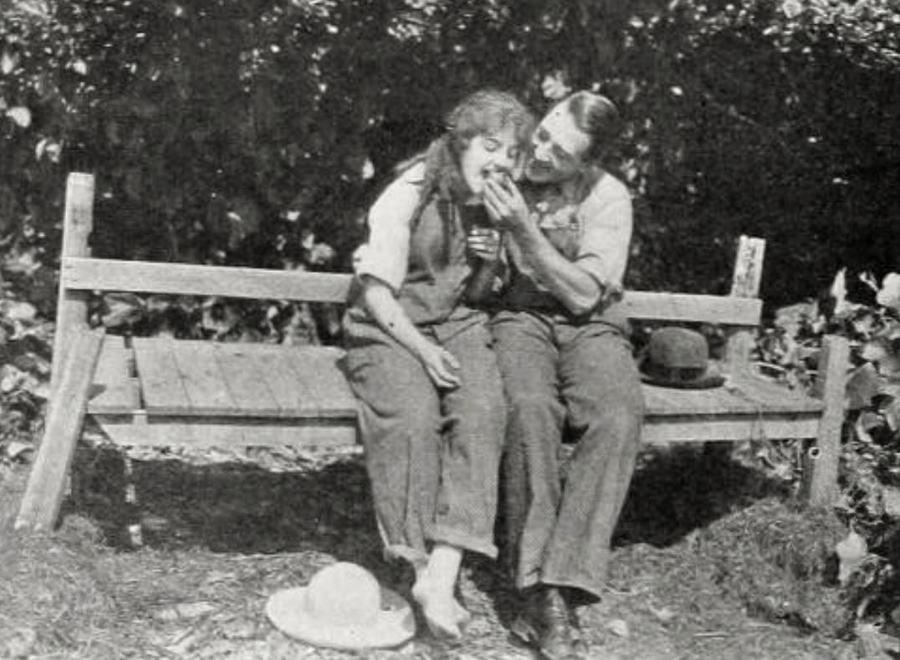
The crisis of knowledge peaks during the midnight farmhouse intrusion. Elsie, locked out, becomes a trespasser in her own property—a Pirandello twist delivered a decade early. Dick, peeping through a keyhole shaped like a heart, witnesses her silhouette jimmying a window and misinterprets the act as criminal rather than domestic. The film underlines this with a superimposed close-up of the keyhole framing Elsie’s eye, which then dissolves into the moon. Love, the imagery insists, is lunar: it illuminates but does not warm.
Spike’s parallel entry into the house is choreographed like a danse macabre. He tip-toes across a checkerboard floor whose squares mirror the flickering lightbeam of the projector itself—film commenting on film. Three bodies circle unaware, each believing the others to be phantoms. When Pinkarter’s net finally ensnares them, the moment is less capture than group portrait of a society entrapped by its own narratives.
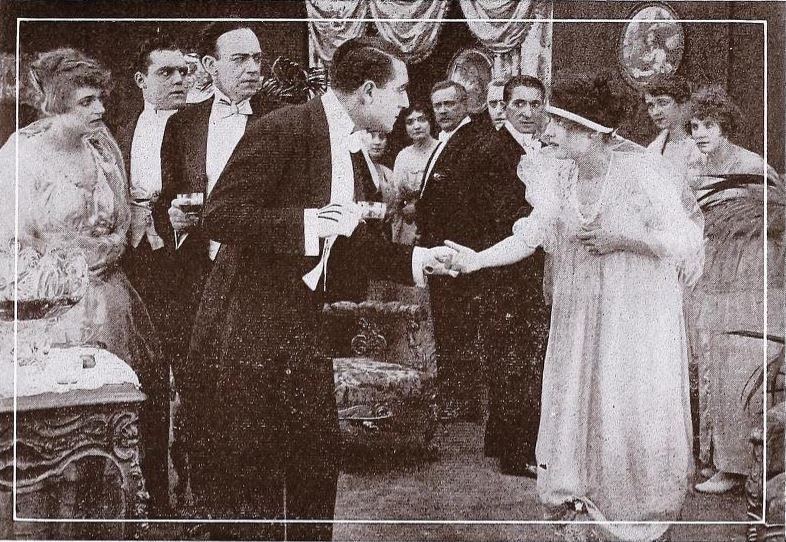
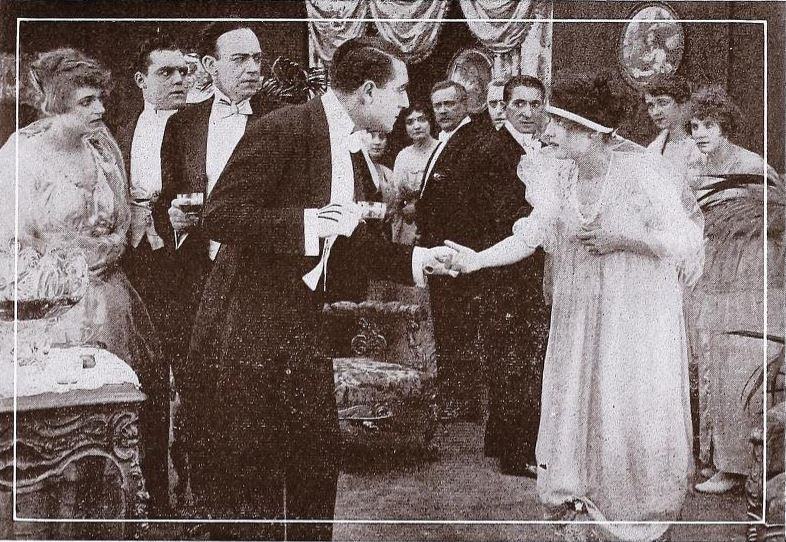
Post-jail, the film risks structural whiplash by leaping to an urbane dinner gala. Yet the tonal shift is savant. The Dunbar mansion’s ballroom, all trompe-l’oeil marble and Baccarat chandeliers, becomes a glacial counterpoint to the hayloft’s sweaty intimacy. Elsie descends a staircase wearing a gown the color of liquid mercury—note how cinematographer Fischbeck over-exposes her close-ups until the fabric merges with the highlights, turning her into a walking aperture. When she recognizes Dick, her scream detonates a montage of reaction shots edited to the metronome of a waltz. The sequence is so rhythmically precise you could sync a club beat under it and call it a music video.
Salvation arrives not through exposition but through wardrobe. Dick produces the original traveling bag; its buckle, monogrammed “D.W.,” matches the Dunbar crest on the ballroom’s stained-glass dome—an ornate Chekhovian gun hanging in plain sight since reel one. Recognition ricochets, violins swell, and the couple’s final clinch is framed against a window where dawn bleaches the night. The film ends on a tableau that freezes mid-kiss, the iris closing like a cautious eye unsure whether to trust what it sees.
Viewed today, The Pretenders feels eerily contemporary. In an era of curated Instagram personas and Linked-in masquerades, its central gag—falling in love with a fiction—plays less like antique screwball and more like documentary. The silent medium amplifies this; without spoken words, every gesture becomes a text begging to be misread. The film whispers that identity is not a core truth but a consensual hoax, a suitcase we swap on trains without noticing.
Restoration-wise, the 2022 4K scan by EYE Filmmuseum scrubs away decades of nitrate freckles while retaining the cigarette-burn flickers that remind us of mortality. The sepia tinting oscillates between buttermilk gold and nicotine umber, a palette that tastes like nostalgia and smells like wet wool. Composer Guus Hoekman’s new score—piano, muted trumpet, brushed snare—leans into the story’s jazz-age undercurrent without anachronistic intrusion. Listen for the klezmer clarinet that sneaks in during Spike’s heist; it’s a sly nod to the Ashkenazi vaudeville circuits that birthed American screen comedy.
Performances remain fresh because they are calibrated to the human pulse rather than the vaudeville wink. Kent’s Dick never begs for sympathy; instead, he allows panic to leak through the lacquer of charm, creating a push-pull that feels psychologically modern. Courtot’s Elsie, meanwhile, wields stillness as weaponry—observe how she freezes mid-stride when the burglar’s bag spills open, her spine a exclamation point of disillusion. In that second, the entire history of romantic idealism collapses into a single vertebra.
Comparative contextualization enriches the experience. Place The Pretenders beside the orientalist confinement of A Prisoner in the Harem and you see Hollywood flirting with, then retreating from, colonial fantasy. Contrast it with the existential fatalism of During the Plague and the film’s buoyancy feels like a breath-held rebellion against post-war nihilism. Even within the mistaken-identity subgenre, it avoids the sadism of Jealousy’s matrimonial torture, opting instead for a humanist shrug that says we’re all imposters, so let’s forgive.
Yet the film is not flawless. Its treatment of class mobility is as facile as a handshake—one revelation and the gulf between manor and mill evaporates. Women of color appear only as nameless maids, blink-and-miss cameos that remind you whose stories were deemed unworthy of pretense. These blind spots date the picture, but they also invite scholarly excavation, a reminder that every artifact carries the moth-holes of its age.
Still, the final aftertaste is one of mercy. In a cinematic universe populated by grifters, the gravest sin is not thievery but the refusal to forgive the theft of self. When Dick and Elsie embrace in that dawn-lit ballroom, the camera cranes upward toward the stained-glass crest, and for a fleeting instant the monogram “D.W.” refracts into “We.” The film closes on the possibility that identity might be communal, a covenant rather than a commodity.
So, should you stream, buy, or project this resurrected curiosity? If you crave the kinetic cynicism of Soviet montage or the swashbuckling certitudes of early Three Musketeers, look elsewhere. But if you’re hungry for a film that kisses you while slipping a whoopee cushion under your seat, The Pretenders is your ticket. Bring a date, bring a mirror, bring your favorite lie about yourself—then watch the screen give it back, sun-bleached and forgiven.
Verdict: a luminous, flawed, necessary relic that proves love, like film stock, is most beautiful when scratched by truth.
IMDb 6.3
1930
Community
Log in to comment.