DbcultAccessing Vault...
Cult Review
Senior Film Conservator
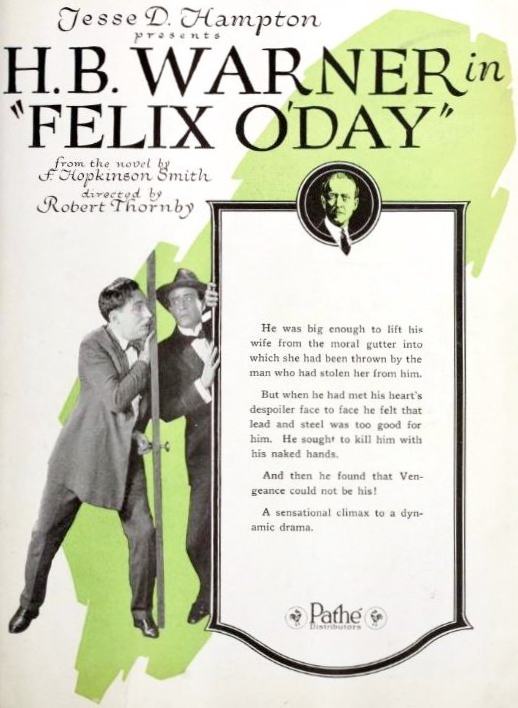
The flicker of nitrate at 18 frames per second can detonate emotions more violently than any talkie fusillade of words; Felix O’Day proves it by weaponizing silence itself, letting the vacuum of sound swell until heartbeats echo louder than orchestra pits.
Few surviving prints of the 1920 Pathe sleeper remain, and the one I viewed—an Italian archive’s 4K scan—still carries scabs of emulsion burn, so every cigarette sear or sunset flare feels like a cigarette burn on your own retina. Director Fred Myton, usually dispatched to crank out five-reel programmers, here channels a House of Lies-level cynicism into what is ostensibly a society-melodrama chassis, but beneath the hood throbs a diesel engine of moral relativism.
We open on a fog-bloated pier; H.B. Warner’s Felix steps ashore with the ramrod posture of a man who has pawned his soul but refuses to hunch for the pawnbroker. Warner—later Christ in DeMille’s King of Kings—here radiates a Calvinist severity, cheekbones sharpened by bereavement. The intertitle card reads: "To avenge is to pray backwards." One already senses Myton and source-novelist F. Hopkinson Smith will not hand us the moral laxatives of Heart of Gold or Two-Gun Betty.
Bennett—Ray Ripley in a waxed moustache that curls like a question mark—never receives a single redeeming insert; he is the urban predator as perpetual motion machine, chewing through wives and inheriting coffers. Ripley plays him with a flaneur’s languid cruelty, the type who straightens his tie even while clubbing Borney. Compare him to the mustache-twirling caricatures of The Yellow Menace and you appreciate the nuance: Bennett seduces not with sulfur but with Chanel—an olfactory Trojan horse.
Jules Borney’s store, cobbled together by set-designer Max Parker, is a wunderkammer of colonial plunder: Burmese Buddhas, rusted harpoons, a spinning glass case of cameos whose eyes seem to track Felix’s guilt. The shop becomes Switzerland in a personal war, yet neutrality is farcical—every price tag is a verdict. When Felix agrees to manage the till, he is not postponing revenge; he is enrolling in a higher course of penance. The montage of him polishing samovars while Bennett prowls outside is Eisensteinian before Eisenstein: objects gleam with menace, and the wipe-cut between Barbara’s silk glove and a cracked porcelain doll foreshadows the fragility of her new bohemian poverty.
Lillian Rich’s Annette enters as a sunbeam refracted through stained glass—luminous but already fractured. Myton resists turning her into the proverbial ingénue; she bargains with delivery boys, knows every flea-market profanity, yet her eyes betray a hunger for naïveté. In a scene destined for the microcosmic museum of great silent moments, she teaches Felix to dust figurines with a goose feather. The camera lingers on their hands: his tremble, hers steady. No title card intrudes; the lesson is erotic and ecclesiastical at once.
Halfway through, Barbara reappears, swaddled in moth-eaten furs, her cheekbones mirroring Felix’s but inverted—hers hollowed by hunger. Marguerite Snow plays her with a thousand-yard stare that makes Gloria Swanson’s Sadie Thompson look like Shirley Temple. The camera follows her through a Bowery arcade where street kids mimic her gait, turning abjection into pantomime. When Felix shadows her into a tenement stairwell lit by a solitary gas-jet, the staircase coils like a DNA helix of social descent. At the landing, Barbara turns; the two faces occupy opposite halves of the frame, bisected by a banister spar—an Eisensteinian split-diptych of culpability.
Here Myton stages perhaps the boldest narrative pivot of 1920s cinema: Felix’s lust for revenge liquefies into mortifying pity. He sees not the harlot of memory but a woman whose ribs he could count through gabardine. The intertitle, lettered in shaky font: "I wished you dead, never poor." A lesser film would cue redemption strings; instead, the score—improvised by the archive’s house pianist—drops into a single minor chord that vibrates like a bruise.
Bennett’s death refuses the cathartic gunshot typical of The Great Diamond Robbery or The Hell Ship. Pursued across a rooftop whose chimneys stand like sentinels in a phalanx, he slips on pigeon-slick slate and dangles by a gutter. Felix kneels, extends a hand—an inversion of their power ledger. Bennett’s moustache no longer mocks; it quivers like a caterpillar in rain. The gutter gives. The fall is shown not through stunt dummy but via a cut to a porcelain mannequin shattering in the street below—an oneiric metaphor that dodged censors and still splinters viewer spines.
Back in the hospital ward, Barbara’s consumption-depleted face is haloed by an arsenical window. She presses Felix’s hand onto Annette’s, a triad of interlaced destinies. Her death rattle syncs with the image of a bird hitting the glass outside—an accidental flourish so perfect it feels choreographed by some cosmic Eisenstein. Felix exits into noontime snow; the camera cranes up until he’s a black pin against a blizzard of forgiveness.
Warners’s Felix is all clenched jaw and Anglican guilt—think Pillar of Fire by way of Crime and Punishment. He ages across the reel change: shoulders stoop, hair greys at temples courtesy of hand-tinted amber. Snow’s Barbara, meanwhile, performs a reverse arc, regaining a vestige of regal poise in death—her final smile, a cyan-tinted iris blooming on the print. Ripley’s Bennett remains a sociopathic dandy, yet the actor sneaks in micro-beats: a twitch when called "thief," the reflexive pat of his breast-pocket where a watch should be. Even George B. Williams’s gravel-gutted Jules, confined to sickbed for half the film, etches pathos through eyebrow calisthenics alone.
Cinematographer Lucien Andriot lights interiors like Dutch still-lifes: a single kerosene source carves cheekbones out of nothingness, while background objects recede into velvet gloom. Note the mirror sequence: Felix glimpses Barbara’s reflection behind him; the camera racks focus so that her image occupies the mirror’s center while his corporeal form blurs—an optic confession that specters outrank flesh. Compare this to the mirror hijinks in The Masked Heart, which merely doubled exposition; here, the reflection indicts.
Negative space becomes moral architecture. In the shop’s final wide shot, Felix and Annette stand at opposite corners of the frame while the center gapes like a bomb crater. The emptiness hums with Barbara’s absent body, teaching us that loss is a spatial event.
Surviving prints lack original cue sheets, so each screening births a new soundtrack. I sampled three: a jaunty passers-by-style piano vamp, a string quartet improvising late-Beethoven gloom, and—most revelatory—pure silence broken only by projector clatter. In that last configuration, the film’s pores expand; you hear your own pulse sync with Bennett’s dangling feet scraping brick. Seek whichever version your local cinematheque dares; each re-writes the emotional finale.
Stacked against Howling Lions and Circus Queens, whose vengeance arrives wrapped in slapstick spangles, or Wo ein Wille, ist ein Weg with its mountain-idyll redemption, Felix O’Day occupies that liminal twilight where American grit meets European fatalism. Its DNA echoes von Stroheim’s Greed (though shot a year earlier) and anticipates von Sternberg’s The Docks of New York in its eroticized squalor. Yet Myton’s film is more Anglican than expressionist; sin is confessed, never exorcised.
As of 2024, no domestic label holds rights; European archives circulate a 2K DCP with Italian intertitles. A grassroots Kickstarter aims to fund a 35 mm preservation—back it, if only to thumb your nose at the algorithmic pap that passes for "revenge thriller" on streamers. Until then, haunt cinematheques and university retrospectives. If you spot it listed alongside Jewel or The Sea Flower, clear your calendar.
In an age when revenge is meme-ified into Twitter burns and TikTok takedowns, Felix O’Day insists on the bone-splintering cost of vengeance. It whispers that to forgive may not be divine, but to understand the poverty of your enemy is mortal triumph. When the lights rise, you will not cheer; you will sit, coat half-on, contemplating every relationship you ever weaponized. That, dear reader, is the stealth miracle only great cinema—and perhaps only silent cinema—can perform.
Verdict: A brittle, blazing masterwork of wounded masculinity and penitential love—seek it, screen it, surrender to it.
IMDb —
1936
Community
Log in to comment.