DbcultAccessing Vault...
5.6/10
Senior Film Conservator
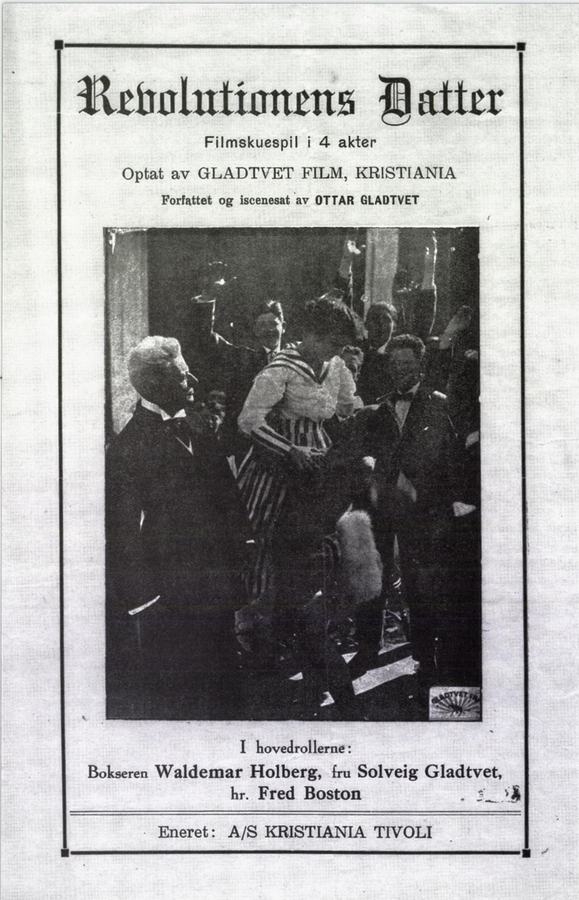
A definitive 5.6/10 rating for a film that redefined the boundaries of cult cinema. Revolutionens datter remains a cornerstone of transgressive art.
In the pantheon of early silent cinema, few films capture the raw, unvarnished friction of the industrial age with as much vigor as Revolutionens datter. Released in 1918, a year defined by the global tremors of the Russian Revolution, Ottar Gladvedt’s work is not merely a romantic melodrama but a profound sociological study. The film opens in the claustrophobic, soot-stained environment of a shipyard—a setting that mirrors the burgeoning discontent of the era. Here, we find Albert Fjeld, portrayed with a stoic, muscular intensity by Johan Price. Albert is the quintessential proletarian hero, a man whose identity is forged in the sparks of the shipyard and the collective struggle of his peers. Unlike the protagonists in The Power of Decision, whose internal conflicts are often rooted in moral quandaries of the soul, Albert’s struggle is visceral and external, rooted in the very survival of his class.
The cinematography in these early scenes is remarkably sophisticated. Gladvedt uses the towering hulls of skeletal ships to dwarf the human figures, a visual metaphor for the crushing weight of capital. When the workers, led by Albert, present their demands to Director Staalhammer, the spatial dynamics tell the story. The director sits ensconced in mahogany and glass, a stark contrast to the grease-stained men on the other side of the desk. This is not just a pay dispute; it is a collision of two irreconcilable worlds. The refusal of the pay rise is the catalyst that transforms the shipyard from a place of labor into a theater of war. The subsequent revolt is filmed with a kinetic energy that predates the formalist experiments of Soviet montage, yet captures the same sense of inevitable historical momentum.
At the heart of this political firestorm is a romance that defies the rigid stratifications of the time. Solveig Gladvedt delivers a nuanced performance as Claire Staalhammer, the director’s daughter. While she begins as a symbol of the bourgeoisie, her character arc is one of radical displacement. The storming of the Staalhammer residence is a sequence of harrowing intensity. As the workers breach the gates—a scene reminiscent of the social ruptures explored in The Red Circle—Albert’s role shifts from agitator to protector. This transition is crucial; it complicates the film’s revolutionary politics by introducing a personal loyalty that transcends class lines.
Their flight to the neighboring country is a transition from the grey, industrial realism of the first act to a more pastoral, almost operatic second act. The change in scenery reflects Claire’s internal state: she is a woman without a country, a daughter of the revolution who has been uprooted from her ivory tower. In this new land, the film explores the parasitic nature of the landed gentry through the character of Squire Dalton. If the shipyard was a site of production, Dalton’s estate is a site of consumption and vanity. The Squire’s son, an effete and entitled figure, represents a different kind of threat to Claire—one that is social and marital rather than physical and violent. This dynamic creates a fascinating tension; while Albert saved her from the mob, he must now save her from the suffocating expectations of his social superiors.
The climax of Revolutionens datter is perhaps one of the most unique resolutions in silent cinema. When Claire inherits a fortune of nearly a million kroner, she becomes a prize for the Dalton family. The Squire’s hospitality is revealed to be a calculated investment. In a brilliant narrative move, Claire proposes a boxing match between Albert and the Squire’s son to decide her hand in marriage. This sequence is a masterstroke of symbolic storytelling. It strips away the complexities of inheritance law and social standing, reducing the conflict to its most primal element: physical prowess and the integrity of the individual body.
The fight itself is choreographed with a raw, unpolished realism. It is not the stylized combat seen in modern cinema, but a desperate, heavy-hitting affair. Albert’s victory is not just a personal win; it is a symbolic triumph of the working man over the idle aristocracy. Much like the transformative experiences in A Florida Enchantment, the match serves as a catalyst for a total reordering of social roles. However, Gladvedt is careful not to leave the film in a state of perpetual conflict. The five-year jump to the conclusion shows Albert and Claire living in harmony in their homeland, suggesting that the revolution’s ultimate goal is not the destruction of the other, but the creation of a space where merit and love can coexist regardless of origin.
To understand the impact of Revolutionens datter, one must compare it to contemporary works like The Golden Chance or The Girl Without a Soul. While those films often focused on the moral redemption of the individual, Gladvedt’s work is concerned with the redemption of the collective. The film’s visual language is deeply rooted in the European tradition of the era, echoing the shadows and psychological depth found in The Student of Prague, yet it applies this aesthetic to the grit of the factory floor rather than the gothic castle.
The performances are remarkably restrained for 1918. Johan Price avoids the over-the-top histrionics common in the silent era, opting instead for a brooding presence that suggests a deep well of internal resolve. Solveig Gladvedt, as the titular daughter, manages to convey a complex range of emotions—from the terror of the riot to the calculated defiance of the boxing match proposal—with subtle shifts in her gaze. The film also benefits from a script by Ottar Gladvedt that avoids easy answers. The revolution is shown as both a necessary force for change and a terrifying agent of chaos. This duality is what gives the film its lasting power.
Ultimately, Revolutionens datter is a testament to the power of silent cinema to tackle complex socio-political themes. It navigates the treacherous waters of class warfare, exile, and romantic devotion with a steady hand and a visionary eye. By the time we see Albert and Claire in the final scene, the fires of the shipyard and the tension of the Dalton estate have been distilled into a quiet, domestic peace. It is a rare film that manages to be both a call to action and a celebration of human connection. For those interested in the evolution of social realism in film, this is an essential viewing experience, standing alongside giants like A föld embere in its depiction of the human spirit’s resilience against the machinery of oppression. Gladvedt has crafted a work that is as visually arresting as it is intellectually provocative, a true jewel of the early 20th-century screen.

IMDb —
1924
Community
Log in to comment.