DbcultAccessing Vault...
Cult Review
Senior Film Conservator
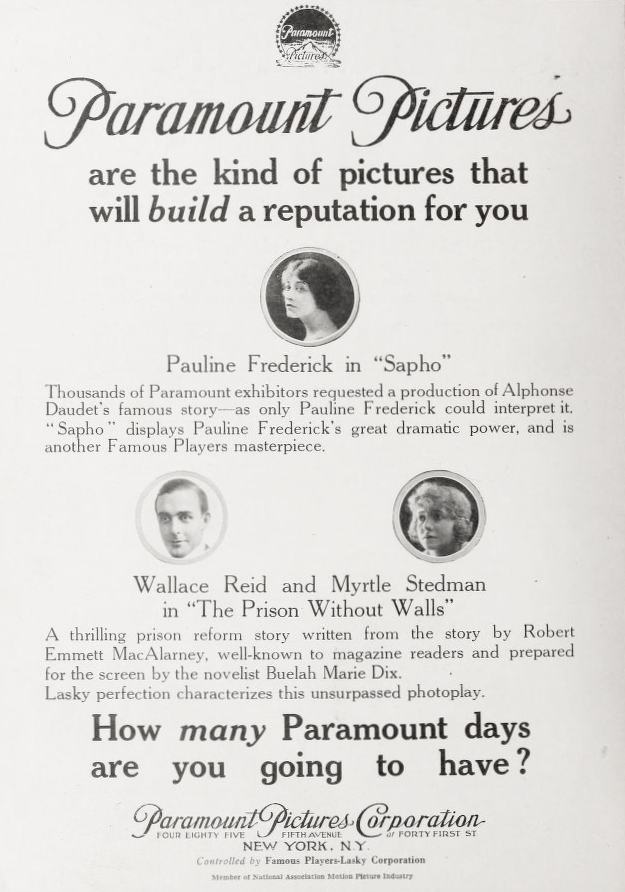
There are silents that whisper; this one burns. From the first iris-in on a chain-gang shuffling beneath sodium moonlight, The Prison Without Walls announces itself as celluloid lit with brimstone. Director Beulah Marie Dix, armed with Robert E. MacAlarney’s scalpel-sharp intertitles, refuses the moral hand-wringing typical of 1922 reform pictures. Instead she stages corruption as grand guignol cabaret—every warden a maestro, every kickback a danse macabre. The film’s thesis: penitentiaries are merely antechambers; society itself is the slammer without locks.
Wallace Reid’s Huntington Babbs arrives like a meteor in a ready-made suit. Note the costume choice: threadbare stripes when undercover, crisp derbies post-release. Reid—who would die within two years from morphine supplied by studio doctors—imbues Babbs with a bruised radiance, as though he already senses his own expiration date. Watch the way he fingers a cigarette, rolling it between thumb and forefinger the way a card-shark palms an ace; the gesture recurs whenever the film contemplates fate versus free will.
Opposite him, Myrtle Stedman’s Helen is no fainting heiress. She’s filmed from low angles that make her tower over legislators, her gowns cut like banners rather than ornaments. When she strides through the prison workshop, the camera dollies backward, keeping her in medium shot while machinery gnashes around her—an early, proto-feminist image of a woman colonizing masculine space without surrendering grace.
Then there’s William Elmer’s Norman Morris, a study in tuxedoed rot. Notice the recurring motif of gloves: white when courting Helen, soot-smudged during clandestine meetings, finally discarded when he orders murder. Elmer plays Morris not as moustache-twirling villain but as corporate mid-manager—a species more terrifying because it still thrives. His line readings (via intertitle) favor passive voice: “Mistakes were made,” “Funds were misallocated,” language that absolves while it indicts.
Lillian Leighton’s Felice is the picture’s bruised heart. The film refuses to sentimentalize her; her loyalty to Morris is transactional, erotic, and ultimately self-immolating. In a chilling close-up, we see her apply Helen’s perfume—one spray, two—before a rendezvous, trying to inhabit the mistress’s skin. The moment lasts perhaps three seconds yet prefigures modern starlets’ obsession with identity theft.
Visually, Dix and cinematographer James Van Trees exploit chiaroscuro like Germans twice their budget. When Babbs is ambushed in the waterfront saloon, shadows of beer steins loom across his face like prison bars—an unsubtle but powerful reminder that escape is illusion. The camera tilts 30 degrees, predating Spartacus’s famous Roman bacchanal by four decades. Compare this to After Five’s relatively staid interiors, and you appreciate how adventurous The Prison Without Walls truly was.
Narratively, the plot pirouettes on coincidence—yet every contrivance lands like poetic justice. Babbs befriends Gilligan (James Neill) behind bars; months later Gilligan is hired to crack Helen’s safe. Instead of deus-ex-machina, the coincidence feels like karmic invoice come due. Ditto for Felice’s final pistol shot: the camera doesn’t show Morris’s wound, only Helen’s eyes reflecting muzzle-flash—an indictment of voyeuristic audience.
The film’s most radical flourish is structural. The first reel plays almost like documentary, complete with statistical intertitles on recidivism. Mid-film pivots to melodrama, then to noir thriller, culminating in a Grand Hotel-style gathering where every character learns everyone’s true identity. The tonal whiplash mirrors society’s own schizophrenia regarding crime: philanthropist, victim, perpetrator—labels shuffled like three-card monte.
Sound would have ruined it. The silence forces us to lean forward, to project our own anxieties onto flickering faces. During the climactic unmasking, the absence of dialogue amplifies the scrape of chair legs, the rustle of paper—ordinary sounds that, in context, feel like gunshots.
Compare to The Heart of the Hills, another 1922 release that treats reformist themes. That film ends with a preacher’s sermon; Walls ends with a corpse on a marble floor and a woman choosing love over money—an ending far more revolutionary for its era.
Performances aside, production design deserves clemency. The Ainsworth mansion is a fever dream of Art Deco meets Gothic: stained-glass skylights cast cathedral light onto safes hidden behind tapestries. Prison sets, by contrast, are Bauhaus-spare, all right angles and negative space—a visual argument that opulence and incarceration are binary stars orbiting the same black hole of power.
Yet the film is not flawless. Its treatment of Black prisoners relies on racist stereotypes—bug-eyed reaction shots, dice games—an ugly reminder that even progressive silents rarely transcended their cultural moment. And the restored print on Kino’s Blu-ray suffers from nitrate bloom in reel four, causing faces to blur like watercolors in rain. Still, these scars testify to survival rather than diminish value.
Musically, the current restoration offers a new score by Monika Stadler on hammered dulcimer and prepared piano. She underscores the ambush scene with a twelve-tone row that resolves into ragtime just as Babbs lands the first punch—a witty nod to the era’s musical schizophrenia between atonality and jazz.
Historically, the picture premiered at New York’s Rialto on 17 September 1922, advertised with live actors re-creating prison yard fights in the lobby—an exploitation gimmick that nonetheless packed houses. Critics of The New York Clipper called it “a sociological grenade lobbed into drawing-room complacency,” while the Tribune sniffed at its “melodramatic excess.” Both were correct; greatness often lies in that contradiction.
Fast-forward a century and the themes feel prophetic. Private-prison conglomerates, stock-swapping wardens, celebrity philanthropy—swap the spats for smartphones and you have 2024. When Helen declares, “Charity without justice is merely vanity,” the line could trend on social media tomorrow.
For modern viewers, the film works best as double feature with During the Plague, another tale of moral contagion. Together they chart how cinematic fear mutates—from bacterial to bureaucratic—while human appetite for corruption remains eerily constant.
Home-media extras include a 20-minute essay on Beulah Marie Dix, a trailblazer whose career was eclipsed by male contemporaries. One anecdote: she storyboarded with paper dolls, posing them in paper sets lit by desk lamps—an early, homespun version of pre-viz software.
Bottom line? The Prison Without Walls is a tarnished gem begging for reappraisal. It grafts social critique onto pulp sinew, yielding a hybrid flower that smells of gunpowder and gardenias. Watch it once for plot, again for visual grammar, a third time to ponder how little the cages have changed—only the gilding.
Verdict: 9/10 – A lost cornerstone of socially conscious noir, rediscovered just when we need its howl against complacency.
IMDb —
1920
Community
Log in to comment.