DbcultAccessing Vault...
6/10
Senior Film Conservator
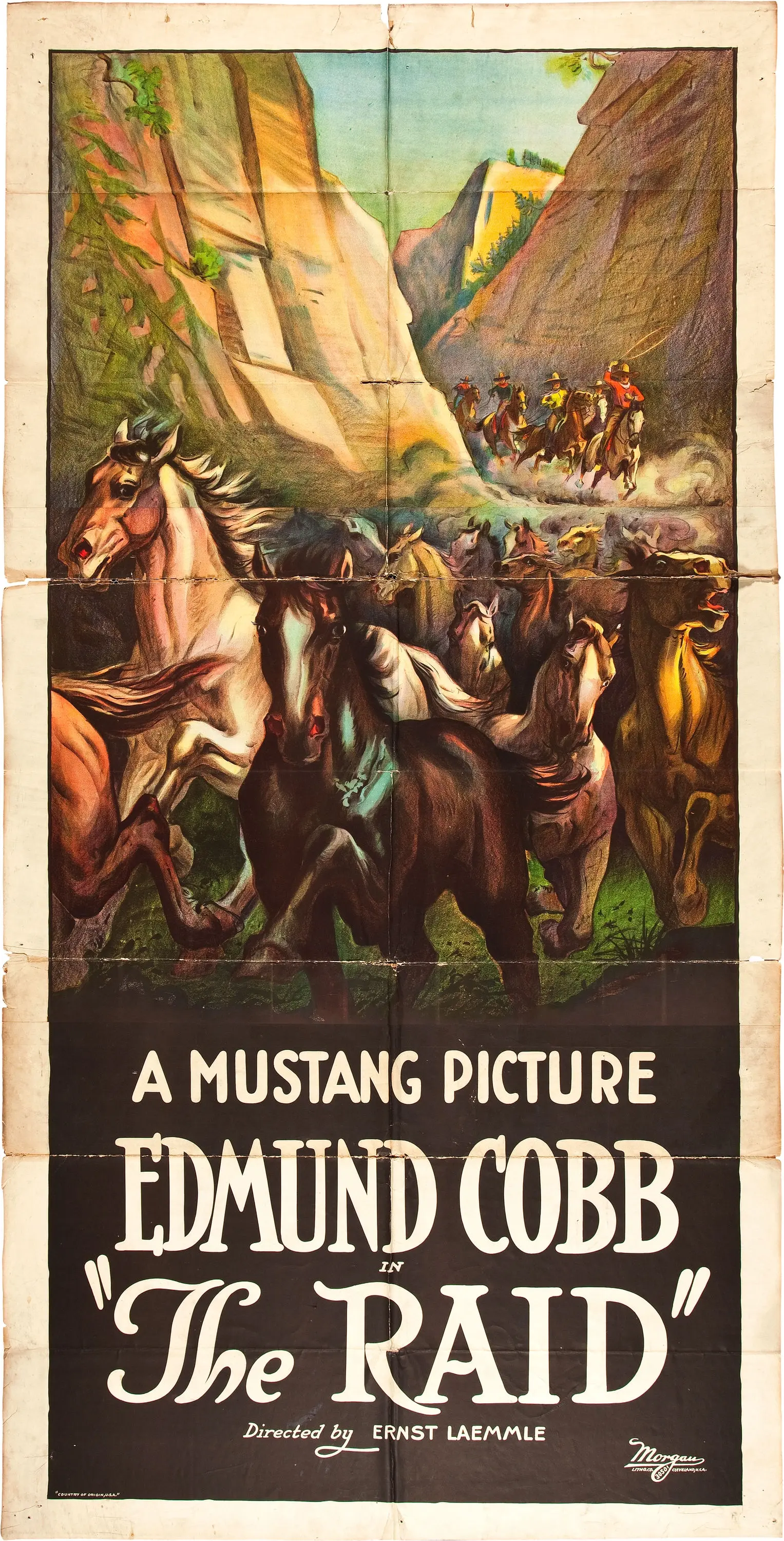
A definitive 6/10 rating for a film that redefined the boundaries of cult cinema. The Raid remains a cornerstone of transgressive art.
Is The Raid a mandatory watch for the modern cinema enthusiast? Short answer: No, unless you are a dedicated historian of the silent era or a completist of early Western tropes.
This film is specifically for those who appreciate the foundational building blocks of the American Western; it is definitely not for viewers who require nuanced character arcs or the fast-paced editing of the post-Ford era.
1) This film works because Edmund Cobb possesses a rugged, unforced charisma that makes Jerry Smith feel like a prototype for the later Western icons of the 1930s.
2) This film fails because the plot relies on a "damsel in distress" trope that felt tired even in 1917, coupled with a predictable rescue sequence that lacks genuine stakes.
3) You should watch it if you want to see the DNA of the American frontier mythos in its rawest, most unpolished form, free from the later cynicism of the genre.
To determine if this 1917 relic deserves your time, you have to ask what you value in silent cinema. If you are looking for the technical experimentation found in Day Dreams, you will be disappointed. The Raid is a meat-and-potatoes production. It exists to deliver a clear moral narrative with a physical payoff. It doesn't try to reinvent the wheel, but it spins the wheel with a certain blue-collar competence that is hard to hate.
The film’s primary value today is as a time capsule. Watching Edmund Cobb navigate the frame is a lesson in economy. He doesn't waste movement. While other actors of the era were still stuck in the exaggerated gestures of the stage—something seen in the more theatrical Ladies Must Live—Cobb feels remarkably grounded. He is the anchor that keeps this simple story from drifting into melodrama.
Edmund Cobb was a workhorse of the industry, and in The Raid, you see why. He has a face that looks like it was carved out of a canyon wall. In the scene where he first arrives at the Raymond ranch, his interaction with Jessica (played with a surprising amount of agency) isn't built on flowery title cards. It’s built on looks. He observes the environment. He isn't just a "hero"; he is a professional doing a job.
Compare his performance here to his later work in Speed Wild. You can see the evolution of the Western archetype. In The Raid, he is more restrained. There is a specific moment when he finds the abandoned cabin where the Raymonds are held. The way he checks his surroundings before entering isn't just good blocking; it's a character beat that suggests a history of violence we never actually see. It works. But it’s flawed by the limitations of the script.
William E. Wing and George Morgan aren't names that usually come up in the same breath as Griffith or Murnau, and for good reason. Their direction is functional. The camera stays largely static, serving as a proscenium arch for the action. However, the pacing of the raid itself is surprisingly tight. The transition from the ranch to the kidnapping happens with a suddenness that would make even a modern editor nod in approval.
The film lacks the visual density of The Tiger Woman, but it gains points for clarity. You always know where Jerry is in relation to the rustlers. In an era where spatial continuity was often a suggestion rather than a rule, The Raid manages to keep its geography coherent. The final fight at the cabin is a messy, sprawling affair. It’s not the choreographed ballet of modern action, but a desperate scramble in the dirt. It feels real because it looks difficult.
One cannot discuss a 1917 Western without mentioning the environment. The Raymond ranch feels like a real place, not a backlot. The dust is palpable. The way the sunlight hits the scrub brush creates a high-contrast look that defines the "Western aesthetic" before it became a cliché. The cinematography doesn't reach for the poetic heights of The Ancient Highway, but it captures the harshness of the setting.
The abandoned cabin is the film’s most effective set-piece. It’s a claustrophobic box in the middle of nowhere. When Jerry arrives, the cabin represents both a prison for the Raymonds and a trap for the rustlers. The lighting inside the cabin—likely natural light filtered through cracks—provides a texture that many studio-bound silents like Daughter of the Night lack. It’s gritty. It’s dirty. It’s effective.
When placed alongside other films of the period, The Raid occupies a middle ground. It isn't as experimental as Yankee Doodle in Berlin, nor is it as purely melodramatic as Forever. It sits comfortably in the genre-defining space of early American action films. It shares some DNA with The Fighting American, particularly in its focus on a singular, capable protagonist who must rectify a social disorder through physical force.
However, it lacks the whimsical charm of My Hero! or the domestic focus of What's His Name. The Raid is singular in its focus: there is a problem (rustlers), there is a solution (Jerry), and the film moves toward that solution with the directness of a bullet. This lack of subplots is both its greatest strength and its most obvious limitation.
Pros:
- Edmund Cobb’s commanding and stoic lead performance.
- Effective use of natural locations that enhance the gritty tone.
- Clear, easy-to-follow action geography that avoids confusion.
- A brisk runtime that doesn't overstay its welcome.
Cons:
- The rustlers are completely anonymous villains with no motivation beyond greed.
- The romantic subplot feels tacked on as a genre requirement.
- Minimal character development for the supporting cast.
It is important to remember that The Raid was produced in an era where the language of cinema was still being written. The camera movements are non-existent, and the editing relies heavily on the "cut to reaction" shot. Yet, there is a primitive power in this simplicity. Unlike the more polished Bab the Fixer, The Raid feels like it was made by people who were more comfortable with horses than with cameras. This gives the film an authenticity that later, more expensive Westerns lost.
The use of title cards is sparse. This is a blessing. The film trusts the actors to convey the stakes through their physicality. When Jessica implores her father to hire Jerry, you don't need a paragraph of text to understand her fear. Her posture says it all. This is visual storytelling in its most basic form, and it is more effective than many of the dialogue-heavy talkies that followed a decade later.
The Raid is not a masterpiece. It is a functional, well-constructed piece of genre entertainment from a time when the Western was still finding its legs. It lacks the emotional depth of something like Sadounah or the technical bravado of Balleteusens hævn, but it has a rugged honesty that is hard to dismiss. It works. But it’s flawed.
If you have 25 minutes and an interest in how the cowboy became the quintessential American hero, The Raid is worth a look. Just don't expect it to change your life. It’s a simple story about a man, a girl, and a cabin in the woods. Sometimes, that’s enough. It’s a testament to the power of the archetype that, even over a hundred years later, we still find Jerry Smith’s rescue mission satisfying.
IMDb —
1929
Community
Log in to comment.