DbcultAccessing Vault...
Cult Review
Senior Film Conservator
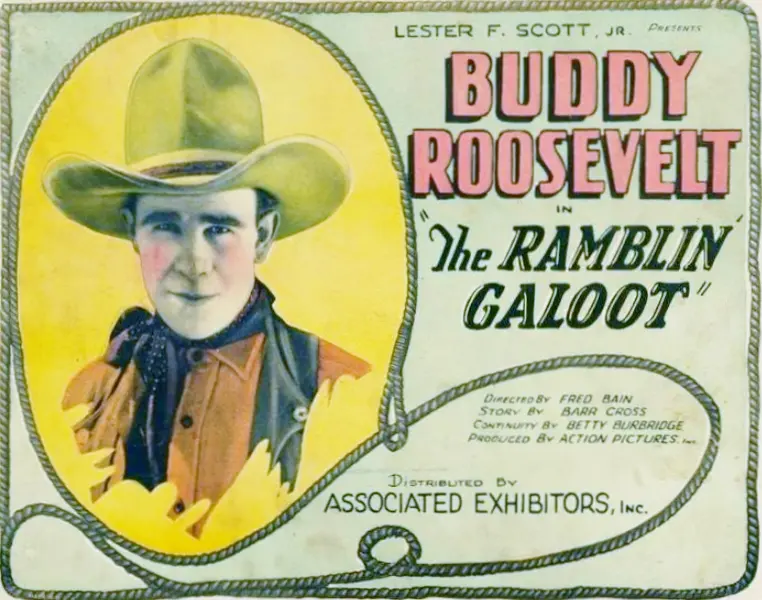
Is The Ramblin' Galoot worth watching today? Short answer: yes, but with significant caveats. This early Western, while a fascinating historical artifact, will primarily appeal to dedicated fans of silent-era cinema and those with a keen interest in the genre's formative years. It is decidedly not for viewers seeking modern pacing, complex character development, or high production values.
For those accustomed to the polished narratives and technical wizardry of contemporary film, The Ramblin' Galoot might feel like a quaint, almost rudimentary exercise. Yet, within its simple framework lies a charming, if somewhat clunky, piece of cinematic history that offers a unique window into the entertainment sensibilities of its time.
To truly appreciate The Ramblin' Galoot, one must approach it not as a direct competitor to modern blockbusters, but as a cultural artifact. It's a snapshot of a particular moment in American filmmaking, a testament to the nascent power of the Western genre, and a showcase for the nascent charisma of its star, Buddy Roosevelt. It works. But it’s flawed.
This film works because of Buddy Roosevelt’s undeniable screen presence, which manages to elevate even the most formulaic plot points. Its unique blend of Western action with the utterly unexpected sport of golf provides a quirky charm that sets it apart from its contemporaries. Furthermore, as an example of early genre filmmaking, it offers valuable insights into the tropes and narrative structures that would come to define the Western for decades.
This film fails because its plot is aggressively simplistic, its villain is cartoonishly one-dimensional, and its technical execution, while competent for the era, offers little in the way of visual innovation. The pacing, though swift, often feels rushed, sacrificing depth for sheer narrative velocity. Character motivations are painted in broad strokes, leaving little room for nuance or genuine emotional investment.
You should watch it if you are a devotee of silent films, a historian of the Western genre, or a fan of Buddy Roosevelt's particular brand of cowboy charm. It’s also a curious watch for anyone interested in how seemingly disparate elements—like cattle ranching and golf—could be woven into a popular narrative, however thin. If you demand intricate plots, sophisticated cinematography, or psychologically complex characters, this is probably not your cup of tea.
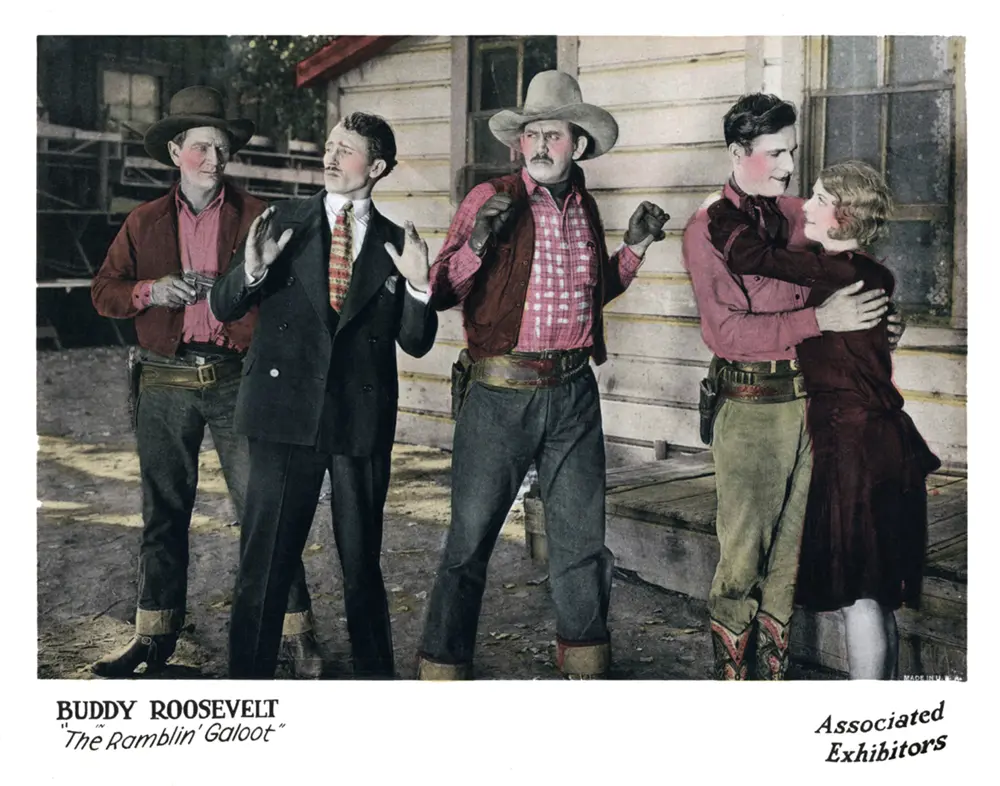
The narrative backbone of The Ramblin' Galoot is, by today's standards, remarkably straightforward. We are introduced to Buddy Royle, a cowpuncher with an unusual hobby: golf. This seemingly innocuous detail becomes the fulcrum upon which the entire plot pivots, allowing him access to Colonel Price and his daughter, Pansy, on their sprawling ranch. It's a clever, if somewhat transparent, narrative device to bring the hero into the orbit of the potential love interest and the wealthy victim.
The villain, Roger Farnley, a bank cashier, is established with little subtlety as the mastermind behind a counterfeiting operation. His scheme to frame Buddy by planting fake bills and orchestrating a robbery is a classic trope of mistaken identity and criminal deception. The swiftness with which this plot unfolds, from setup to Buddy's abduction, speaks to the efficiency, if not the depth, of silent-era storytelling.
Pansy's role in freeing Buddy is a brief moment of female agency, quickly overshadowed by Buddy's subsequent reveal as an agent of the Bankers' Association. This twist, while predictable to modern audiences, serves to elevate Buddy from a mere cowpuncher to a law-enforcing hero, tying up the criminal threads neatly and paving the way for the inevitable romance. The plot is less about surprise and more about the satisfying, albeit familiar, progression of good triumphing over evil.
Buddy Roosevelt, as Buddy Royle, is the undeniable anchor of The Ramblin' Galoot. His physicality and easygoing charm are palpable even through the grainy black and white footage. Roosevelt doesn't just ride a horse; he embodies the spirit of the Western hero, albeit one with a putter in hand. His performance is largely driven by action and expressive gestures, typical of the era, yet he manages to convey a sense of earnestness that makes his character genuinely likable. The scenes where he teaches golf are particularly endearing, showcasing a lighter side to the traditional cowboy.
Compared to more stoic Western stars, Roosevelt brings an approachable quality, a kind of 'everyman' hero who just happens to be adept at both cattle wrangling and putting. His interactions with Violet La Plante's Pansy are charming, if not deeply passionate, leaning into the innocent romance expected of the period.
The supporting cast, however, struggles to leave a lasting impression beyond their archetypal roles. Slim Whitaker as Roger Farnley delivers a performance that is, frankly, cartoonishly evil. He's the mustache-twirling villain personified, lacking any discernible nuance or motivation beyond pure malice. While effective in providing a clear antagonist, it offers little in the way of compelling character study. Pansy, played by Violet La Plante, is largely relegated to the role of the damsel in distress, her moments of proactive heroism brief and quickly resolved by Buddy's ultimate intervention. The film doesn't ask much of its supporting players, and they deliver precisely what's required: clear, uncomplicated portrayals of their respective types.
Charles Clary's direction of The Ramblin' Galoot is best described as functional. He prioritizes narrative clarity and forward momentum, ensuring that the audience always understands what's happening and why. There are no grand artistic flourishes, no experimental camera angles, or profound visual metaphors. The film is shot in a straightforward manner, serving the story without drawing undue attention to its own filmmaking. This approach, while perhaps uninspired, ensures that the film is never confusing or slow, a considerable achievement for a silent film designed for mass appeal.
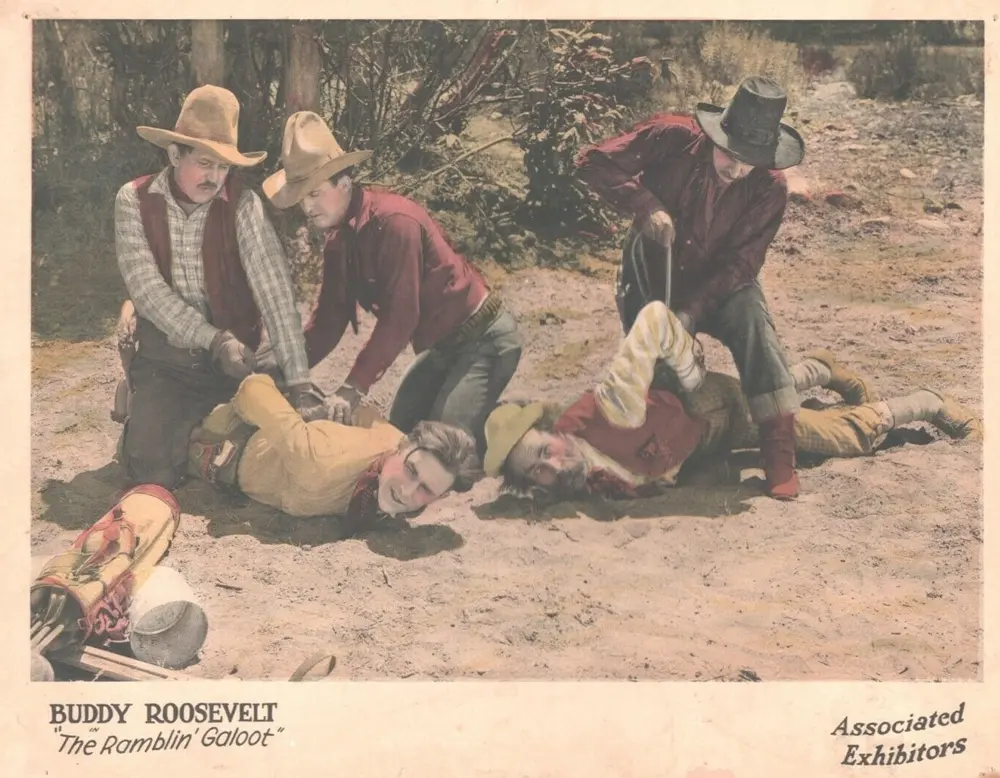
The cinematography by Harry De More captures the Western landscape with a utilitarian beauty. We see sweeping vistas, dusty ranches, and the open plains that are synonymous with the genre. While not as breathtaking as some of the more epic Westerns of the era, the shots are competent, establishing setting and mood effectively. The action sequences, particularly the kidnapping and subsequent escape, are filmed with a kinetic energy that, despite technical limitations, manages to convey excitement. The golf scenes, surprisingly, are well-staged, making the sport visually engaging even without sound, relying on clear actions and reaction shots.
One could argue that the film’s visual simplicity is both a strength and a weakness. It avoids pretension, delivering a clean, digestible story. However, it also means that few images linger in the mind long after the credits roll. It’s a workhorse of a film, designed to entertain rather than innovate, much like other genre pictures of the time such as Breed of the Border.
The pacing of The Ramblin' Galoot is characteristic of many silent films: swift, often breathless, and occasionally jarring. The narrative barrels forward, introducing characters, conflicts, and resolutions with remarkable speed. There's little time for lingering shots, contemplative moments, or prolonged emotional beats. This rapid-fire storytelling can be both a blessing and a curse. On one hand, it prevents boredom; on the other, it can make the plot feel underdeveloped and the characters thinly sketched. Key plot points, like Buddy's abduction and Pansy's rescue, unfold with an almost abrupt efficiency that leaves little room for suspense to truly build.
The tone is primarily one of lighthearted adventure, punctuated by moments of melodramatic suspense. The golf subplot injects a surprising amount of levity, often bordering on comedic relief, which contrasts sharply with the more serious elements of counterfeiting and kidnapping. This tonal oscillation, while perhaps unintentional, gives the film a unique flavor. It's not a gritty, realistic Western, nor is it a pure comedy. It straddles a line, sometimes awkwardly, between the two.
The film’s brisk pace means that character motivations and emotional arcs are often conveyed through exaggerated expressions and intertitles rather than organic development. The romance between Buddy and Pansy, for instance, blossoms less through shared experiences and more through the sheer narrative necessity of a happy ending. This isn't a flaw unique to The Ramblin' Galoot, but rather a common characteristic of silent-era genre films, where plot mechanics often took precedence over psychological depth, much like The Pony Express.
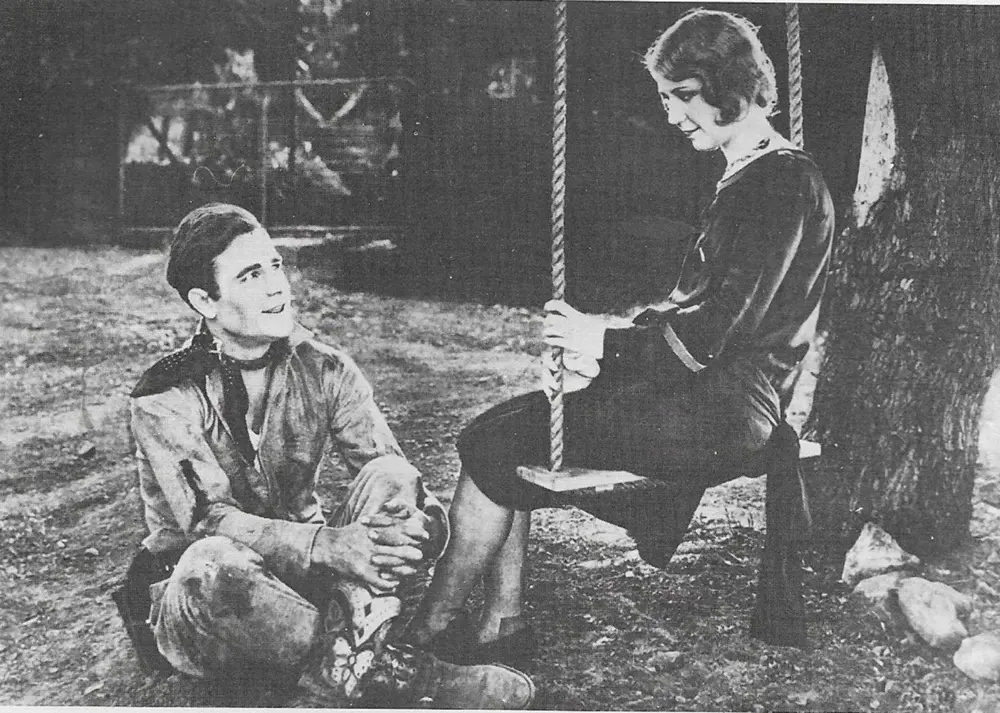
Perhaps the most peculiar and memorable aspect of The Ramblin' Galoot is its central gimmick: a golf-playing cowpuncher. Who knew the Wild West was so ripe for a golf course? This unconventional blend is both its most distinctive feature and, arguably, its biggest narrative contrivance. The initial scenes of Buddy teaching Colonel Price and Pansy the intricacies of the game are genuinely charming and provide a unique hook for the film.
However, this golf subplot, while providing a quirky entry point, ultimately feels more like a narrative device than an organic character trait. It exists to place Buddy in the right social circles and to give him a distinguishing characteristic, but it doesn't deeply inform the core conflict or his heroic actions. Once the counterfeiting plot kicks into high gear, the golf largely fades into the background, a forgotten novelty until the end. This makes it a delightful, if somewhat superficial, element.
It's a strong, debatable opinion that the film would have been more cohesive if the golf element had been either more integrated into the resolution or entirely removed, allowing for a more focused Western narrative. As it stands, it’s a fun, surprising observation that gives the film its unique identity, but doesn't quite pay off in a substantial way.
Released in the late 1920s, The Ramblin' Galoot sits at the cusp of the sound era, a testament to the enduring popularity of silent Westerns even as talkies loomed large. It represents a particular brand of escapism, offering audiences straightforward adventure, clear-cut heroes and villains, and the romantic allure of the American frontier. Films like this were the bedrock of Hollywood's early years, shaping audience expectations and solidifying genre conventions.
While not a groundbreaking film in terms of artistic merit or technical innovation—it certainly doesn't stand alongside the likes of Hintertreppe in terms of cinematic artistry—it serves as an excellent example of the commercial Western. Its legacy lies not in its individual brilliance, but in its contribution to the vast catalog of films that defined a genre. It shows how even a simple story, bolstered by a charismatic star and a quirky premise, could entertain the masses.
The film’s biggest flaw isn't its age, but its almost aggressive simplicity. It aims for broad appeal and hits its mark, but in doing so, it sacrifices the depth and complexity that might have given it more lasting critical acclaim. It's a product of its time, reflecting the storytelling priorities and audience tastes of the era: action, romance, and a clear moral compass, all delivered efficiently.
The Ramblin' Galoot is far from a forgotten masterpiece, but it is also far from a waste of time. It’s a charming, if somewhat primitive, piece of early Hollywood. Buddy Roosevelt carries the film with an infectious energy, making even the most formulaic plot points feel engaging. The golf gimmick, while never fully exploited, provides a delightful and unexpected twist that gives the film a distinct personality amidst a sea of similar Westerns.
For those willing to adjust their expectations to the conventions of silent cinema, this film offers a pleasant diversion. It’s a brisk, unpretentious adventure that delivers exactly what it promises: a cowboy, a conspiracy, and a bit of golf. It serves as a valuable reminder of the foundations upon which the Western genre was built, even if those foundations are sometimes a little wobbly. Approach it with an appreciation for its historical context and its lead star's charisma, and you might just find yourself rooting for the golfing cowpuncher.
IMDb 6
1936
Community
Log in to comment.