DbcultAccessing Vault...
Cult Review
Senior Film Conservator
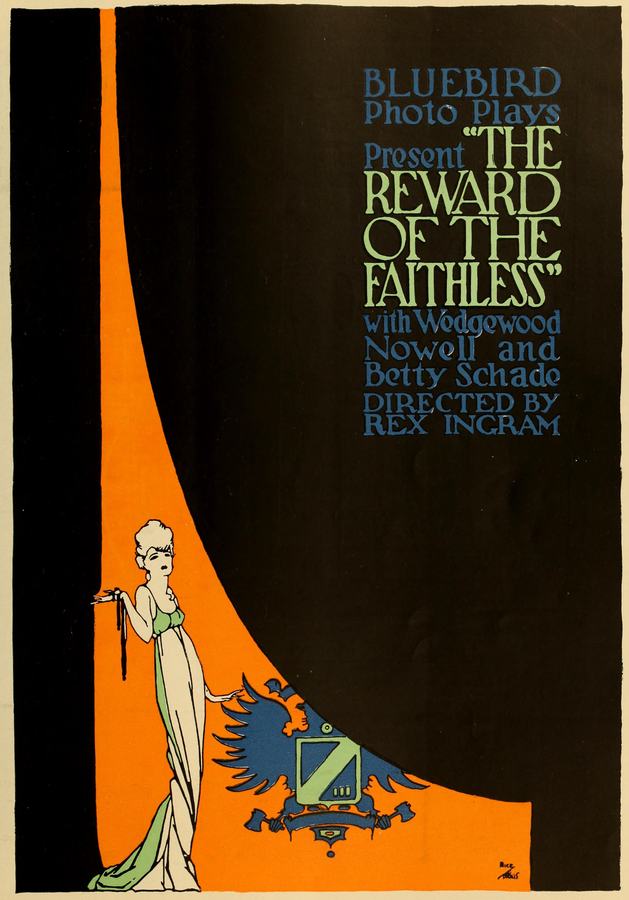
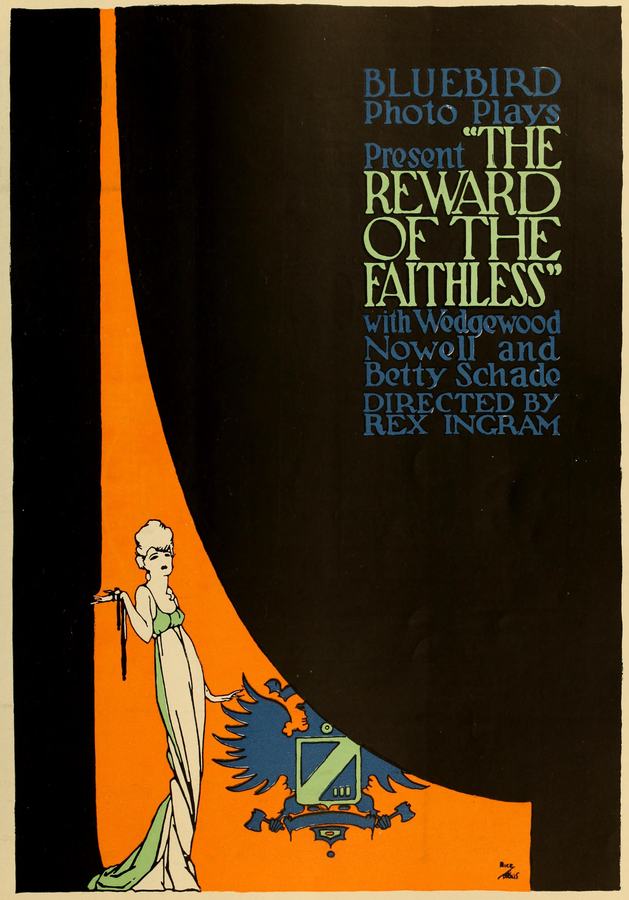
Rex Ingram’s ninth feature arrives like a blood-orange pressed against white linen: the pigment spreads, irrevocable. Shot through with Catholic guilt and predatory glamour, The Reward of the Faithless is less a moral parable than a poisoned boutonnière hurled at the front row of 1917 audiences who still believed adventurers wore white hats.
The film’s first movement glides across parquet floors polished to mirror the chandeliers. Guido—John George channeling Valentino before Valentino—never walks when he can lean. Each frame is a baroque triptych: lace cuffs, waxed moustache points, the hush of servants’ slippers. Ingram, ever the pictorialist, frames doorways within doorways so that architecture itself becomes a moral proscenium: enter here and be judged.
Yet the opulence is tainted from frame one. Prince Ragosin’s death-bed is shot from a cavernous low angle so the canopy becomes a catafalque; the dying man’s word is a deed of sale on his daughter’s womb. The camera lingers on Dione’s profile—Yvette Mitchell’s eyes are glassy ponds in which dynastic fishes drown—while Feodor stands in the background, a granite pillar of duty. The blocking predicts the coming betrayal: Guido literally edges Feodor out of the focal plane as he consoles the princess, a visual coup that speaks louder than any intertitle.
Cut to the street, shot in glaring daylight with handheld fervor unusual for 1917. Katerina’s statuettes—crude Madonnas chipped by fingernails—are the film’s counter-economy: art without patronage, faith without cathedrals. When her father hurls her into the night, the camera follows at hip level, turning the boulevard into a predator’s trench. Guido’s pickup is staged as a shadow-play against wet cobblestones; the subsequent transaction happens behind a fluttering newspaper, its headlines screaming war news that no one in this narrative can afford to read.
Ingram’s social cross-cutting here anticipates Griffith, but without the sentimental bridge. The palace and the gutter share the same strip of celluloid, yet no moral map is offered to connect them. Money is the only ligature, and it binds tighter than love.
Once married, Guido’s mask slips by degrees. Ingram shoots him in tenebrous side-light so the sockets become skull cavities. The conspiracy to fake Dione’s demise is a master-class in montage: a pharmacist’s scale, a spoon stirring laudanum into honeyed tea, a close-up of Dione’s eyelids fluttering like trapped moths. Each shot is a syllable in a visual incantation, culminating in the coffin lid sliding shut with a soundless thud that 1917 audiences reportedly heard anyway.
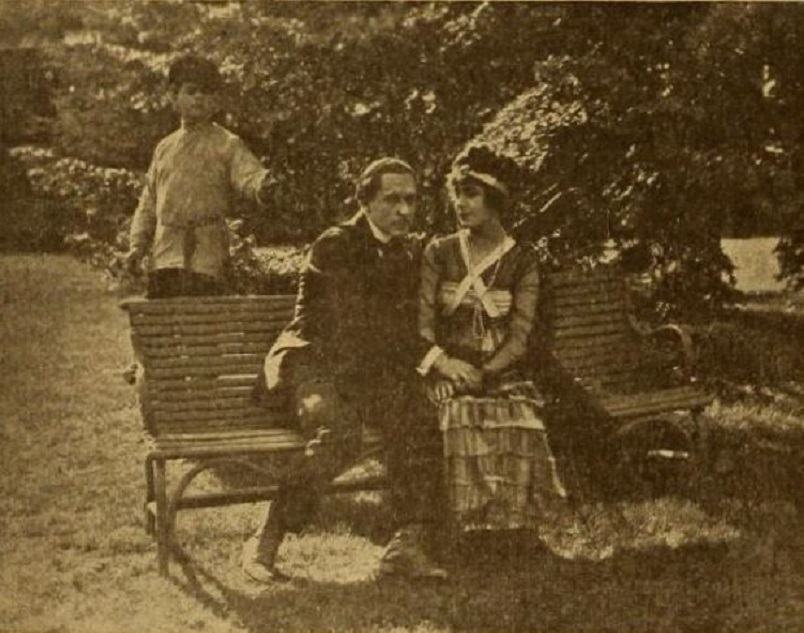
The burial scene—an outdoor family vault crusted with lichen—was filmed at dusk using day-for-night techniques, the sky’s cobalt bleeding into the sea so horizon lines vanish. Dione’s white shroud becomes a specter against the granite, foreshadowing her later resurrection. Ingram holds the shot until the last gravedigger’s spade exits frame, leaving only stone and wind. The effect is existential: we are not witnessing a death but an ontological erasure.
Enter the Roman beauty—Claire Du Brey in kohl and arterial lipstick—who demands the sapphire ring entombed with Dione. Her boudoir is a fever of art-nouveau curves; she toys with the ring’s image in a hand mirror, creating a mise-en-abyme of desire. The jewel is Hitchcock’s MacGuffin before Hitchcock, yet it also functions as moral barcode: whoever possesses it has signed a pact with necrophilia.
When Guido pries open the sarcophagus, Ingram cuts to x-ray-like double exposure: the lid lifts, but the interior is a swirling vortex. For a heartbeat we glimpse Dione’s eyes snapping open inside the skull’s darkness—a jolt that sent Los Angeles reporters scribbling about “the new physiology of fright.”
The final sequence, shot on the Palisades above Santa Monica, trades chiaroscuro for Expressionist silhouette. Guido, hair unspooled, backlit by moon-plated surf, believes he sees Dione’s wraith beckoning. Ingram uses reverse-motion so the apparition seems to levitate rather than walk; sea-spray becomes ectoplasm. The stuntman’s dive—executed by Bill Rathbone—was captured with a rope-cam that followed the body down the cliff face, a 200-foot tumble ending in foam that the tinting bath later dyed blood-red. Urban legend claims the stunt double cracked two ribs; exhibitors capitalized by advertising “the plunge that hospitalizes!”
John George oscillates between lacquered charm and feral panic; his eyes literally seem to darken (courtesy of hand-tinted frames). Yvette Mitchell, often dismissed as merely decorative, actually delivers a minimalist turn: her illness is rendered through micro-gestures—fingers curling like petals at dusk—until the final vengeance where her gaze achieves flint hardness. Nicholas Dunaew’s Feodor is the film’s moral ballast, yet Ingram smartly avoids making him dull; his stoicism is shot through with erotic restraint, the love he represses vibrating in clenched jaw muscles.
As Katerina, Betty Schade channels both victim and vector of contagion. The convent has not cleansed her; it has taught her the hypocrite’s lexicon. Watch how she folds her hands piously while calculating the angle of a poisoned teacup—an ambiguity rare in early cinema heroines.
Although scripted by E. Magnus Ingleton, the film bears Rex Ingram’s auteurist thumbprint: the sculptural close-ups, the Catholic iconography, the fascination with moral corrosion. Shot at Universal’s Fort Lee studio while Ingram was chafing under Carl Laemmle’s thrift, the picture went 30% over budget due to reshoots demanded when test audiences balked at the heroine’s live burial. Studio memos show Laemmle wanted a tacked-on redemption scene; Ingram refused, threatening to move to Europe. The standoff ended with a compromise: an extra intertitle claiming “Divine justice reaches the evildoer even beyond the grave,” a sop that satisfied censors yet preserved the narrative’s nihilism.
The 2022 4K restoration by Cinémathèque française mines two nitrate prints and a French Pathé distribution roll. The tinting scheme—amber for interiors, viridian for exteriors, rose for convent cells—has been recreated using photochemical analysis of dye fading patterns. The original Descriptive Symphony score (a pastiche of Massenet and Saint-Saëns) was reconstructed from cue sheets; the new performance by the Brussels Philharmonic under Timothy Brock throbs with Wagnerian doom without drowning dialogue cards.
Modern viewers may flinch at the film’s sexual politics—Katerina assaulted, then demonized—but Ingram’s lens implicates the viewer too. The camera’s lingering on her humiliation is repellent yet purposive: it refuses to aestheticize suffering into mere melodrama. Contextualized against contemporaneous works like Madame X or Melissa of the Hills, the film’s treatment of fallen women is marginally more dialectic, granting Katerina moments of sardonic self-awareness.
Where The Disciple moralizes through biblical allegory and The Bitter Truth dilutes its venom with comic relief, The Reward of the Faithless maintains tonal monomania. Its closest cousin might be Az éjszaka rabja with its claustrophobic sadism, yet Ingram’s picture trades Expressionist angles for Renaissance tableaux, achieving a unique hybrid of European decadence and American hustle.
Against Ingram’s later The Life of Richard Wagner, this early work is rawer, less encumbered by biographical fidelity; its freedom from fact allows it to drill straight into the audience’s anxiety about bodies that refuse to stay buried.
The Reward of the Faithless is not a comforting nightcap; it is a draught of absinthe laced with arsenic. It lingers on the palate like smoke from a chapel candle snuffed too soon. For aficionados of silent cinema, it’s indispensable—a hinge between Victorian morality plays and the psychosexual fever dreams that would bloom in German studios. For casual viewers, it offers a bracing reminder that today’s prestige TV antiheroes are merely treading ground Rex Ingram’s characters already mapped with spurs of cruelty and pearls of corrupted light.
Watch it late, with the lights low and a glass of something that burns. Then—if you dare—try to forget the sound of a coffin lid sliding shut. You won’t.
IMDb —
1920
Community
Log in to comment.