DbcultAccessing Vault...
Cult Review
Senior Film Conservator
There's a peculiar magic in early cinema, a raw, untamed spirit that often feels more akin to a fever dream than a meticulously crafted narrative. And then there's The Screen Fan, a film from 1917 that doesn't just capture that dreamlike quality; it actively dissects it, exploring the very mechanisms of aspiration, illusion, and the brutal reality lurking just beneath the silver screen's shimmering surface. It's not merely a story; it's a meta-commentary, a film about the act of creation and consumption, wrapped in a deceptively simple package. To call it ahead of its time would be an understatement; it's a profound, almost unsettlingly self-aware piece of early filmmaking that deserves far more scrutiny than it typically receives.
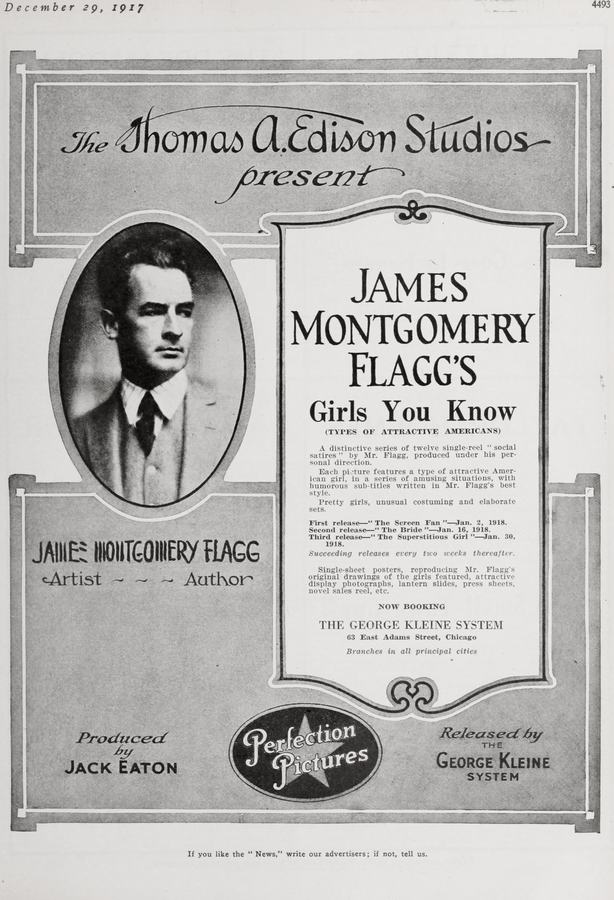
The film commences not with the usual title card or establishing shot of a bustling city, but with the intimate, almost voyeuristic, tableau of an artist at work. James Montgomery Flagg, a name synonymous with iconic American illustration (think 'I Want YOU for U.S. Army'), is presented in his element, charcoal in hand, meticulously rendering the contours of a young woman's face. This isn't just a scene; it's an overture, a declaration that what we are about to witness is born from the crucible of artistic imagination. Flagg, as both writer and actor in this framing device, becomes the progenitor of the narrative, the storyteller whose words imbue his subject with the very soul of the character she is to portray. It's a brilliant stroke, immediately establishing a distance, a layer of artifice, that paradoxically makes the subsequent journey into cinematic fantasy all the more compelling. This opening sequence is a subtle yet potent reminder that every character, every story, originates from a spark of human creativity, a deliberate act of shaping reality into something new.
This self-referential beginning sets a unique tone, differentiating The Screen Fan from many of its contemporaries. While films like The Americano or Captain Alvarez might have plunged straight into their adventure narratives, The Screen Fan pauses to acknowledge the hand that guides the pen, or in this case, the camera. It’s a moment of deliberate meta-awareness, suggesting that even in 1917, filmmakers were contemplating the nature of their medium and its power to shape perception.
Once Flagg's narrative begins to take cinematic form, we are introduced to the titular 'screen fan,' portrayed by Eleanor Masters. She is not merely an audience member; she is the embodiment of an entire cultural phenomenon. Seated in the hallowed front row of a theater, her face becomes a canvas of raw emotion, mirroring every twist and turn of the on-screen tragedy with a vividness that transcends mere empathy. Her countenance, we are told, 'reflects colorfully' the drama, a fascinating descriptor for a black-and-white silent film, suggesting an internal world so vibrant it spills outward, visible to the discerning eye. This 'fan' represents the millions captivated by the nascent art form, the dreamers who saw not just flickering images, but reflections of their own desires, their own potential for greatness or despair.
Her initial portrayal is one of pure, unadulterated absorption, a testament to the hypnotic power of early cinema. She is not a critic, but a devotee, her reactions unfiltered, visceral. This immersion sets the stage for her own aspirations to become reality. In a swift, almost magical transition, she finds herself elevated, brought into the orbit of the 'Cooper Hewitts,' a name that evokes a sense of established wealth, influence, and perhaps even a hint of old-money artistic patronage. This proximity to power and glamour is the first step in her journey from spectator to participant, a common fantasy that the film both indulges and, ultimately, deconstructs. It speaks to the allure of Hollywood, even in its infancy, as a place where dreams could, ostensibly, materialize overnight.
The narrative takes a pivotal turn as our heroine, awaiting the fateful call from a director, succumbs to sleep. This isn't just a plot device; it's a symbolic descent into the very heart of cinematic illusion. Her dream is 'wonderful,' a kaleidoscope of her deepest desires brought to vivid, if ephemeral, life. She transforms into the 'leading woman of the play,' no longer a mere fan, but the star, living a life of 'ease and affluence.' She is treated with a 'heavenly respect,' a reverence 'such as none of her kind in wildest dreams has ever imagined.' This dream sequence is the film's most potent exploration of escapism, portraying the ultimate fantasy of fame and adoration that cinema promised to its most devoted followers. It's a vision of unadulterated success, a world where talent, beauty, and good fortune align perfectly.
The visual language of this dream, though constrained by the technology of the era, must have been designed to convey opulence and grandeur. Perhaps through elaborate sets, costume design, or even subtle camera movements, the film would have aimed to create a stark contrast with the mundane reality of waiting for a call. This segment resonates with the romanticized visions of stardom often depicted in popular culture, a stark counterpoint to the more cynical portrayals found in later films that explored the industry's underbelly. Here, the dream is pure, untarnished, and overwhelmingly seductive.
The dream's 'rude awakening' is precisely that: rude, abrupt, and utterly horrifying. The director's summons is not to a glamorous set but to a lion's cage, with the chilling directive to 'make meat for the lion.' This scene is a masterful stroke of surreal horror, a sudden plunge from the sublime to the grotesque. The director's casual assurance that he 'will be right outside and everything' only amplifies the terror, highlighting a callous disregard for human life, or at least, for the life of an aspiring actress. It’s a visceral, unforgettable image that strips away all pretense of glamour and exposes the raw, predatory nature lurking beneath the surface of the entertainment industry.
The lion's cage is not merely a literal threat; it is a potent symbol. It represents the ultimate exploitation, the willingness of the powerful to sacrifice the vulnerable for their own spectacle. It speaks to the inherent dangers and the potential for dehumanization within an industry that thrives on illusion. This scene draws a stark parallel with the darker themes explored in films like The Vampires: Hypnotic Eyes, which delves into manipulation and danger, or even Shadows of the Moulin Rouge, which hints at the seedier side of entertainment. But The Screen Fan takes it to a more literal and shocking extreme, suggesting that the price of fame can be one's very existence, or at least, one's dignity and safety.
The director's nonchalance is key here. It's not a villainous cackle, but a detached, almost bureaucratic, command, suggesting that such sacrifices are simply part of the job, a grim expectation in the pursuit of 'art' or profit. This exposes a harsh truth about power dynamics in any industry, but particularly in one built on the fragile hopes of aspiring talents. The film's abrupt shift from utopian dream to dystopian nightmare is its most impactful statement, a sudden, cold shower for anyone who believed the silver screen offered only golden opportunities.
The picture's conclusion is as stark and unambiguous as the lion's cage scene. Miss Screen Fan, her dreams shattered and her innocence irrevocably lost, makes a 'hasty flight to "Mommer!".' This final act of retreat is profoundly telling. 'Mommer!' represents not just a parental figure, but a return to safety, to the familiar, to a world untainted by the predatory glares of the director or the lurking danger of the lion. It's a rejection of the entire glamorous facade of Hollywood, a desperate scramble back to a primal sanctuary. The exclamation mark in 'Mommer!' conveys both urgency and a childlike plea, underscoring her regression from an aspiring adult into a terrified child.
This ending is a powerful counterpoint to the initial aspirations. It suggests that for some, the dream factory is not a place of fulfillment but a site of profound disillusionment and danger. It's a cautionary tale, a stark warning to those who might mistake the silver screen's shimmer for genuine gold. The flight to 'Mommer!' is her ultimate act of self-preservation, an abandonment of the very fantasy that initially consumed her. Unlike the stoic resilience or tragic heroism often seen in dramas like The Stronger Love or Her Good Name, our heroine's response is one of primal fear and escape, a raw, unfiltered human reaction to existential threat.
The Screen Fan, despite its brevity and its early production date, is remarkably rich in thematic depth. It masterfully explores the perennial conflict between illusion and reality, a central tenet of cinematic art itself. The film begins by openly acknowledging its constructed nature through Flagg's artistic frame, then plunges into the intoxicating illusion of the screen fan's dream, only to violently yank her back to a reality far more terrifying than any on-screen tragedy. This oscillation between fantasy and harsh truth is a sophisticated narrative device, particularly for its era.
Beyond this, the film offers a nascent critique of the entertainment industry itself. It hints at the exploitation of aspiring talents, the commodification of dreams, and the often-unseen dangers that lurk behind the glamour. The director's casual cruelty in the lion's cage scene is a chilling foreshadowing of countless stories of Hollywood's dark side, long before such narratives became commonplace. It suggests that even in its infancy, the industry harbored a predatory undercurrent, far removed from the innocent escapism it sold to the masses. This commentary feels surprisingly modern, anticipating later, more explicit exposés of the industry's ethical failings.
The film also touches upon the psychology of fandom, depicting the profound emotional investment of an audience member and the subsequent desire to transcend that boundary into the world they so admire. The 'screen fan' is an archetype that persists to this day, a testament to the enduring human need for identification and aspiration. Her journey, though fictional, reflects a universal yearning to be part of something larger, something magical.
From a technical perspective, while specific details of its cinematography or editing are not overtly detailed in its plot summary, the very structure of the narrative—the framing device, the dream sequence, the abrupt shift in tone—speaks to a sophisticated understanding of cinematic storytelling. The film relies heavily on visual metaphor (the lion's cage) and psychological progression, demonstrating that silent cinema, even in its early years, was capable of conveying complex ideas beyond simple action or melodrama. The effectiveness of the 'colorfully reflecting' countenance of the fan, for instance, implies a powerful use of close-ups and performance to communicate internal states, a hallmark of compelling silent acting.
In comparison to other films of the era that might focus on more straightforward dramatic narratives like The Mystery of the Black Pearl or character studies such as The Heart of Midlothian, The Screen Fan stands out for its self-awareness. It’s not just telling a story; it’s examining the very act of storytelling and its impact. Even films that delved into darker urban themes like Das Mädchen aus der Opiumhöhle often did so with a more direct, less metaphorical approach to danger. The subtle layers of The Screen Fan elevate it beyond simple entertainment into a proto-philosophical commentary on media and aspiration.
The Screen Fan, then, is more than just a historical curiosity. It's a remarkably prescient piece of filmmaking that encapsulates the intoxicating allure and the inherent perils of the entertainment industry. It speaks to the universal human desire for glamour and recognition, while simultaneously exposing the brutal mechanisms that can chew up and spit out those who dare to dream too boldly. From the artist's initial sketch to the harrowing flight to 'Mommer!', the film takes its audience on a journey through the seductive power of illusion and the crushing weight of reality. It's a testament to the enduring power of cinema to not only tell stories but to reflect, critique, and even warn us about the very nature of those stories and the worlds they create. It serves as a stark reminder that sometimes, the most wonderful dreams can lead to the rudest awakenings, and the brightest lights can cast the deepest, most terrifying shadows. For anyone interested in the psychological underpinnings of early cinema or the timeless struggle between aspiration and exploitation, The Screen Fan offers a compelling, if unsettling, viewing experience that resonates far beyond its silent frames.
IMDb 6
1915
Community
Log in to comment.