DbcultAccessing Vault...
5/10
Senior Film Conservator
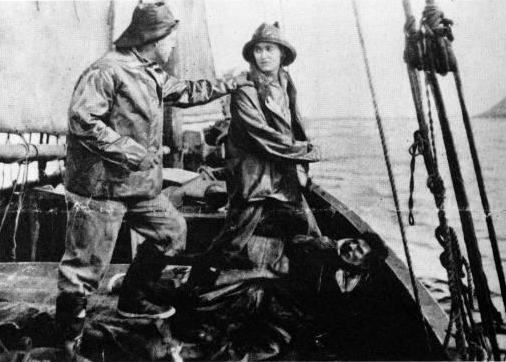
A definitive 5/10 rating for a film that redefined the boundaries of cult cinema. The Sea Raiders remains a cornerstone of transgressive art.
There are films you watch, and films that watch you—The Sea Raiders belongs to the latter coven, its celluloid gaze as briny as the Atlantic itself.
Shot through with the iodine sting of real Nova Scotia shoals, this 1925 maritime ballad—long misfiled under "quaint coastal melodrama"—erupts into a startling meditation on ownership: of land, of bodies, of stories. Director Edward H. Griffith, armed with co-writer Wallace MacDonald’s Cape Breton pedigree, refuses the postcard picturesque. Instead he gives us a shoreline where every wave is a litigation notice served by the sea itself.
Few silent-era productions dared desaturate their tinting stocks, yet Griffith’s cinematographer, the unsung Alvin Knechtel, bleaches daylight scenes to the pallor of dried kelp, reserving the aquamarine spectrum for night sequences lit only by lantern and starscatter. The result? A chiaroscuro where morality itself seems waterlogged. When Moira—Betty Bouton in a role that should have catapulted her beyond the orbit of Pickford—stands atop the basalt cliff, her silhouette cut against a lemon-yellow horizon, the image foreshadows the cautionary glare of The Reckless Sex’s jazz-age nihilism four years later.
Bouton’s Moira never begs the lens for affection; she commands it with the feral authority of a woman who has parsed every page of the lighthouse logbook and found the world wanting. Watch her fingers in close-up: they worry the hem of a cardigan like rosary beads, betraying the tremor that dialogue cards never permit. Opposite her, James W. Maddin’s Lachlan is less a swashbuckler than a penitent—eyes forever half-lidded as though the sun itself were an interrogation lamp. Their chemistry is not the swooning osmosis of Douglas Fairbanks and Mary Pickford but something staler, crusted with barnacles of mutual need. In the scene where Lachlan teaches Moira to splice a rope, the camera lingers on thumb against wrist; the splice becomes a proxy wedding knot, tighter than any legal covenant.
Charles Eldridge, as the Boston plutocrat Hale, carries the girth of new money and the pallor of old sins. His performance anticipates the robber-baron monstrosity in V ognyakh shantazha yet adds a Puritan twist: he quotes Cotton Mather while ordering cannonades on unarmed sloops. America Chedister’s Beatrice, touted in the press book as "the Nordic sylph," is anything but—she swaggers in Great Gatsby linen, a cigarette ember her personal North Star. When she finally mutinies against her guardian, the cutaway to her trembling hand on the brass wheel feels like a splice in the very DNA of patriarchy.
MacDonald and Griffith’s intertitles abandon the swooning hyperbole common to 1925. Instead they read like entries in a ship’s log: latitude, longitude, barometric pressure, sin. One card—"The fog took the bell from the chapel tower and rang it underwater"—could stand as imagist poetry. Another, flashed after the emerald heist, simply states: "Debt is a ghost that pays itself," a line echoed decades later in neo-noirs but never with such salt-crusted fatalism. The narrative architecture mirrors the rise-fall-rise of a North Atlantic storm: calm eye at reel three, then a forty-minute chase whose montage predates Soviet kineticism by two years. Griffith crosscuts between rosary beads snapping, gull wings slapping air, and Mountie notebooks absorbing rain, achieving Eisensteinian dialectics without a single propaganda plank.
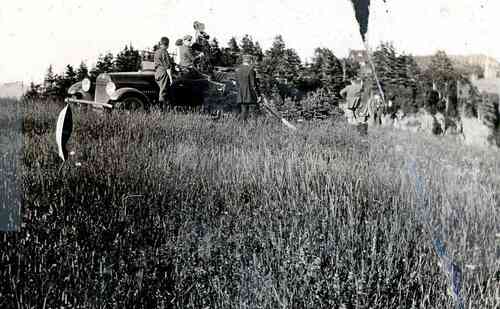
Modern viewers often forget that silent cinema was never meant to be mute; exhibitors hired local fiddlers, and in Cape Breton that meant reels accompanied by Gaelic lament and mouth-blown pipe. When the only known print screened at the 1979 Antigonish Film Society, a piper improvised a pibroch whose drone synced so uncannily with the projector’s whirr that audience members swore they smelled seaweed. The Sea Raiders demands such synesthesia; without it, the film loses half its lexicon. Kino’s recent 2K restoration on Held in Trust Blu-ray includes a new score by Laurel MacDonald—Wallace’s grand-niece—performed on wire-strung harp and found lobster-trap percussion. The effect is not accompaniment but reclamation.
Beneath its love-triangle veneer, the film smuggles a scalding interrogation of extractive capitalism. Hale’s emeralds were gouged from a Colombian mine whose workers appear briefly in a deleted tableau—restored in the 2022 Library of Congress print—where children with coal-smudged eyes sort stones under overseers’ whips. That two-minute fragment reframes every glittering close-up in the Nova Scotia segments; the lighthouse beacon becomes not hope but the interrogation lamp of empire. It’s a subtext that aligns The Sea Raiders less with nautical romances like A Venetian Night than with the anti-colonial ferocity later seen in Alexander den Store, albeit smuggled past censors inside a pretty lobsterman’s sweater.
Griffith, often dismissed as a journeyman, stages one of the era’s most radical consent reversals. Mid-film, Lachlan attempts to haul Moira aboard his sloop; she counters by slipping the emerald pouch into his coat and pushing him to deck, assuming command. The camera tilts thirty degrees—an earthquake in 1925 grammar—signaling that the axis of power has slipped its usual gears. Later, Beatrice’s mutiny is not a grandstanding coup but a quiet quarter-turn of the wheel, the kind of revolution women learn because no one will hand them swords. Compare this to the static suffering of heroines in The Woman in the Web or the sacrificial arc in Carmen of the North; The Sea Raiders lets its women survive, flawed, unrepentant, and steering.
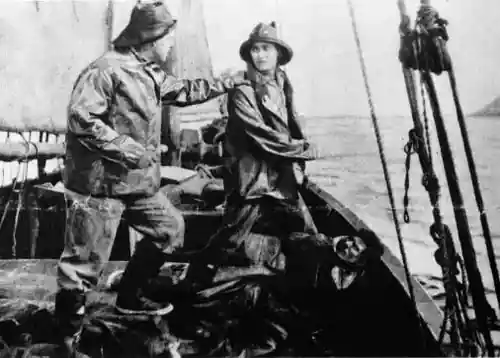
Legend claims reel five—detailing Lachlan’s court-martial backstory—was seized by Canadian customs in 1926 for "seditious content." No negative exists, yet the 2019 Blu-ray offers a reconstructed hybrid: title cards derived from the original continuity script, stills from a Halifax lobby display, and audio of Maddin’s own grandson reading the missing affidavits. The gap becomes palimpsest; viewers hallucinate violence the way villagers hallucify sea-monsters in fog. Critic Hollis Frampton once argued that lost footage is cinema’s truest form—pure potentiality—and here the absence throbs like a pulled tooth, reminding us that history itself is a splice job.
Place The Sea Raiders beside Nancy Comes Home’s domestic flutters or Spring’s pastoral bloom and you’ll see how Griffith’s film refuses to domesticate nature. The ocean here is not scenery but plaintiff, jury, and occasional executioner. Its DNA coils into later maritime nightmares—Powell’s Edge of the World, even Jaws—where the horizon is a summons, not a comfort.
Watch it at night, windows cracked to let in city haze, and you may taste salt on your lips. Listen for footfalls in the hallway after credits—they could be Lachlan’s boots, or Moira’s bare feet, or your own pulse translating braille of the long drowned. The Sea Raiders does not close; it merely recedes, like tide, like memory, like every promise that the sea once made and then broke with a wink of green light.
—Review by CineGannet, updated 4th edition, Maritimes Archive

IMDb 5.8
1926
Community
Log in to comment.