DbcultAccessing Vault...
Cult Review
Senior Film Conservator
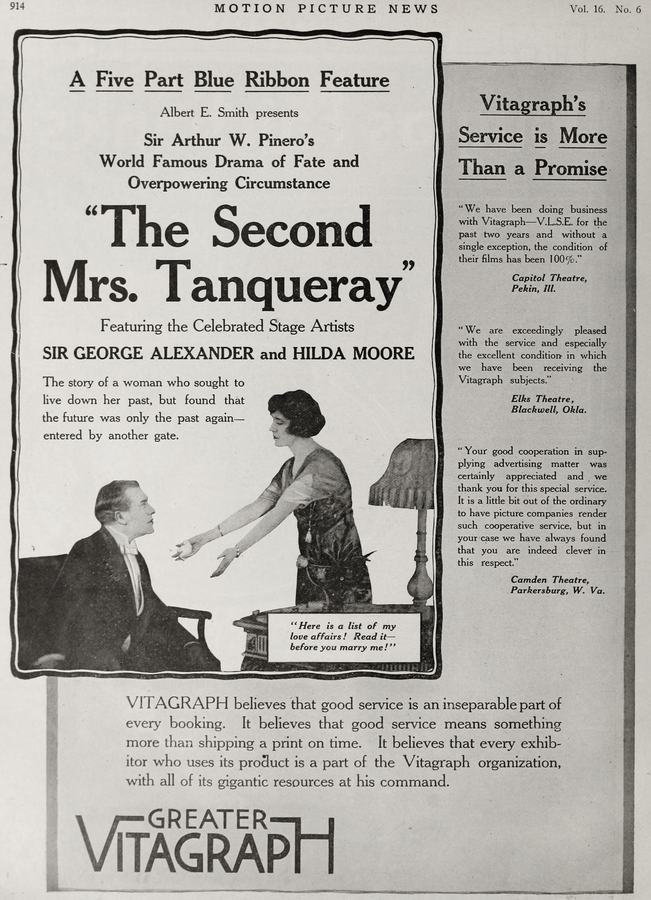
The 1916 cinematic translation of The Second Mrs. Tanqueray serves as a fascinating, if haunting, artifact of early British cinema’s struggle to reconcile the verbosity of the stage with the nascent visual language of film. Directed with a certain reverent stiffness, the film captures the twilight of the Victorian era's moral absolutism, presenting a world where social mobility is a mirage and the past is a predatory beast that never truly sleeps. Unlike the sweeping historical epics like Famous Battles of Napoleon, this is an interior drama—a claustrophobic study of a woman drowning in the shallow waters of respectability.
At the heart of the narrative lies Minna Grey’s portrayal of Paula Tanqueray. In an era where screen acting was often characterized by wild gesticulation—seen in more fantastical works like The Mysteries of Myra—Grey brings a nuanced, simmering resentment to the role. Paula is not a villain; she is a casualty of a double standard that permits men like Aubrey to have 'histories' while demanding that women be pristine vessels of virtue. The film meticulously illustrates the suffocating boredom of the countryside, where the silence of the trees is only broken by the icy disapproval of the neighbors.
The cinematography, though primitive by modern standards, utilizes the limited locations to emphasize Paula's entrapment. We see her pacing the drawing-room like a caged animal, a stark contrast to the spiritual journeys depicted in films such as Dante's Inferno. While Dante navigated the circles of Hell, Paula is trapped in a purgatory of her own making, built from the bricks of her previous indiscretions. The film captures the 'well-made play' structure of Pinero’s original work, ensuring that every character, from the well-meaning Aubrey to the judgmental Ellean, functions as a cog in a machine designed to crush the protagonist.
The introduction of James Lindsay as Captain Hugh Ardale is the catalyst for the film's second-act descent into tragedy. The irony is almost too heavy to bear: the one person who can offer Ellean a future is the very man who represents Paula’s past. This narrative device, while perhaps appearing melodramatic today, was a searing critique of the 'smallness' of the social circles of the time. It echoes the thematic weight of films like Judge Not; or the Woman of Mona Diggings, where the legal and moral systems conspire to ensure that a woman’s past is always her present.
The performance of George Alexander as Aubrey Tanqueray provides a necessary anchor. Alexander, who had famously played the role on stage, brings a weary dignity to the screen. His Aubrey is a man who believes himself to be enlightened, yet he is ultimately unable to shield his wife from the societal venom he underestimated. His chemistry with Grey is fraught with a tragic misunderstanding; they love each other, but they do not speak the same moral language. This disconnect is far more devastating than the overt conflicts found in The Ragged Earl or the political machinations of What 80 Million Women Want.
Technically, The Second Mrs. Tanqueray is a bridge between two worlds. It lacks the experimental flair of Naked Hearts or the mythic scale of Niobe, yet it excels in its quiet moments. The use of intertitles is judicious, allowing the actors' expressions to carry the burden of the emotional subtext. There is a specific scene—a long shot of Paula staring out of a window—that conveys more about her isolation than any dialogue could. It is a moment of pure cinema, a brief escape from the film’s theatrical origins.
The film’s pacing is deliberate, mirroring the slow, agonizing realization that there is no 'happily ever after' for a woman like Paula. Unlike the redemptive arcs found in Joseph in the Land of Egypt, Pinero’s world offers no divine intervention. The climax is a masterclass in tension, as the revelation of Ardale’s identity ripples through the household like a lethal contagion. The subsequent suicide of Paula is handled with a stark, almost clinical detachment that heightens the tragedy. It is not a grand, operatic end, but a quiet, lonely exit from a world that had already turned its back on her.
Viewing this film today requires a recalibration of our modern sensibilities. We must look past the flicker of the film stock and the occasional over-the-top reaction to see the genuine human pain at its core. It shares a certain DNA with My Madonna in its exploration of the female archetype as both a muse and a pariah. However, The Second Mrs. Tanqueray is more grounded, eschewing the mystical for the sociological. It asks difficult questions: Can a person truly be 'cleansed' of their history? Or are we all merely the sum of our past mistakes, waiting to be found out?
The supporting cast, including Marie Hemingway as the pious Ellean, provides a necessary foil to Paula’s vivacity. Ellean’s transition from a convent-bred girl to a woman in love is handled with a fragility that makes her ultimate rejection of Paula even more cutting. It is a reminder that the most profound cruelty often comes from those who believe they are standing on the moral high ground. This dynamic is explored with similar intensity in A Sister of Six, though perhaps with less of the drawing-room sophistication present here.
While some might find the film’s adherence to stage conventions a limitation, I would argue it is its greatest strength. It captures a specific moment in time when the theater was the primary medium for serious discourse, and cinema was just beginning to find its voice. The film doesn't try to be an action-packed thriller like The Blacklist; it is content to be a character study, a slow-burn drama that rewards the patient viewer. The writing by Benedict James and Arthur Wing Pinero ensures that the dialogue—even when presented as text on screen—retains its razor-sharp wit and devastating clarity.
In the broader context of 1916 cinema, The Second Mrs. Tanqueray stands as a testament to the power of the 'problem play'. It lacks the whimsical charm of Have You Heard of Schellevis-Mie?, but it replaces it with a profound, lingering sadness. It is a film about the walls we build around ourselves and the high cost of trying to tear them down. For any serious student of early film or Edwardian social history, this is essential viewing—a bleak, beautiful, and utterly uncompromising look at the fragility of reputation and the permanence of regret. It remains a stark reminder that even in the brightest drawing rooms, the shadows of the past are never far away, waiting for the right moment to reclaim their own.
Whether compared to the romantic struggles of Her Own Way or the pivotal life choices in His Turning Point, this film occupies a unique space. It is a tragedy in the truest sense, where the protagonist's downfall is not caused by a flaw in her character, but by a flaw in the world she inhabits. Paula Ray didn't fail society; society failed Paula Ray, and the 1916 film captures that failure with haunting, silent precision.
IMDb 6.8
1923
Community
Log in to comment.